Why Your Small Business Feels Stuck: How to Find Your Biggest Business Gaps
Many small business owners are not lazy. They are not careless. They are simply too close to their business to see what is really going on.
They answer messages. They serve customers. They manage daily tasks, think about marketing, and worry about money. And still, at the end of the day, they wonder: “Why does my business still feel stuck?”
The problem is usually not effort. The problem is clarity.
When everything feels important, nothing becomes a real priority. And when you do not know where your biggest small business gap is, it is very hard to move in the right direction.
Before you make another plan or try another tactic, you may need something simpler: a basic business check-up.
Being Busy Does Not Mean Your Business Is Moving Forward
There is a big difference between being busy and making real progress.
Many small business owners fill their day with activity. But not all activity leads somewhere useful.
A restaurant owner might spend money on social media ads, while the real problem is that existing customers never come back.
A consultant might spend weeks creating new content, while the real problem is that her message is too vague to attract the right clients.
A small shop owner might think the problem is price, while the real problem is that customers do not feel enough trust to buy.
In each case, the action is real. The effort is real. But the focus is pointed at the wrong place.
That is why clarity often matters more than action. If you work hard on the wrong problem, even your best effort creates very little result.
What Is a Business Gap?
A business gap is the distance between where your business is now and where it needs to be.
It is not always dramatic. Most small business gaps show up quietly, as small daily frustrations, repeated mistakes, slow decisions, or ideas that never move forward.
A gap can appear between:
- What your customer needs and what you currently offer
- The income you want and the systems you actually have
- The decisions you need to make and the information you have to make them
- The work your business requires and the time you can realistically give it
- The marketing you are doing and the message your customer actually needs to hear
Some simple examples:
- You want more sales, but your offer is not clear enough for people to say yes quickly.
- You want repeat customers, but you have no follow-up process after the first purchase.
- You want growth, but every part of the business still depends entirely on you.
- You want better decisions, but you are not tracking the numbers that matter.
Identifying your gap is the first step. Without that, you are solving the wrong problem.
Why Small Business Owners Struggle to See Their Real Gaps
If gaps are this common, why do so many business owners miss them?
Because they are too close to the business to see it clearly.
When you are inside the business every day, answering messages, handling problems, chasing tasks, it is hard to step back and look at the whole picture. Everything feels equally urgent. Everything feels like a problem.
There is also no simple structure for assessment. Most business owners do not have a regular way to review their business across key areas. They rely on instinct, habit, or the pressure of whatever is loudest that week.
And many problems in a small business are connected to each other. A cash flow problem might be linked to pricing. A pricing problem might be linked to an unclear offer. An unclear offer might be linked to not fully understanding the customer. When problems are layered like this, it is easy to treat the wrong one first.
As a business consultant, I often find that the first problem a business owner mentions is not the real problem. It is the most painful symptom.
If you diagnose the wrong problem, you may spend time, money, and energy on a solution that changes nothing.
The Real Problem Is Often Not the Obvious Problem
This is one of the most important ideas in business: the visible problem and the root problem are often not the same thing.
Here is a simple way to see how this works:
| What you think the problem is | What the real gap might be |
|---|---|
| I need more customers | My offer is not clear or compelling enough |
| I need more marketing | I do not understand my customer’s real problem |
| I need more time | My operations are not systemized |
| I need more sales | My follow-up process is weak or missing |
| I need a new idea | I have not improved my existing business model |
| I need better staff | My processes and expectations are not documented |
Looking at this table, it is easy to see how someone could spend months working on the wrong thing.
This is exactly why a simple business check-up can be more useful than jumping into another random tactic.
5 Common Small Business Gaps That Keep Owners Stuck
Most small business owners are dealing with one or more of these five gaps. See which ones feel familiar.
1. Clarity Gap
What it is: You are not sure exactly where to focus. You have several ideas, several projects, and several problems, but no clear answer on which one comes first.
Common signs:
- Your top priority seems to change every week
- You have multiple unfinished projects
- Most of your decisions feel reactive, not intentional
- You feel productive but not sure what you are actually moving toward
Diagnostic question: What is the one area that, if improved, would make the biggest difference in your business right now?
2. Customer Gap
What it is: You are not fully clear on who your best customer is, or what problem they are actually trying to solve.
Common signs:
- Your content gets views but does not bring in leads
- People show interest but do not buy
- Your marketing message feels too general
- You struggle to explain exactly who you serve best and why
Diagnostic question: Do I clearly understand who my best customer is and what specific problem they are trying to solve?
3. Offer Gap
What it is: Your product or service is good, but your offer, the way it is packaged, communicated, and priced, is not landing clearly.
Common signs:
- Potential customers often ask “what exactly is included?”
- Your pricing takes a lot of explaining
- People do not immediately see the value
- You have a service but no clear path for a new customer to say yes
Diagnostic question: Can a potential customer quickly understand what I offer, who it is for, and why it matters to them?
4. Operations Gap
What it is: Your business processes are too dependent on you personally, and there are no clear systems for how things get done.
Common signs:
- You repeat the same tasks but have never written down how to do them
- The same mistakes happen more than once
- When you step away, things slow down or break
- Too much of your time goes to small operational tasks
Diagnostic question: Which repeated task in my business needs a clearer process or system?
(If you want to read more about building better processes, this article on why your SOPs are failing is a useful next read.)
5. Decision-Making Gap
What it is: Your decisions are driven by pressure or urgency rather than clear priorities and information.
Common signs:
- You constantly switch between projects and ideas
- You are not sure which problem is worth working on first
- Everything feels equally urgent
- You make a decision and still feel uncertain about it
Diagnostic question: Do I have a simple, reliable way to compare problems and choose what matters most right now?
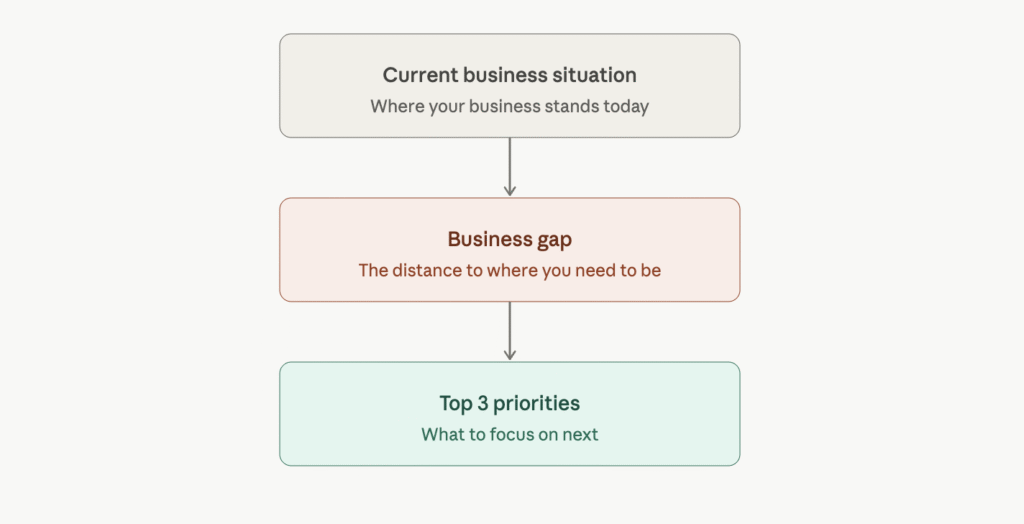
How to Identify Your Biggest Business Gap
You do not need a complicated process to find your main gap. Here is a simple three-step approach.
Step 1: Look at your business from the outside.
Imagine you are a consultant hired to review your own business. Look at it as a system, not as a daily to-do list. What areas are running well? What areas feel unclear, slow, or inconsistent?
Step 2: Score key areas honestly.
Rate each area of your business on a simple scale, for example, 1 to 5. Be honest, not optimistic. Areas to review include:
- Clarity (do you know exactly what to focus on?)
- Customer (do you deeply understand who you serve?)
- Offer (is your offer clear and compelling?)
- Sales process (do you have a consistent way to convert interest into revenue?)
- Operations (do you have systems, or does everything depend on you?)
- Financial awareness (do you know your key numbers?)
- Decision-making (are your decisions strategic or reactive?)
Step 3: Choose only your top 3 priorities.
The goal is not to fix everything. The goal is to identify the three areas that deserve your focus now. More than three usually leads to scattered effort and slow progress.
This is exactly the process behind the Business Clarity Mini Diagnostic Tool. It gives you a simple Excel-based structure to assess each area, identify your biggest gaps, and choose your top 3 priorities, without overthinking or spending hours in analysis.
Why Choosing Your Top 3 Priorities Matters
The problem for most small business owners is not a lack of ideas. It is having too many ideas and no clear way to choose between them.
When you try to fix 10 things at once, none of them get the attention they need. Progress becomes shallow. Energy gets divided. And the business still feels stuck, even when you are working hard.
Choosing three priorities changes that.
It creates focus. It makes decisions easier. It tells you what to say yes to and what to leave for later.
A real priority is not just something important. A real priority is something that deserves your limited time, attention, and energy right now, because fixing it will either reduce the pressure on your business or create meaningful movement.
Want to find your top 3 business priorities? The Business Clarity Mini Diagnostic Tool helps you run a simple check-up and see where your biggest gaps are, so you can stop guessing and start choosing.
A Simple Business Check-Up Before You Make Another Plan
Before you create a new strategy, launch a new offer, or try a new marketing channel, take one step back.
Do a simple business health check first.
The Business Clarity Mini Diagnostic Tool is a simple Excel-based business assessment tool designed for small business owners who want to see their business more clearly.
It helps you:
- Look at your business across the key areas that matter most
- Identify where your biggest gaps are right now
- Choose your top 3 priorities with confidence
- Decide what to actually work on next
- Avoid wasting time on actions that do not fix the real problem
It is not a complicated system. It is a practical, structured starting point, intentionally simple and low-risk, so you can use it even if you are not ready for a full consulting session yet.
Simple Business Check-Up Tool
The Business Clarity Mini Diagnostic Tool is a simple Excel-based worksheet that helps you identify your biggest business gaps and choose your top 3 priorities.
Who This Tool Is For
This tool is designed for you if:
- You are a small business owner, solo business owner, freelancer, coach, or consultant
- You feel busy but unclear about what to focus on
- You have too many ideas and not enough direction
- You are not sure what to fix first
- You want a simple, structured way to look at your business before making your next decision
- You are not yet ready to book a full consulting session but want a real starting point
If you want to understand your business better before spending time or money on solutions, this tool is exactly that first step. You can also explore the free BMC Notion Template or the free resources page for additional starting points.
Who This Tool Is Not For
Being clear about this matters, because the right tool for the right person creates the best result.
This tool is probably not the right fit if:
- You are looking for a complete, formal business plan
- You expect a tool to make your decisions for you
- You are not willing to look honestly at your current situation
- You are looking for a magic solution or overnight growth
- You want to outsource your thinking entirely without any personal reflection
The tool works best when you are ready to be honest with yourself about where your business really stands.
What to Do After You Find Your Biggest Gap
Finding the gap is not the end. It is the beginning. Here is what to do next, depending on what you find.
If the gap is simple and clear: Define one small, specific action you can take this week. You do not need a big plan. You need one honest next step.
If the gap keeps repeating: That is a signal that you need a system, not just effort. A repeated problem usually means there is no clear process in place. This article on building better systems may be helpful here.
If the gap feels complex or unclear: That is often a sign that your business needs a deeper look, someone who can ask the right questions and help you see what you cannot see from the inside.
If you complete the tool and still feel unsure about what your results mean or where to go next, a Business Clarity Sessioncan help you turn the diagnosis into a clear action plan. It is not about doing more. It is about doing the right things in the right order.
You can also explore the BMC Playbook if your gap points toward needing more clarity on your business model.
Final Thought: Clarity Comes Before Growth
You do not need to fix everything today.
But you do need to know what deserves your attention first.
Most small business owners who feel stuck are not failing because of lack of effort. They are stuck because they have not yet identified their real gap. They are solving symptoms, reacting to noise, and moving without a clear direction.
A simple business gap analysis changes that. It helps you stop guessing and start choosing.
Clarity does not solve every problem. But it helps you ask the right questions, focus on the right areas, and take the kind of action that actually moves your business forward.
Ready to find your biggest business gaps?
If you want a simple way to check your business and choose your top 3 priorities, the Business Clarity Mini Diagnostic Tool is built for exactly that.
It is a simple Excel-based business check-up tool designed to help small business owners get clarity, identify their biggest gaps, and decide what to work on next.
Frequently Asked Questions
What is a business gap? A business gap is the distance between where your business is now and where it needs to be. It can appear in your offer, your customer understanding, your sales process, your operations, your systems, or your decision-making.
How do I know what is holding my business back? Start by reviewing the key areas of your business and scoring them honestly. Look for repeated problems, unclear decisions, wasted time, or areas where you feel the most pressure. Those are often where the real gaps are hiding.
What is a business diagnostic tool? A business diagnostic tool helps you assess different areas of your business so you can identify weaknesses, gaps, and priorities before choosing your next action. It replaces guesswork with a structured, honest view of where your business actually stands.
Why does my small business feel stuck? Your business may feel stuck because you are working on too many things at once, solving symptoms instead of root problems, or because there is no clear system for choosing priorities. Being busy and making real progress are not the same thing.
How many business priorities should I focus on? For most small business owners, three priorities are enough. More than that creates scattered focus and slow progress. The goal is to choose the areas that, if improved, will create the most meaningful change right now.
Do I need a full business plan to get clarity? Not always. A full business plan is useful, but it is not always the right starting point. Sometimes you need a simple business check-up first, to understand your current gaps before building a bigger plan around them.
Sarah Moradi is a business consultant who helps small business owners gain clarity, build better systems, and make decisions with confidence. Explore her free resources or start with a simple business check-up tool.