Clarifying Pricing and Revenue Streams Using the Business Model Canvas
If you’ve ever stared at your prices and thought “Am I charging too little, or am I scaring people away?”, you’re not alone.
Most freelancers and small business owners set their prices based on gut feeling, what competitors charge, or what feels “reasonable.” The result? Inconsistent revenue, undercharging for real value, and no clear plan for growth.
Here’s the short answer: business model canvas pricing gives you a structured way to decide what to charge, how to charge it, and why, all in one visual framework. By the end of this article, you’ll have a clearer way to use the Revenue Streams block, together with Cost Structure, Value Proposition, and Customer Segments, to think more strategically about pricing.
Let’s get into it.
Why Pricing Feels So Confusing for Small Business Owners
Pricing isn’t just a number. It’s connected to everything, your costs, your customers, your value, and how you deliver your service. When you try to set a price in isolation, you’re only seeing one piece of a much bigger picture.
That’s why random pricing doesn’t work. You might undercharge because you haven’t mapped your real costs. You might overcharge without matching it to a clear value proposition. Or you might offer just one pricing option when your customers actually want flexibility.
The Business Model Canvas (BMC) solves this by putting all nine elements of your business on one page, and showing you how they connect.
What Is Business Model Canvas Pricing, Really?
I use the phrase “business model canvas pricing” to describe a simple idea: your price should not be decided separately from your business model.
In the BMC framework, pricing isn’t a standalone decision. It sits inside the Revenue Streams block, one of the nine building blocks of the canvas. But it’s shaped by at least three other blocks:
- Cost Structure: what you spend to deliver your service
- Value Proposition: what transformation or benefit you offer
- Customer Segments: who’s paying, and what they’re willing to pay
When these four blocks are aligned, your price makes sense. When they’re not, you end up guessing.
The BMC doesn’t replace your accounting software or a pricing calculator. What it does is show you the logic behind your price, so every rate card or subscription tier you create is intentional, not accidental.
The Revenue Streams Block, Where Pricing Lives on the BMC
The Revenue Streams block answers one simple question: how does your business make money?
According to the Business Model Canvas Playbook, revenue streams are the different “money paths” into your business. A well-diversified revenue strategy keeps you financially stable and reduces the risk of relying on just one income source.
Here are the most common revenue stream types that apply to freelancers and small business owners:
Direct Sales: a one-time payment for a product or service. A graphic designer charging per project, or a handmade jewelry brand selling individual pieces online.
Subscription / Recurring Fees: customers pay on a regular schedule. A home cleaning service offering a monthly cleaning package is a great example of this model.
Freemium: basic access is free, premium features cost money. Common in digital tools and online education.
Service Packages / Retainers: bundling services for a fixed monthly fee. Very common in consulting and freelancing.
Commission-Based: earning a percentage of each transaction. Think of platforms like Airbnb or Etsy that take a cut of every sale.
Licensing: charging others to use your intellectual property, methodology, or content.
The key insight here is this: you don’t have to pick just one. The playbook emphasizes that a successful business often has multiple revenue streams to ensure stability. If you’re only charging one way, you may be leaving money on the table.
How the BMC Connects Pricing to the Rest of Your Business
Here’s where the canvas becomes genuinely useful as a pricing strategy canvas. Let’s look at three blocks that should directly inform your pricing decisions.
Cost Structure Sets Your Floor
You cannot price below your costs and survive. The Cost Structure block maps all the expenses involved in running your business, both fixed (rent, tools, salaries) and variable (materials, delivery, platform fees).
Once you know your real costs, you have a floor, the minimum you must charge to break even. Most small business owners skip this step. Don’t.
Value Proposition Sets Your Ceiling
In practical pricing terms, your Value Proposition influences how much pricing power you have.
Your value proposition is the reason customers choose you over someone else. The more clearly you can articulate the transformation, convenience, or result you deliver, the easier it becomes to justify a price above the basic cost of delivery.
The playbook puts it simply: your value proposition isn’t about what your business does. It’s about how your business improves the lives of your customers. A home cleaning service doesn’t sell “cleaning.” It sells time, peace of mind, and a stress-free home. That’s worth more than an hourly rate for scrubbing floors.
When your value is clear, your price becomes easier to justify.
Customer Segments Tell You Who’s Paying (and What They Expect)
Different customers have different expectations, and different budgets. The BMC’s Customer Segments block helps you think about whether you’re serving budget-conscious buyers, premium clients, or both.
For example, a retail store (as shown in the playbook) might serve walk-in price-sensitive customers differently from loyal repeat buyers. These two segments may need different pricing models, a standard rate for one, a loyalty discount or bundle for another.
Real Examples from the Business Model Canvas Playbook
The playbook includes several detailed business examples, each with a fully mapped canvas. Here are two that show how revenue streams on the business model canvas work in practice.
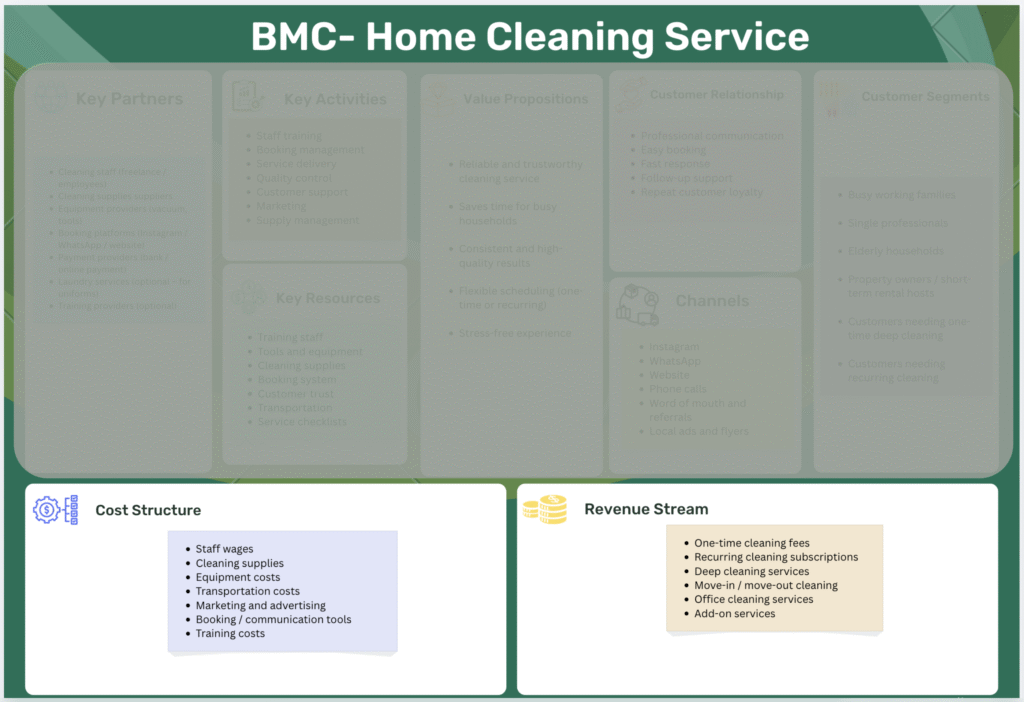
Example 1: Home Cleaning Service
This service business generates income through multiple streams: one-time cleaning fees, recurring monthly subscriptions, deep cleaning services, move-in/move-out packages, office cleaning, and add-on services.
Notice what this means for pricing: the business doesn’t just charge by the hour. It structures its revenue so that customers can commit to regular packages (predictable income) or book specialist services at a premium rate (higher margin). The Cost Structure block, staff wages, supplies, transport, booking tools, defines the floor. The Value Proposition, saving time, reducing stress, reliable results, justifies pricing above that floor.
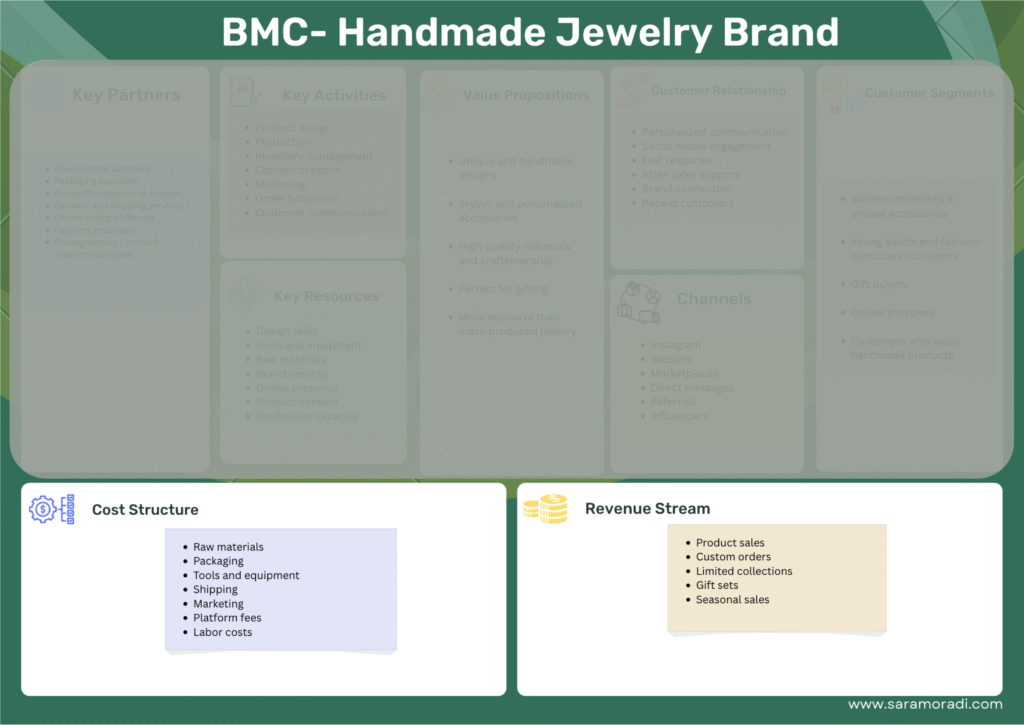
Example 2: Handmade Jewelry Brand
This product business uses direct sales, custom orders, limited collections, gift sets, and seasonal sales as revenue streams. Because the value proposition is uniqueness and craftsmanship, the brand avoids competing on price with mass-produced alternatives entirely. Instead, the pricing reflects exclusivity and quality, something customers who value handmade products are already willing to pay for.
This is a good reminder that pricing strategy canvas thinking isn’t about finding a “correct” number. It’s about aligning your price with the value your specific customer segment expects.
How to Use the BMC as a Pricing Strategy Canvas: A Simple Process
If you want to use the Business Model Canvas to clarify your own pricing, here’s a practical starting point:
Step 1: Map your Cost Structure first. List every expense, fixed and variable. This gives you your minimum viable price.
Step 2: Write out your Value Proposition clearly. What specific result, transformation, or experience do you deliver? The stronger this is, the higher you can price.
Step 3: Define your Customer Segments. Are your ideal clients budget-focused, quality-focused, or time-focused? Each answers the question differently.
Step 4: Brainstorm your Revenue Streams. List all the ways you currently charge. Then ask: could you add a subscription tier? A premium package? A one-off product? A licensing offer?
Step 5: Check alignment. Do your prices cover your costs? Do they reflect your value? Do they match what your customers expect to pay? If not, adjust one block, and watch how it changes the others.
This five-step process is a simplified version of the full canvas work covered in the Business Model Canvas Playbook.
This five-step process is a simplified version of the full canvas work covered in the Business Model Canvas Playbook.
This article only focuses on one pricing-related angle of the canvas. In the full playbook, you can work through all nine blocks step by step and see how they connect in real business examples.
Frequently Asked Questions
What is the Revenue Streams block in the Business Model Canvas? The Revenue Streams block describes how your business earns income from each customer segment. It includes all pricing models, one-time sales, subscriptions, commissions, licensing, and more. It’s the block that answers “how do we actually make money?”
How does the BMC help with pricing strategy? By connecting pricing to your Cost Structure (what you spend), Value Proposition (what you offer), and Customer Segments (who buys), the BMC ensures your price is grounded in business logic, not guesswork.
Can I have more than one revenue stream as a freelancer or small business? Absolutely, and it’s recommended. A freelancer might charge project fees, offer a monthly retainer, and sell a digital template. Multiple streams reduce financial risk and often increase total income without proportionally increasing workload.
What’s the difference between a pricing model and a revenue stream? A revenue stream is the category (e.g., subscription, direct sale). A pricing model is the specific structure within it (e.g., $99/month, $500 flat fee). The BMC helps you choose the right revenue stream type before you decide on specific numbers.
Ready to Map Your Revenue Streams?
If you’ve been setting prices based on instinct, this is your sign to bring some structure to it.
The Business Model Canvas Playbook walks you through all nine blocks, including Revenue Streams and Cost Structure, with real-world examples, guiding questions, and ready-to-use templates. It’s designed specifically for freelancers and small business owners who want clarity without complexity.
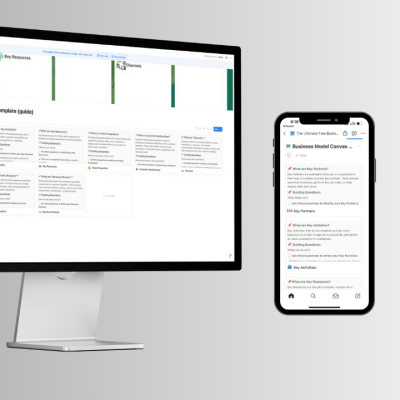
And if you’re not ready to go deep yet, start with the free BMC Notion template, it gives you a working canvas you can fill in today.
Pricing confusion is usually a business model clarity problem. The canvas fixes that.