From Ideas to Action: Using Strategic Prompts to Build Your Business Model
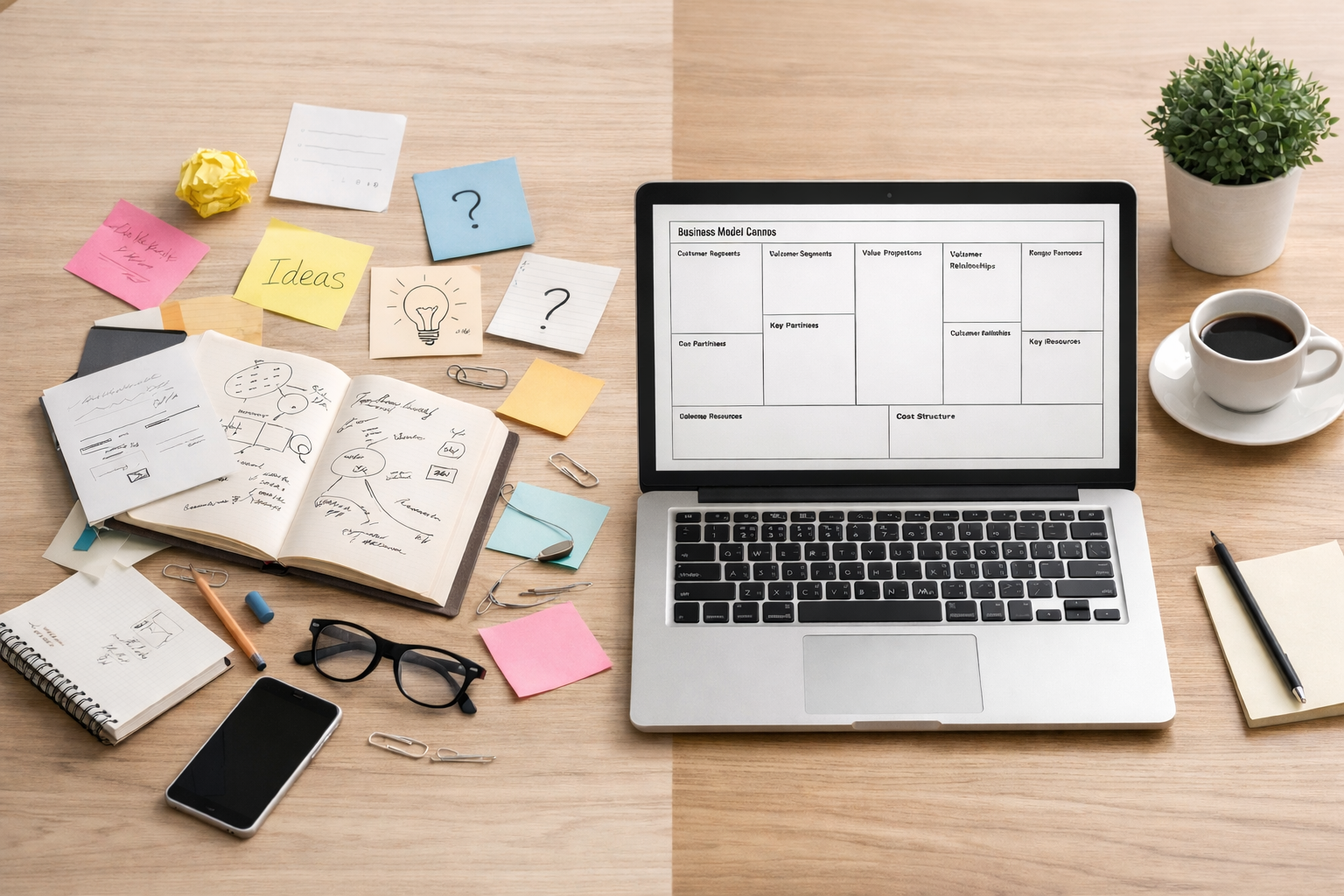
You have ideas. Lots of them. They live in sticky notes, voice memos, half-finished Google Docs, and the back of your mind at 2 a.m. But when someone asks you “so, what’s your business model?” you freeze.
Here’s the truth: the problem isn’t that you don’t have a strategy. The problem is that no one has given you the right questions to pull it out of your head and onto paper.
That’s exactly what business model canvas prompts do. And in this article, I’m going to show you how to use them to finally turn your scattered ideas into a structured, working business model, without the overwhelm.
What Is the Business Model Canvas (And Why Should You Care)?
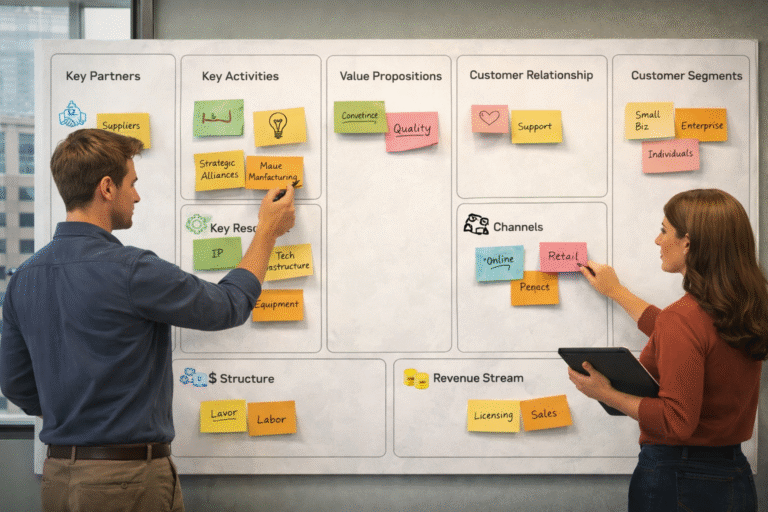
The Business Model Canvas (BMC) is a one-page framework that captures everything about how your business works across nine building blocks: Customer Segments, Value Proposition, Channels, Customer Relationships, Revenue Streams, Key Resources, Key Activities, Key Partners, and Cost Structure.
It was designed to replace the 40-page business plan no one ever reads, and it works. But here’s what most people get wrong: they open a blank canvas template and stare at it like it’s going to fill itself in.
That blank-canvas paralysis is real. And it’s not a you problem, it’s a tool design problem.
The fix? Strategic prompts.
Instead of staring at an empty box labeled “Value Proposition,” imagine being asked: “What problem do your best customers have before they find you? What does their life look like after working with you?” Suddenly, you have something to write.
According to a CB Insights study, 35% of startups fail because there’s no market need for their product, a gap that a structured business model review could catch early.
What Are Business Model Canvas Prompts?
Business model canvas prompts are guided questions that help you think through each section of the BMC with clarity and depth, rather than guessing what to write.
Think of them as a knowledgeable friend sitting across the table from you, asking the right questions at the right time, so your answers actually reflect your real business, not a generic version of it.
Good prompts do three things:
- They break a big, abstract concept (like “Key Partners”) into something concrete and personal
- They connect the nine building blocks to each other so your model stays internally consistent
- They push you past surface-level answers to the insights that actually matter
For example, instead of asking “who are your customers?”, a strategic prompt might ask: “Who gets the most value from what you offer? What are they trying to achieve, and what’s stopping them from getting there right now?”
That’s the difference between filling in a form and actually thinking about your business.
Why Small Business Owners Especially Need Prompted Exercises
If you’re running a small business, a coaching practice, a boutique agency, a local service business, you’re probably doing five jobs at once. Strategy often gets pushed to “later.”
But here’s what I’ve seen working with small business owners over the years: when they sit down with the right questions, they already have most of the answers. The work isn’t research, it’s excavation.
Prompted exercises work because they:
- Fit into limited time. You can work through one building block in 20-30 minutes with focused prompts, rather than spending hours staring at theory.
- Make the process feel less intimidating. One question at a time is manageable. Nine blank boxes is not.
- Surface blind spots. A prompt like “Which of your key activities could you not function without, and what would happen if you had to stop doing them tomorrow?” reveals vulnerabilities you didn’t know existed.
- Create consistency. When your nine building blocks are shaped by related questions, they fit together like puzzle pieces instead of nine unrelated answers.
How Strategic Prompts Work Across the 9 Building Blocks
Here’s a quick look at how prompts shift the quality of your thinking across each section of the Business Model Canvas:
| BMC Section | Generic Question | Strategic Prompt |
|---|---|---|
| Customer Segments | Who are your customers? | Who gets the most immediate, obvious result from working with you? What do they have in common beyond demographics? |
| Value Proposition | What do you offer? | What frustration disappears for your customer after using your product or service? |
| Channels | How do you reach customers? | Where do your best customers already spend time before they find you? |
| Customer Relationships | How do you connect with customers? | What does your customer need to feel during and after the experience to come back, or refer others? |
| Revenue Streams | How do you make money? | Are you being paid for the outcome you deliver, or just the time you spend? |
| Key Resources | What assets do you need? | If you had to rebuild your business from scratch in 90 days, what would you need first? |
| Key Activities | What do you do? | Which three activities, if done poorly, would most damage your customer’s experience? |
| Key Partners | Who do you rely on? | Who makes your business run better, cheaper, or faster, and what would you do without them? |
| Cost Structure | What do you spend? | Which costs are investments that grow your business, and which are expenses that just keep it running? |
Notice how each strategic prompt pushes you to think in outcomes, relationships, and tradeoffs, not just facts.
From Scattered Notes to a Structured Model: A Real Example
Let me give you a scenario I see all the time.
A freelance graphic designer comes to me with years of experience, a strong portfolio, and a growing client base. But she’s exhausted. She doesn’t know how to scale, her pricing is inconsistent, and she’s not sure who her “real” customer is.
We sit down with the Business Model Canvas and a set of guided prompts.
By the time we work through the Value Proposition prompts (“What specific transformation do you create? What would it cost your clients to NOT work with you?”), she realizes she’s not selling design, she’s selling brand credibility for product-based businesses launching on Instagram.
That one insight reshapes her Customer Segments, her Channels, her pricing, and her Key Activities. One hour of prompted thinking did more than six months of trial and error.
That’s the power of asking the right questions in the right order.
How to Use Business Model Canvas Prompts Effectively
You don’t need to answer every prompt in one sitting. Here’s a simple framework to get started:
Step 1: Pick one building block per session.
Don’t try to complete the whole canvas in a day. Give one section, say, Value Proposition, your full attention for 30 minutes.
Step 2: Answer the prompts without filtering yourself.
Write everything that comes up. You’ll edit later. Right now, you’re excavating.
Step 3: Look for connections.
After completing a section, ask: how does this connect to what I already wrote? Your Key Activities should serve your Value Proposition. Your Channels should match where your Customer Segments already are.
Step 4: Revisit and refine.
Your Business Model Canvas is not a document you write once. It’s a living map that grows with your business. I recommend reviewing it at least once a year, or whenever you’re making a major strategic shift.
Step 5: Use a template.
A visual template makes it much easier to see how the nine blocks relate to each other. If you haven’t already, grab the free Notion Business Model Canvas template here, it’s set up so you can fill it in digitally and update it anytime.
What Makes a Good Set of BMC Prompts?
Not all prompts are equal. The best business model canvas prompts share a few qualities:
- They’re specific enough to be actionable, but open enough to apply to any type of business
- They’re sequenced logically, so each answer builds on the last
- They challenge assumptions, not just collect information
- They’re written in plain language, no MBA jargon required
This is exactly the design principle behind the Business Model Canvas Playbook I created for small business owners. Every section of the Playbook walks you through the “what” and “why” of each building block, then gives you a set of guided prompts and action steps to apply it directly to your own business, with real-world examples to show you what it looks like in practice.
What’s Inside the Business Model Canvas Playbook
The Playbook covers all nine building blocks of the BMC, with:
- Clear explanations of each concept (without the business school jargon)
- Industry examples from both global brands and local small businesses
- Guided questions and actionable steps for each section
- Templates in Notion, Canva, and printable PDF format
- Real business model case studies to deepen your understanding
It’s designed for small business owners, freelancers, and consultants who want to build a real strategy, not just fill in a template.
You can read the first part of the Playbook for free before deciding to purchase. Preview it here on the product page.
Start With One Question
Building a business model doesn’t have to feel like a big scary project. It starts with one good question, and then another, and another.
The right prompts don’t add complexity. They cut through it.
If you’ve been running on instinct and scattered notes, this is your invitation to slow down for a few hours and actually think about your business. You might be surprised how much you already know, and how much clearer things look when someone asks you the right questions.
Ready to start?
→ Download the free Notion Business Model Canvas Template : a clean, digital canvas to map your business in one place.
→ Explore the Business Model Canvas Playbook : guided prompts, real examples, and a step-by-step framework to build your strategy from the ground up, or if you prefer, get it directly on Gumroad. Both come with a 100% money-back guarantee.