
How to Diagnose Your Small Business Before You Waste Money Fixing the Wrong Thing
A practical method to find the real problem, before spending more time and money on the wrong fix.
You invested in a new logo. Or hired someone to run your ads. Or spent weeks redesigning your offer. And still, not much changed.
If you have ever spent money or time on a fix that did not work, you are not alone — and you are probably not the problem. The problem is more likely that you fixed the wrong thing.
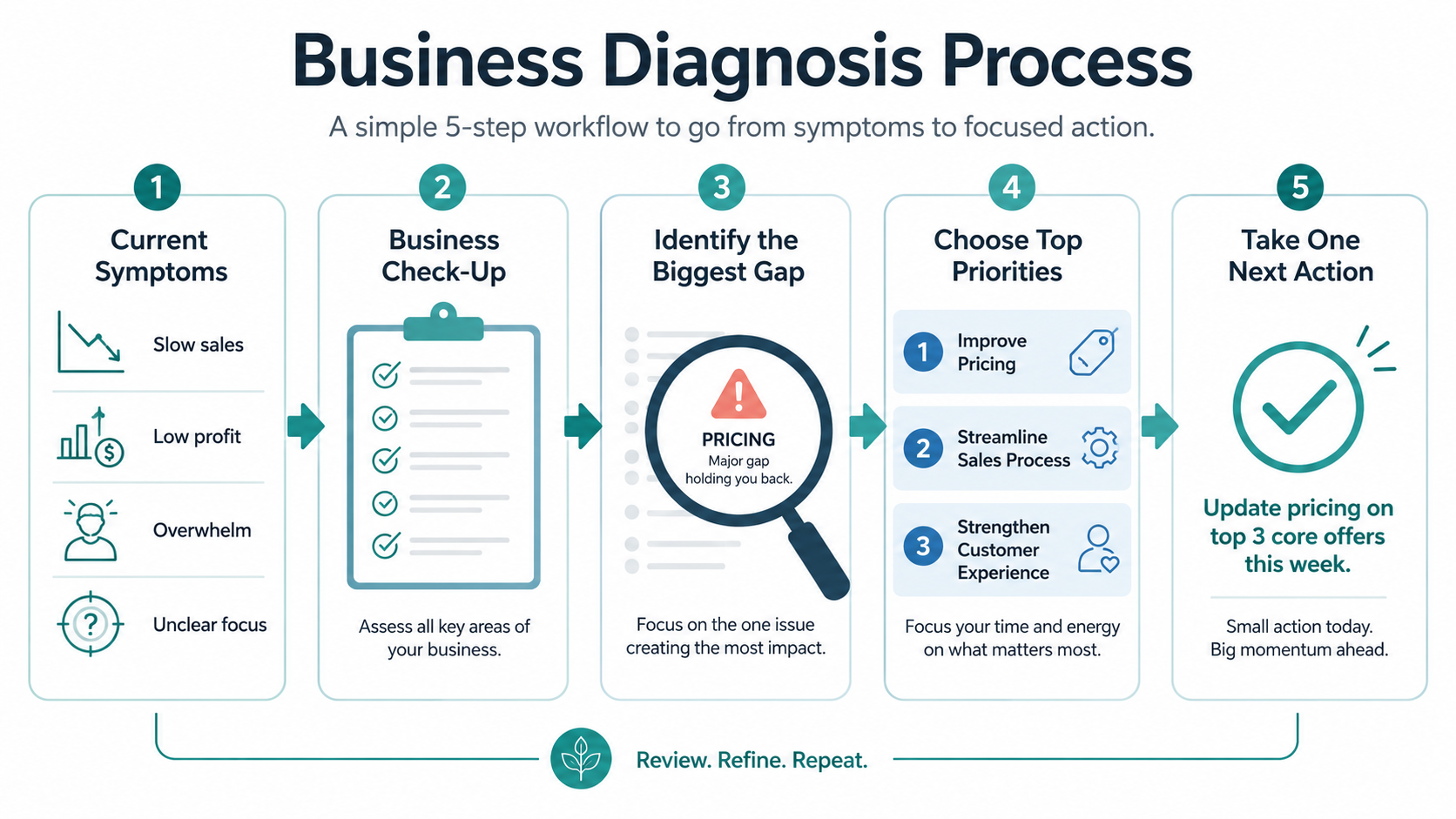
Before you try the next tactic, there is one step that most small business owners skip entirely: diagnosing your small business honestly. Not a 30-page audit. Not a complicated consulting report. Just a clear, structured look at what is actually going on — so you know where the real gap is before you spend anything else.
That is what this article is about.
What Does It Mean to Diagnose a Small Business?
To diagnose a small business means to look at it clearly and identify which area is weak, unclear, inconsistent, or creating pressure.
It does not mean overthinking everything. It does not mean blaming yourself. It does not mean writing a long document.
It means pausing before action and asking one honest question:
“What is really going on here?”
A simple business diagnosis helps you see whether the real issue is in your customer understanding, your offer, your marketing, your sales process, your operations, your finances, or your focus. It gives you a clearer starting point before you take your next step.
Business diagnostic tools have been used for years to help business owners and advisors assess strengths and weaknesses across different areas of a business, from operations and finances to strategy and customer experience. The principle is simple: you cannot fix what you have not clearly identified.
Diagnosis comes before action. If you solve the wrong problem, even hard work can create very little progress.
Why Most Business Owners Fix the Wrong Problem
When a business feels stuck, the natural response is to act. Change the price. Post more content. Launch a new offer. Run a promotion. Try a new platform.
Sometimes one of those things helps. But often, nothing changes much. Because those actions are addressing a symptom, not the underlying gap.
A symptom is what you notice. A business gap is what is actually causing it.
Here are some of the most common mismatches:
- They think the problem is marketing, but the real issue is offer clarity.
- They think the problem is price, but the real issue is unclear value.
- They think the problem is lack of customers, but the real issue is a broken follow-up process
- They think the problem is lack of time, but the real issue is no repeatable system.
- They think the problem is motivation, but the real issue is unclear priorities.
This is not a new idea. Research on root cause analysis shows that effective problem-solving starts with identifying the underlying cause, not just responding to the surface symptom. The same principle applies directly to your small business.
When you fix symptoms instead of gaps, you stay busy but do not move the business forward.
The Symptom vs. the Real Problem: A Quick Reference
| What You Notice | Possible Real Gap | First Question to Ask |
|---|---|---|
| Low sales | Offer clarity or sales process | Can people easily understand the offer and what to do next? |
| Low engagement online | Customer understanding or message clarity | Are you speaking to a real problem your customer cares about? |
| Too much manual work | Operations and systems | Which repeated task still depends entirely on you? |
| Stress about money | Financial visibility | Do you know your revenue, costs, and actual profit? |
| Too many unfinished projects | Decision-making and focus | Do you know your top 3 priorities for this stage? |
This table is a starting point, not a full diagnosis. The goal is to help you look beyond the first symptom and find what deserves attention before you invest more time, energy, or money.
The 8 Key Areas to Check Before You Try to Fix Anything
You do not need a complicated framework to start. A solid business diagnosis checks eight core areas. For each one, there is a simple question you can ask yourself right now.
1. Business Clarity
What it means: You know what your business does, who it helps, and what problem it solves, clearly enough to explain it in one sentence.
Diagnostic question: Can you describe your business in one clear sentence right now?
When this is unclear: You change direction often, struggle to make decisions, or explain your business differently every time someone asks.
2. Customer Understanding
What it means: Customer understanding means you know who your ideal customer is, what they truly need, what they want, and why they may hesitate to buy.
Diagnostic question: Do you clearly understand your customer’s real problem and desired outcome?
When this is unclear: Your content may feel general, your offers may not connect emotionally, and people may show interest but not buy.
3. Offer Clarity
What it means: Offer clarity means people can quickly understand what you sell, who it is for, what is included, and why it matters to them.
Diagnostic question: Can the right person quickly understand your offer and its value?
When this is unclear: People may ask too many basic questions, hesitate to buy, or simply not understand why your offer is worth it.
4. Sales Process
What it means: A sales process is the clear path from interest to payment. It tells a potential customer exactly what to do next.
Diagnostic question: Do interested people know exactly what to do next if they want to buy?
When this is unclear: Potential customers may disappear, delay, or get confused, and you lose sales that were already close.
5. Marketing Consistency
What it means: Marketing consistency means your message, content, and channels are focused enough to attract the right people consistently, not just occasionally.
Diagnostic question: Is your marketing message consistent and connected to a clear customer problem?
When this is unclear: You may post often but still attract the wrong people, or feel invisible even though you are active.
6. Operations and Systems
What it means: Operations and systems are the way repeated work gets done in your business — reliably, without depending on your memory or energy every single time.
Diagnostic question: Which repeated task still depends too much on your memory, energy, or personal attention?
When this is unclear: You may repeat the same mistakes, spend too much time on small tasks, or feel like everything depends on you personally. If this resonates, it may be worth reading a practical business systemization guide to understand where to start.
7. Financial Visibility
What it means: Financial visibility means you can clearly see your revenue, costs, profit, and cash flow, not just at the end of the year, but regularly.
Diagnostic question: Do you know which parts of your business actually make money?
When this is unclear: Pricing, spending, planning, and decision-making all become stressful, because you are guessing instead of knowing.
8. Decision-Making and Focus
What it means: Decision-making and focus mean you know what matters most right now, and what can wait until later.
Diagnostic question: Do you know your top 3 priorities for this stage of your business?
When this is unclear: Everything feels urgent, and you may jump between ideas without finishing the most important work.
Not sure how to honestly score these areas?
The Business Clarity Mini Diagnostic Tool walks you through all 8 areas with guided questions and a clear scoring system, in a simple Excel worksheet. It is $5, takes about 20–30 minutes, and helps you see where the real gap is before your next move. → Try it here
How to Score Your Business Without Making It Complicated
You do not need a complex report to start diagnosing your business. A simple score from 1 to 5 can help you see patterns quickly.
| Score | What It Means |
|---|---|
| 1 | Unclear or weak — this area is not working |
| 2 | Needs serious attention soon |
| 3 | Working, but inconsistent |
| 4 | Mostly clear and working well |
| 5 | Clear, consistent, and effective |
The score is not for judgment. The score is for clarity.
You are not trying to prove that your business is perfect. You are trying to see what needs attention first, so you can make a smarter next move.
How to Find Your Biggest Business Gap
After scoring the key areas, look for the biggest gaps.
But here is an important distinction: your biggest gap is not always the lowest score. Your biggest gap is the area where weakness creates the biggest impact on your time, money, customers, confidence, or growth.
Ask yourself:
- Which area has the lowest score?
- Which area is creating the most stress right now?
- Which area is costing money or time?
- Which area affects other parts of the business?
- Which area, if improved, would create the biggest relief?
A business gap matters most when it creates pressure, confusion, lost money, lost time, or repeated mistakes.
This approach aligns with what McKinsey describes in their seven-step problem-solving process: define the problem clearly, break it down into parts, and prioritise before acting. The same logic applies here, clarity about which gap matters most is more valuable than a long list of things to fix.
How to Choose Your Top 3 Business Priorities
Once you identify possible gaps, do not try to fix everything at once. That is the same trap as before, just with better information.
The goal is not to solve eight problems. The goal is to choose the top 3 priorities that deserve attention now.
Use three simple criteria:
- Impact: Will fixing this improve your time, money, customers, quality, or confidence?
- Urgency: Is this creating pressure right now?
- Simplicity: Can you take one small, honest action this week?
A good priority is not just important. It is important for this stage of your business.
For example, a small service business may discover that more marketing is not the first priority. The real priorities may be: clarifying the offer, improving the follow-up process, and tracking basic cash flow. Those three things could have a much bigger impact than any marketing campaign.
What This Looks Like in Practice: Three Different Businesses
The same diagnostic approach works across very different types of businesses. Here are three examples.
Example 1: A Local Café Owner
The owner feels sales are slow and assumes she needs better Instagram content and more promotions. After a quick business check-up, she finds three actual gaps:
Offer clarity (score: 2) — Customers do not understand the difference between daily products, custom orders, and event catering. The menu exists, but the offer is confusing.
Sales process (score: 2) — People message asking about custom orders, but there is no clear next step. Interested customers get lost.
Financial visibility (score: 1) — She does not know which products are profitable and which ones just look popular. She may be investing time and ingredients in items that barely break even.
Better first actions: write one clear description for each offer, create a simple inquiry-to-order process, track product profit for 30 days. More Instagram posts can come later.
Example 2: A Freelance Graphic Designer
He has clients but feels chronically underpaid and overwhelmed. He suspects the problem is that he needs to raise his rates.
After diagnosing his business, he finds the real gaps:
Customer understanding (score: 2) — He has been accepting any client that comes his way, instead of focusing on the type of project where he delivers the most value and commands premium pricing.
Offer clarity (score: 3) — His portfolio shows everything, which means it speaks to no one specifically. Ideal clients cannot see themselves in his work.
Operations (score: 2) — Every project starts from scratch: new brief, new process, new file structure. This costs him 3–5 hours per project in unpaid setup time.
Better first actions: define his ideal client type, create a focused portfolio page for that niche, build a simple project onboarding checklist.
Raising prices comes after the offer is clearer — not before.
Example 3: A Local Plumber
He gets calls, does good work, and gets referrals — but cash flow is unpredictable. He thinks he needs more marketing.
After a business check-up, the real gaps look different:
Financial visibility (score: 1) — He quotes jobs reactively without a consistent pricing structure. Some months he is very busy but earns less than expected.
Sales process (score: 2) — He gives verbal quotes over the phone but does not follow up. About 30–40% of interested people simply never call back, and he loses them without knowing why.
Operations (score: 2) — Invoicing, scheduling, and follow-up all live in his head. When he is on a job, admin falls behind.
Better first actions: create a written pricing structure for common job types, build a simple follow-up process for quotes, use a basic scheduling template for bookings.
More marketing would bring in more calls, but right now, a significant portion of those calls are already being lost. Fix the leak first.
The pattern across all three examples: The most obvious fix was rarely the right first step. Diagnosis changed the priority entirely.
If you have been wondering why your business feels stuck, a structured check-up is often the clearest starting point.
What to Do After You Diagnose Your Business
A diagnosis is a starting point, not the final step. Here are three paths forward depending on what you find:
If the gap is simple and clear: Take one small action this week. Example: If your offer is unclear, rewrite it in one sentence and test it with someone who does not know your business.
If the gap keeps repeating: Build a simple system so the same problem stops happening. Example: If customer follow-up is inconsistent, create a simple 3-step inquiry-to-sale process. A practical guide to scaling with templates and automationcan show you where to start.
If the gap is strategic (customers, value, revenue model): Work through a broader business model review. Example: The Business Model Canvas or the free Notion BMC template can help you see the full picture.
Use a Simple Tool Instead of Keeping Everything in Your Head
You can apply this method using a notebook, a whiteboard, or a blank spreadsheet. But if you want a structured way to do it, I created the Business Clarity Mini Diagnostic Tool for exactly this purpose.
It is a simple Excel-based business check-up worksheet that helps you:
- Review 8 key areas of your business
- Identify possible business gaps
- Choose your top 3 priorities
- Reduce scattered thinking
- Decide what to work on next
An honest note: this is not a full business audit or strategic consulting report. It is a quick clarity check, a practical first step for small business owners who want to stop guessing and choose a clearer direction before their next move.
It works for cafés, freelancers, tradespeople, coaches, consultants, online sellers, service providers, local shops, and early-stage founders. The size of your business does not matter. The smaller your business, the more useful a focused check-up tends to be, because every hour and every dollar counts more.
Or if you prefer: Start Your Business Check-Up on Gumroad
Who This Business Check-Up Is For
This tool is for you if:
- You own a small business and feel stuck or scattered
- You are working hard but do not know what to fix first
- You have too many ideas and need clearer priorities
- You want to review your business without writing a long business plan
- You are comfortable working in a simple Excel-based worksheet
- You are not ready for a full consulting session yet, but you want more clarity
- You want to choose your top 3 priorities before taking more action
It works for solo entrepreneurs, freelancers, consultants, coaches, service providers, local business owners, online business owners, digital product creators, and early-stage founders.
Who This Tool Is Not For
Being honest about what something is not is just as important as what it is.
This tool is not for you if:
- You want a complete business plan
- You need a full business audit
- You expect the tool to make decisions for you
- You need deep market research or competitive analysis
- You need financial forecasting or investor-ready documents
- You want a solution that works without honest reflection
- You are not willing to look clearly at what is unclear
A simple tool is only useful when it is used for the right purpose. This one is designed to give you a clearer starting point, nothing more, nothing less.
Still Confused After Your Diagnosis?
Sometimes the diagnostic is clear, you can see the gaps and you know what to do next. That is the ideal outcome.
But sometimes you complete it and still feel unsure. You see the scores, but you are not certain which gap to prioritise, or what a realistic next step actually looks like for your specific situation.
If that is where you land, that is completely normal. It often means the issue is strategic rather than operational — and a short conversation can clarify more than hours of solo thinking.
The Business Clarity Session is a focused working session where Sarah reviews your situation, helps you interpret your diagnosis, and gives you a practical and personalised action plan.
→ Fill out the pre-session application form (No commitment required. The form helps You & Sarah, both, understand your situation before the session.)
Final Thoughts: Diagnose Before You Fix
You do not need to fix everything today. You do not need another random tactic. You do not need to judge yourself for where things stand.
What you need is to see the real gap, choose one priority, and take one small, honest step.
A simple diagnosis will not solve every business problem. But it can help you stop guessing. It can help you see what needs attention first. And sometimes, that clarity is the most valuable thing before any growth can happen.
Ready to diagnose your small business?
Use the Business Clarity Mini Diagnostic Tool to review 8 key areas of your business, identify your biggest gaps, and choose your top 3 priorities.
Prefer Gumroad? Get it on Gumroad →
Frequently Asked Questions
What does it mean to diagnose a small business? It means reviewing key areas of your business to understand what is working, what is unclear, and what needs attention before choosing your next action. It is not about writing a long report — it is about seeing your business more clearly.
What is a business diagnostic tool? A business diagnostic tool helps you assess different parts of your business so you can identify gaps, priorities, and possible next steps. It gives you structure instead of guessing.
How do I know what to fix first in my business? Start by checking eight key areas of your business, scoring them honestly, and identifying which gap has the biggest impact on your time, money, customers, or confidence right now. The most impactful gap is not always the most obvious one.
Does this work for offline or non-digital businesses? Yes. The 8-area framework applies to any type of small business, whether you are a plumber, café owner, local retailer, freelancer, or online coach. The symptoms may look different, but the underlying gaps are often the same.
How do I know what to fix first in my business? Start by checking key areas of your business, scoring them honestly, and identifying which gap has the biggest impact on your time, money, customers, or growth. The biggest gap is not always the most obvious one.
Is a business diagnosis the same as a business plan? No. A business plan is a larger document about strategy, direction, and execution, often written for investors or lenders. A business diagnosis is a simpler, faster check-up that helps you identify what is unclear or broken right now, so you can act on the right priority.
Is the Business Clarity Mini Diagnostic Tool a full business audit? No. It is not a full business audit. It is a quick clarity check designed to help small business owners identify possible gaps and choose their top 3 priorities. It is a practical starting point, not a complete analysis.
Can I use this if my business is very small or just starting? Yes. It is designed specifically for small business owners, solo entrepreneurs, freelancers, consultants, coaches, service providers, and early-stage founders. The earlier you use it, the more time and money you can save by working on the right things from the beginning.
Do I need Excel to use this tool? Yes. You will need Microsoft Excel or another spreadsheet application that can open Excel files, such as Google Sheets.