Too Many Business Ideas? How to Choose the Next Move for Your Existing Business
If you have five different directions pulling at you right now and no idea which one to start with, here’s the short version: stop asking which idea excites you most, and start asking which one your business actually needs. That single shift, from what sounds exciting to what closes a real gap, is usually enough to break the loop.
I see this pattern constantly with the business owners I work with. Not people who are lost or lack ambition. The opposite, actually. They’re running something real, bringing in clients, shipping products, and somewhere along the way they started collecting ideas the way other people collect houseplants. A membership here. A new service line there. A course they’ve half outlined in their Notes app. None of it is bad. That’s what makes it hard to sort out.
Having too many ideas isn’t really the problem
Here’s something I tell almost every client who walks in overwhelmed by options: the ideas themselves aren’t the issue. Having a business that generates more possibilities than you can chase is, honestly, a decent sign. You noticed a gap in the market, or a pattern in what clients ask for, or a new way to package something you already do. That instinct is worth something, and I don’t want you to lose it while reading this.
The actual problem is that most business owners never built a way to compare ideas against each other. So every new one gets judged on its own, usually based on how exciting it feels that particular morning, and it either gets squeezed onto an already full plate or shelved out of guilt a few weeks later.
If this sounds familiar, the deeper issue often isn’t the ideas at all. It’s that you don’t have a clear picture of what your business currently needs most. That’s worth sorting out before anything new gets added to your plate. I wrote about how to actually diagnose what’s going on inside your business in more detail here, and it’s usually the step people skip right past.
What idea overload actually looks like
It rarely shows up as one dramatic moment. It builds slowly, in small decisions that each seem reasonable on their own.
Take Mina, who makes handmade leather bags and sells them through her own site and two small wholesale accounts. In a single month, she was juggling the idea of a small in-person workshop series, a YouTube channel to show her process, a push into a new online marketplace, and a limited seasonal collection. Every one of those could work. She had seen other makers do well with each of them. But she had one pair of hands, a part-time assistant three hours a week, and a business that still needed her at the workbench most days.
What happened instead was that she started all four, in pieces, over about three months. A video sat half edited. The workshop had a landing page but no actual date. The seasonal collection ended up with two designs instead of the six she had planned. Nothing failed outright, but nothing finished either, and her core bag sales, the thing actually paying her bills, stayed flat that whole quarter.

That’s the real shape of idea overload inside an existing business. Not one bad decision, but several reasonable ones made without checking them against each other, or against what the business needed most right then.
What it actually costs you
It’s tempting to treat this as a minor inefficiency, some scattered energy that will sort itself out over time. I’d push back on that a little.
Every half-finished project carries a cost beyond the hours already spent on it. There’s the mental weight of an open loop sitting in the back of your mind while you try to focus on something else. There’s the money spent on tools, ads, or a contractor for something that never actually launched. And there’s a quieter cost too: when customers watch a business chase several directions at once, the message about what that business actually does starts to blur. People tend to buy from businesses that sound clear about themselves, even in a single sentence.
I’ve watched this stall growth for genuinely good businesses more than almost anything else I come across. Not a weak product. Not a bad market. Just too many decent ideas competing for the same limited hours, with nothing in place to decide which one actually earns them.
There’s also a version of this that shows up as pure exhaustion rather than a stalled number. You’re technically busy every single day, sometimes busier than you’ve ever been, and yet nothing feels like it’s moving. That gap between effort and progress is usually the clearest sign that the problem isn’t a lack of ideas or a lack of work ethic. It’s a lack of sequence.
A simple filter for choosing what’s next
What helps, in practice, is running every idea through the same short set of questions before it gets any of your time. I use six with clients, and none of them require special tools or training to apply.
Revenue potential. Is this likely to bring in meaningful money within a reasonable window, or is it more of a long-term brand play with an unclear payoff? Both can be worth doing eventually, but they need to be labeled honestly from the start.
Urgency. Is there a genuine reason this needs to happen now, a client waiting on it, a seasonal window closing, a competitor moving into your space, or is the urgency mostly something you’re imposing on yourself?
Effort. How much time, money, and energy will this realistically take? Not the optimistic guess, the number based on how your last few projects of a similar size actually went.
Strategic fit. Does this move you closer to the kind of business you’re actually trying to build, or is it an interesting detour that happens to look good on paper?
Customer need. Are people actually asking for this, or is it something you’re assuming they’d want? There’s a real difference between solving a need someone has told you about and building something you personally find appealing.
Current business gap. This is the factor people skip most often, and it’s usually the one that matters most. What is your business currently missing? Weak retention, unclear messaging, no repeatable sales process, a bottleneck in delivery? The idea that closes that gap tends to beat the idea that doesn’t, even when the other one sounds more fun to work on.
Scoring ideas without turning it into a research project
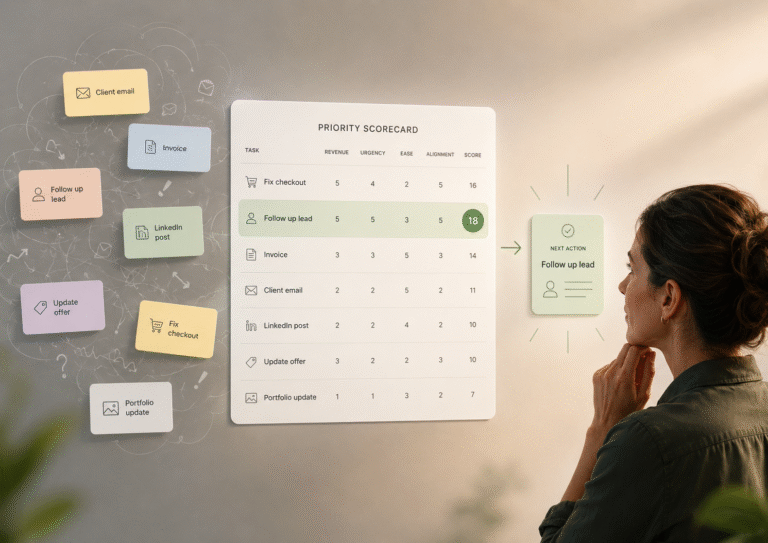
You don’t need fifteen spreadsheet tabs for this. A simple table does the job. List your top three or four ideas down the side, and score each one from one to five against the six factors above. Add up the totals. The highest score is not a command, but it is a signal. It shows you which idea deserves a serious conversation, which one needs more evidence, and which one you may only be keeping around because you liked the sound of it six months ago.
| Idea | Revenue Potential | Urgency | Ease of Execution | Strategic Fit | Customer Need | Closes Current Gap |
|---|---|---|---|---|---|---|
| Workshop series | 3 | 2 | 3 | 4 | 3 | 2 |
| Seasonal collection | 4 | 4 | 4 | 4 | 4 | 4 |
| YouTube channel | 2 | 1 | 2 | 3 | 2 | 1 |
| New online marketplace | 3 | 3 | 2 | 3 | 3 | 3 |
In Mina’s case, once she actually scored things this way, the seasonal collection came out clearly ahead. Not because it was the most exciting idea on the list, but because customers were already asking for it by name, it fit a real gap during her slow season, and it needed less new infrastructure than the other options combined.
This whole process takes maybe twenty minutes once you have your ideas written down somewhere. I bring this up because “I don’t have time to evaluate all my options properly” is the exact thing that keeps people stuck with no filter at all, running each idea through a gut check instead. Twenty minutes now is a lot cheaper than three months split across four half-finished projects, which is roughly what it cost Mina before she sat down and actually scored things out.
If your ideas are still scattered across sticky notes, half-written docs, and voice memos to yourself, and you need help just getting them into a shape you can actually compare, a business model canvas helps more than most people expect. I put together a set of prompts for exactly this in this article on turning scattered ideas into an actual model, and it pairs well with the scoring step above.
What if you choose wrong anyway?
This is usually the real fear sitting underneath all the hesitation, not “which idea is objectively best” but “what if I commit to the wrong one and lose more time.” It’s a fair worry, but it rests on a slightly mistaken idea of how business decisions actually work. You’re not picking the one true correct answer out of a lineup. You’re choosing the best next move based on what you know today, and the other ideas don’t disappear because you picked one. They just wait their turn.
I’ve had clients come back to me seven or eight months after shelving an idea and finally launch it, once the gap it was meant to fill became genuinely urgent instead of theoretical. Choosing well doesn’t mean predicting the future correctly. It means being honest about what your business needs today instead of chasing whatever sounds most interesting today.
If the idea hasn’t been tested yet
One distinction worth making here: this filter works best for ideas you already have some evidence for, things you or people you know have tried in some form before. If one of your options is completely untested territory, something no one has actually told you they’d pay for, it needs a different first step. Scoring an unvalidated idea against “customer need” is mostly guessing dressed up as analysis. In that case, it’s worth testing the idea itself before deciding how much of your business to build around it. I walk through exactly that process in how to validate a business idea before you build it.
The next move is the smart one, not the loud one
The ideas that shout loudest, the ones that feel most exciting on a random Tuesday morning, usually aren’t the ones your business needs most. The quieter idea, the one that closes an actual gap, tends to move things forward faster, even when it’s far less thrilling to talk about at a dinner party.
If you’re not sure what that gap actually is, that’s the real starting point, before you rank a single idea against another. Before you rank one idea against another, you need a clearer view of where the business is actually stuck. That is why I built the Business Clarity Mini Diagnostic Tool for exactly this moment: a short, honest look at where your business is actually stuck, so the “current business gap” factor in this filter stops being a guess. It’s usually a faster route to your next move than sitting with a list of ten good ideas and hoping the right one becomes obvious on its own.
If you’re not ready for that yet and just need a place to lay everything out so you can see it clearly first, the free Notion Business Model Canvas template is a solid place to start. Either way, the goal was never to find more ideas. You already have enough of those sitting in a notebook somewhere. The goal is choosing the one your business is actually ready for right now, and letting the rest wait their turn.