Everything Feels Important: A Practical Framework to Decide What Comes First
I had a client tell me last month that she’d spent forty minutes deciding whether to answer a client email or finish her invoices, and ended up doing neither because a third thing showed up and felt more urgent than both. She runs a one-person bookkeeping practice. Smart, capable, organized in every way except one: she had no real way to prioritize business tasks when three things screamed for her attention at once.
If that sounds familiar, you’re not bad at managing your time. You’re missing a filter.
Why everything feels urgent when you run a small business
When you’re the only decision-maker, every task arrives with the same emotional weight. A client message feels urgent because someone is waiting. A marketing idea feels urgent because you’re scared of falling behind. An admin task feels urgent because it’s been sitting there for two weeks and now it’s loud just from guilt.
None of that tells you what’s actually important. It tells you what’s loud.
I’ve watched this play out the same way with a wedding photographer, a virtual assistant, and someone running a small online course business. Different industries, same pattern: no shortage of effort, but a constant sense that the wrong things are getting done. The business owner isn’t lazy or disorganized. They’re choosing tasks the only way available to them, by gut feeling and noise level, because nobody ever showed them another way.
The real cost of treating everything as equally important
Here’s what actually happens when every task gets the same priority: the important-but-not-urgent work, the stuff that grows the business, gets pushed back indefinitely. Following up with warm leads. Updating your offer. Looking at your numbers. None of it feels urgent today, so it loses to whatever does, every single time.
Three months later, you’re busier than ever and your revenue looks about the same as it did a year ago. That’s not bad luck. That’s what happens when urgency, not importance, runs your calendar.
The fix isn’t working harder or longer. It’s having a way to decide business priorities that doesn’t depend on your mood, your inbox, or whoever complained loudest today.
Why the urgent/important matrix doesn’t actually fix this
If you’ve read anything about prioritization before, you’ve probably seen the classic four-box grid: urgent and important, important but not urgent, urgent but not important, neither. I used to recommend it too, until enough clients told me the same thing. Every task they looked at landed in the same box. Everything felt urgent and important, which is exactly the problem the grid was supposed to solve.
The grid assumes you already know how urgent or important something is. It just asks you to sort that knowledge into quadrants. But if your real problem is that you can’t tell urgency from importance in the first place, sorting them into boxes doesn’t help much. You need something that forces a number out of a feeling, not a chart that asks you to already have the answer. That’s the gap a weighted scorecard actually closes.
A simple way to rank what actually matters
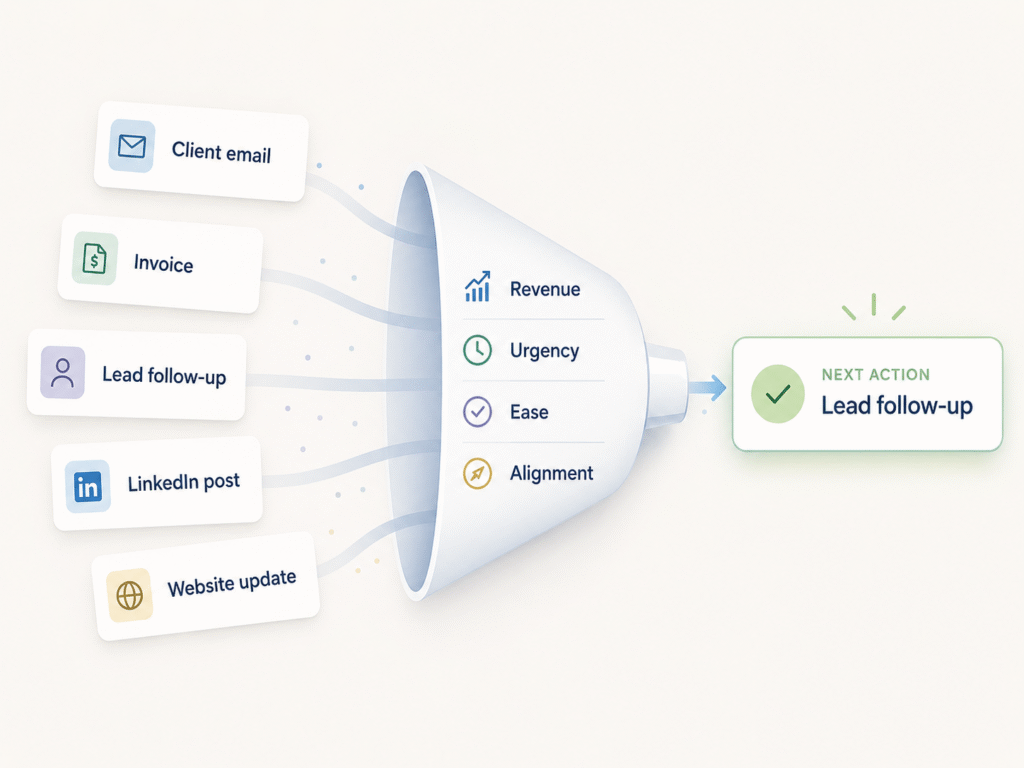
I use a version of this with clients, and it’s deliberately boring. Not a productivity app, not a color-coded system you’ll abandon in nine days. A short list of three or four criteria, scored honestly, that turns a gut feeling into a number you can actually compare.
Here’s how to build it.
Step 1: Pick three to four criteria that matter for your business. Most small businesses can cover this with:
- Revenue impact: does this task bring in money or protect money already coming in?
- Urgency: is there a real deadline, not a manufactured one?
- Effort: how much time or energy will this actually take?
- Alignment: does this move you toward the goal you set for this quarter, or is it a detour?
You don’t need more than four. I’ve seen people build fifteen-criteria spreadsheets and never open them again after the first week.
Step 2: Give each criterion a weight. Not every category deserves equal influence. If you’re three weeks from a launch, urgency might matter more than usual. If you’re rebuilding cash flow, revenue impact carries more weight than alignment. There’s no universal formula here, the weighting should reflect what’s actually true for your business right now, not what a template tells you it should be.
Step 3: Score each task, multiply by the weight, add it up. Whatever lands at the top is what you do first. Not what feels most urgent. What scored highest.
A worked example
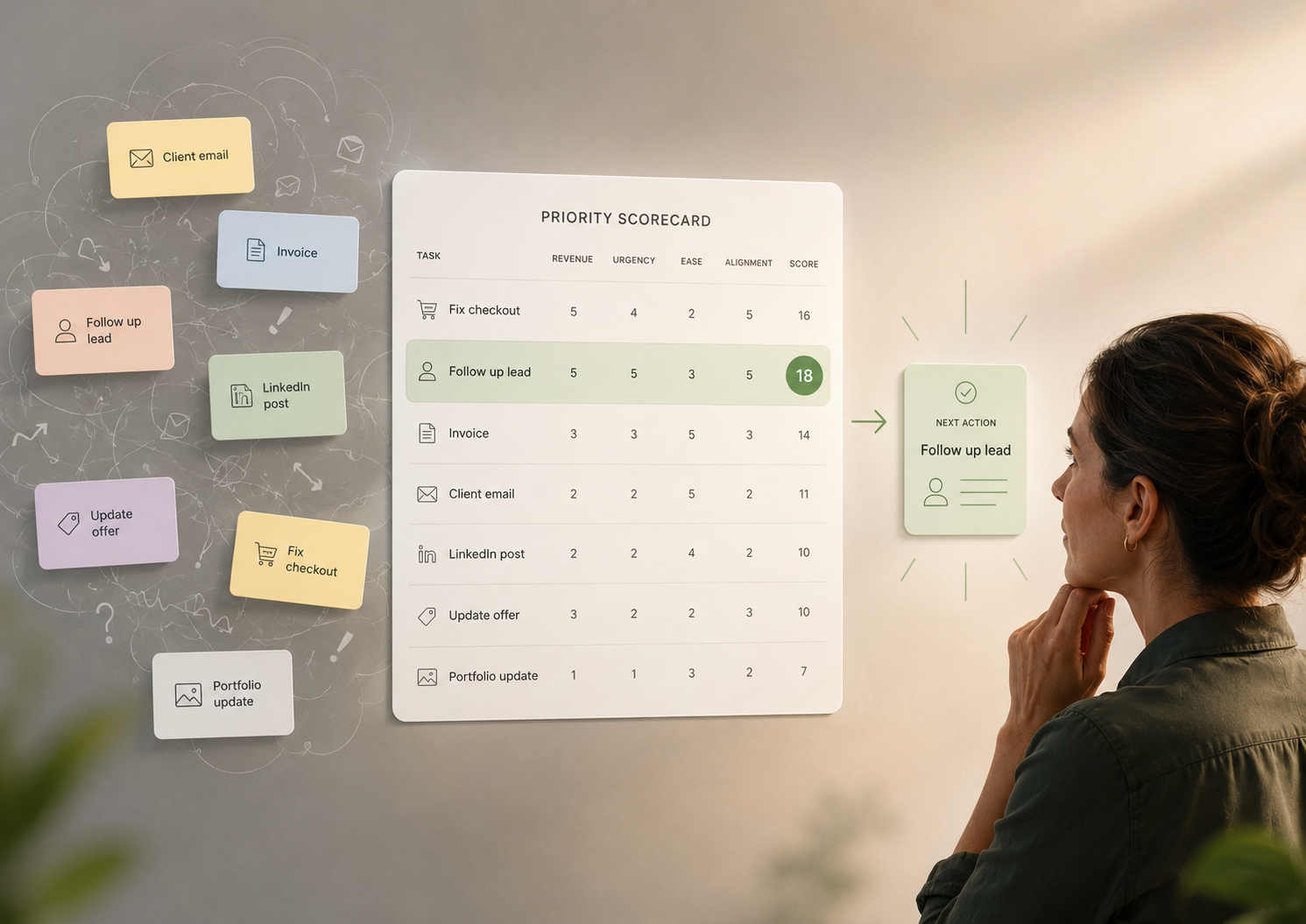
Say you’re a freelance copywriter and Monday morning hands you four competing tasks: a client revision request, drafting a new lead-gen email sequence, posting on LinkedIn, and finally updating your outdated portfolio site.
Here’s what the scoring might look like, using a 1 to 5 scale for each criterion:
| Task | Revenue Impact (x3) | Urgency (x2) | Ease ( x1) | Total Score |
|---|---|---|---|---|
| Client revision | 4 (12) | 5 (10) | 4 (4) | 26 |
| Lead-gen email sequence | 5 (15) | 2 (4) | 2 (2) | 21 |
| LinkedIn post | 1 (3) | 1 (2) | 5 (5) | 10 |
| Portfolio update | 2 (6) | 1 (2) | 2 (2) | 10 |
The client revision wins, which probably matches your gut instinct already. But notice the second spot. The lead-gen sequence outranks the LinkedIn post and the portfolio update by a wide margin, even though all three felt equally “should probably get to this” before you did the math. That’s the part the scoring actually fixes. It’s not the obvious decision you needed help with. It’s the murky middle, the tasks that all feel medium-important until you force a number onto them.
This is also where I’ll be honest about something: the first time you build one of these, the weighting will probably be a little off. That’s fine. Adjust it next week. The goal isn’t a perfect formula, it’s a repeatable habit that beats deciding by panic.
It also helps to know that your weights shouldn’t stay fixed forever. A business in its first year, still figuring out who its customer even is, probably needs alignment and revenue impact weighted heavily, because almost everything competes for attention and there’s no track record yet to tell you what’s working. A more established business with steady clients usually needs urgency weighted lower than it feels, because the owner has gotten used to treating every client request as a five-alarm fire out of habit, not because it actually is one.
Here’s a second example, because one worked scorecard rarely convinces anyone the method generalizes. Say you run a small online course business and Tuesday hands you four things: a student asking a refund question, recording a new bonus module, fixing a broken checkout link someone flagged, and brainstorming your next launch topic.
| Task | Revenue Impact (x3) | Urgency (x2) | Ease ( x1) | Total Score |
|---|---|---|---|---|
| Fix broken checkout link | 5 (15) | 5 (10) | 4 (4) | 29 |
| Refund question | 2 (6) | 4 (8) | 5 (5) | 19 |
| New bonus module | 3 (9) | 1 (2) | 2 (2) | 13 |
| Launch brainstorm | 4 (12) | 1 (2) | 1 (1) | 15 |
The checkout link wins easily, which makes sense, since a broken payment page costs you money every hour it stays broken. But look at the gap between the refund question and the launch brainstorm. They felt close in your head this morning. The math says they aren’t, and that’s the entire point of doing the math.
Build your own version
Grab a notebook, a spreadsheet, or the back of an envelope. List out everything competing for your attention this week. Pick your three or four criteria. Assign weights based on what’s true for your business right now, not what sounds responsible. Score honestly, even when the honest answer is “this task I love doing actually scores low.”
That last part trips people up the most. Small business prioritization isn’t about ranking what you enjoy. It’s about ranking what the business needs, and sometimes those are different lists. I’ve sat across from clients who clearly wanted permission to keep designing pretty graphics instead of making sales calls. The scorecard doesn’t give permission. It just tells the truth.
Where this usually goes wrong
A few patterns I see often enough to call out directly:
People build the framework once, feel great about it, and never run it again. A scoring method only works if it becomes a weekly five-minute habit, not a one-time exercise you did the day you read this article.
People weight everything equally because picking weights feels like a big decision. It isn’t. Pick something reasonable, use it for two weeks, adjust. The weights are a tool, not a contract.
People score tasks based on how they feel about them rather than what’s true. Be specific. “I know this client is unhappy and might leave” is a fact you can score. “This feels important” is a feeling, not data.
And the most common one: people use this for daily tasks but never step back to ask whether the bigger areas of their business, not just today’s to-do list, are actually where the real gap is hiding.
“I’ve tried frameworks before and they didn’t stick”
I hear this a lot, usually from someone who’s already tried a planner app, a productivity book, or a color-coded sticky note system that worked great for nine days. So it’s worth saying plainly: most of those systems fail for a reason that has nothing to do with willpower. They ask you to track everything, forever, with no end point. A scorecard isn’t that. It’s five minutes on a Monday, applied to whatever’s actually in front of you that week, and then you stop thinking about it until the next Monday.
The other reason frameworks don’t stick is that they get treated as a one-time fix rather than a habit you check yourself on. If you build the scorecard once and never compare what you predicted against what actually happened, you never learn whether your weights were right. Give it three or four weeks before deciding it doesn’t work for you. The first attempt is rarely the best one, and that’s true of almost any new habit, not just this one.
Zooming out from tasks to the whole business
Ranking your tasks for the week solves this week’s problem. But if you keep finding that everything still feels urgent no matter how well you score your Monday list, the issue might not be your task management. It might be that one or two core areas of your business, your offer, your sales process, your numbers, are unclear enough that everything downstream of them feels chaotic by default.
That’s a different kind of priority question, and it’s worth answering with the same honesty you’d bring to a task scorecard, just applied at a wider level. I built the Business Clarity Mini Diagnostic Tool for exactly that. It’s a 5-dollar walkthrough that scores 8 core areas of your business, clarity, customer understanding, offer, sales process, marketing, operations, finances, and decision-making, the same way you just scored your Monday task list: with real evidence instead of a guess. It tells you which area has the biggest gap and gives you one small next step instead of an overwhelming list of everything you should fix.
If you want to see this kind of thinking applied to a real situation rather than a worked example, this business clarity example walks through exactly that. And if the deeper question on your mind is less “what do I do first today” and more “what’s actually wrong with my business model,” this guide on how to diagnose your small business is the better starting point.
One small next step
You don’t need a new app, a new planner, or a weekend retreat to fix this. You need three criteria, an honest weight for each one, and the discipline to score your list before you start working instead of after you’ve already burned the morning deciding. Try it this week with whatever’s sitting in front of you right now. The relief isn’t in finishing more. It’s in finally knowing, with some confidence, that what you picked first was the right call.