
Busy but Not Growing: 4 Hidden Reasons Your Effort Isn’t Showing
If your calendar is packed and your bank account doesn’t reflect it, you’re not imagining things. This is one of the most common, and most frustrating, patterns I see in small business owners: full days, real effort, and a business that just isn’t growing the way it should.
The instinct is usually to work harder. Answer emails faster. Take on one more client. Stay later. But more hours rarely fix this, because the problem usually isn’t effort at all. It’s something underneath the effort that’s quietly capping how much that effort can produce.
I’ve sat across from a lot of business owners in this exact spot, and almost every time, the real issue falls into one of four categories. None of them are dramatic. None of them require a complete reinvention. But until you see them clearly, you’ll keep doing more work for the same result.
1. You’re solving the wrong problem for your clients
This one is sneaky because it doesn’t feel like a mismatch from the inside. You’re busy, clients are happy enough, work is getting done. But if you look closely at what you’re actually being hired to do versus what clients actually need most, there’s often a gap.
I worked with a woman who ran a small bookkeeping practice. She was excellent at the technical side, clean books, accurate reports, everything reconciled on time. Her clients liked her. But when I asked what they actually said to her, almost every conversation came back to the same thing: they didn’t understand what the numbers meant. They wanted someone to explain whether they could afford to hire, whether a slow month was normal, whether they were in trouble.
She was delivering accurate books. They wanted someone to help them make decisions. Same hours, same client relationships, but the offer she’d built wasn’t quite the offer they needed — so they kept hiring her for bookkeeping and then quietly hiring (or not hiring, and worrying alone) someone else for the part they actually cared about.
Once she added a short monthly call where she walked clients through what the numbers meant for their decisions, nothing fancy, just 20 minutes, two things happened. Clients stayed longer, and several upgraded to a higher tier without any pushback, because now the service matched the actual need.
If you’re busy but growth has stalled, it’s worth asking: when clients reach out with questions or concerns, are those questions inside the scope of what you’re offering, or just outside it? That gap is often where the next stage of growth is hiding.
2. Your pricing was set a while ago, for a different version of your business
Most people don’t price their work badly on purpose. They price it early, when they had less experience, fewer results to point to, and a need to win the first few clients. Then they get busy, and busy people don’t have time to revisit pricing. So the price stays the same while everything else about the business changes.
A few years in, the gap between what the work is worth and what’s being charged can get surprisingly wide. And here’s the part that catches people off guard: this doesn’t just affect income. It affects capacity. If your price is too low, you need more clients to hit the same revenue, which means more delivery, more communication, more admin, more of everything, for less margin on each one.
I think about a woman I worked with who ran a small marketing support service, managing email campaigns and social posting for local businesses. When she started, she charged a flat monthly rate that felt fair at the time. Two years later, she was managing twice as many accounts, had built templates and systems that made her faster, and had real case studies showing results. The price hadn’t moved.
She wasn’t underpaid in a way that felt dramatic day to day. It felt normal, because it was the only number she’d ever known for this work. But it meant she needed roughly 40% more clients than she should have, just to reach the income she wanted, and each of those extra clients came with their own onboarding, their own questions, their own slice of her week.
Raising prices isn’t about charging “what you’re worth” in some abstract sense, that phrase gets thrown around a lot and doesn’t mean much on its own. It’s about making sure the number on your invoice still reflects the actual value of what you’re delivering now, not what you were delivering when you set that price.
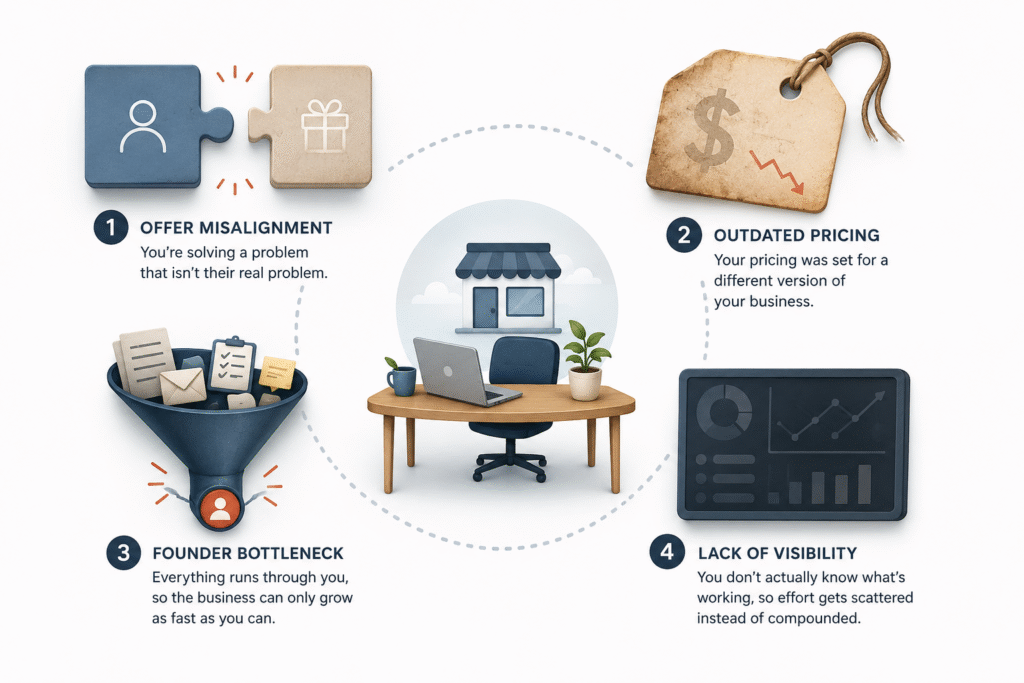
3. You’re the bottleneck, and you don’t have a way to see it
This is the one that’s hardest to spot, because being the bottleneck often feels like being indispensable. Everything runs through you. Every decision waits for you. Every client question lands in your inbox first. From the inside, that can feel like dedication.
From the business’s perspective, though, it’s a ceiling. If every project, every client, every task has to pass through you personally before it can move forward, then the business can only grow as fast as you personally can work, and you’re already at capacity.
I saw this clearly with a small business that did custom signage and vehicle wraps for local companies, restaurants, contractors, that kind of thing. The owner designed every piece himself, approved every print run, and handled every client call. He was talented, and the work was good. But every job had to wait for a slot in his schedule, because no part of the process could happen without him.
When a few larger clients came in at once, instead of growing, the business actually slowed down. More orders meant more bottleneck, not more output. Jobs that used to take a week were taking three, and a couple of clients went elsewhere, not because the work was bad, but because the timeline became unpredictable.
The fix wasn’t working faster. It was figuring out which parts of the process genuinely needed his judgment (final design approval, client relationships) and which parts didn’t (file prep, scheduling, basic print setup), and building a simple way for those second parts to move without him. Nothing complicated. Just a clear enough process that someone else could follow it.
If you notice that things slow down when you’re busiest, which sounds backwards but is incredibly common, that’s usually a sign the business is built around you rather than around a process that can hold steady whether you’re available or not.
4. You don’t actually know what’s working
This last one is less about a single problem and more about a missing piece of information. A lot of business owners are working hard, trying new things, adjusting their offers, but doing it somewhat blind, because they don’t have a clear view of which efforts are actually producing results and which ones are just… happening.
Maybe you posted on social media three times a week for six months. Did that bring in clients? Maybe you launched a referral incentive. Did anyone use it? Maybe you switched from one type of client project to another because it “felt” more profitable. Was it?
Without some way of tracking this, even something simple, you end up making decisions based on what feels productive rather than what is productive. And those aren’t always the same thing. Writing a blog post feels productive. Posting consistently feels productive. Redesigning your website feels productive. Sometimes these things genuinely move the needle. Sometimes they’re just activity that fills the hours that could have gone toward the thing that actually grows the business.
This is often the quietest of the four issues, because it doesn’t look like a problem from the outside. The business owner is working hard, trying things, staying active. But without visibility into what’s actually connecting to revenue, a lot of that effort ends up scattered across things that don’t compound.
So which one is it?
Here’s the honest answer: it’s rarely just one. Usually it’s some combination, maybe your offer is slightly misaligned and your pricing hasn’t kept up, or you’re the bottleneck and you’re not tracking what’s working, so you can’t even tell where to start fixing things.
That combination is different for every business, which is exactly why generic advice (“post more on Instagram,” “raise your prices,” “delegate more”) so often falls flat. It might be true. It might also be aimed at a problem you don’t actually have.
If any of these four reasons sounded familiar, or if more than one did, that’s worth paying attention to. I wrote about why scattered fixes tend to waste both time and money in Stop Wasting Money on Random Fixes, and if you want to see what it actually looks like when a business owner gets clarity on their specific situation, A Simple Business Clarity Example walks through a real one.
If you’d rather get a read on your own situation specifically, I put together a free pre-consultation assessment. It’s short, and after you fill it out, I personally look at your answers and send back my honest first impressions, what I’m noticing, and what I’d suggest as a next step, whether that’s a tool, a tweak to your offer or systems, or just a conversation. There’s no obligation attached to any of it. It’s just a way to turn “something feels off” into something specific enough to actually work on.
And if you’d rather talk it through first, a quick 30-minute coffee chat works too, sometimes it’s easier to just say it out loud.
Either way, being busy isn’t the problem. It’s what the busyness is actually pointed at that decides whether it turns into growth.