
When Your Business Lives in Your Head: Building Systems to Free Yourself
If everything about how your business runs lives in your brain, and your business depends on you being present for every decision, every process, and every small crisis, you have a specific kind of problem. Not a personality problem or a willpower problem. A systems problem.
This article is about what it actually looks like when a business lives inside one person’s head, why that’s more costly than it appears, and what it takes to start moving it somewhere else.
You Are the System (And That’s the Problem)
Most small business owners who reach this point did not plan to get here. In the early days, being the center of everything made sense. There was no team to write processes for. Writing things down took longer than just doing them. You ran on instinct and memory, and it worked fine.
Then things grew. Maybe you brought on a part-time helper, or your client list got longer, or the volume of weekly tasks crossed the point where you could hold them all comfortably in your head. But by then, the way your business operated was already locked inside you. Nothing was documented. Every piece of knowledge about how things got done transferred verbally, imperfectly, and only as long as the person receiving it stayed around.
This is what people mean by the founder bottleneck. And while the phrase sounds clinical, what it feels like is much more personal. It feels like being needed in a way that’s quietly draining. Like you can never really switch off, even on a Sunday, because nothing actually runs without your input.
The uncomfortable part is that this pattern usually shows up in the most capable owners, not the disorganized ones. You built something that works precisely because you know how to do everything. That knowledge is real and valuable. The problem is that it’s trapped in a place nobody else can access.
What Running a Business in Your Head Actually Costs You
The practical costs are obvious enough. You can’t take a week off without your laptop coming with you. Bringing on someone new means weeks of explaining everything from scratch. Delegating a task creates more work for you in the short term because you have to supervise every step of it.
But there’s a subtler cost that’s harder to see until you’re deep in it.
When a business depends on you for everything, you’re never fully present anywhere. You’re in a conversation with someone but mentally reviewing a client situation from earlier in the day. You’re on a weekend away but half-waiting for something to go wrong at work. The mental load does not clock out when you do. It follows you everywhere because it has nowhere else to go.
There’s also the growth ceiling this creates. If you are the business, then the business can only grow as far as you can personally stretch. More clients does not automatically mean more income and more freedom. More often it means more weight.
And if you ever want to sell the business, step back from it, or hand it to someone else someday, a business that runs entirely on memory stored in one person is very hard to transfer. The value walks out the door when the owner does. That’s not a scare tactic. It’s just what happens to businesses where nothing is written down.
Why “My Work Is Too Complex to Document” Is Usually Not True
This is the most common thing I hear, and I understand it. When you know your work deeply, it genuinely can feel impossible to reduce it to a set of steps. The nuance, the judgment calls, the context behind every decision. How do you put that in a document?
But here’s what I have noticed consistently: when owners actually sit down and map out how they do something, the repeatable part is almost always much larger than they assumed.
A friend of mine runs a small wedding floristry business. She was convinced her client process was entirely unique every single time. Too creative to document, she said. When we looked at how she actually handled new client inquiries, how she structured initial consultations, how she managed supplier orders, how she communicated delays, roughly 75 percent of it followed the same pattern each time. The creative work was specific to each wedding. The process around it was largely identical.
She wrote it down. Her assistant started handling the parts that didn’t require her specific eye. She got back something she hadn’t had in two years: a couple of evenings per week that weren’t spent on inbox management.
The goal isn’t to document the art. It’s to document the scaffolding around the art so you’re not rebuilding it from scratch every single time.
What Documenting Systems Actually Means
If the phrase “build business systems” makes you picture an elaborate operations manual that takes months to write, I want to offer a more realistic version of what this actually is.
A system is just a documented way of doing something. It can be a Google Doc with steps written out plainly. It can be a short Loom recording walking through a task. It can be a simple checklist your team follows without needing to interrupt you. The format is less important than the fact that it exists outside your head.
The useful ones tend to have a few things in common:
- A clear starting point, so everyone knows when this process begins
- The actual steps, written in the order they happen
- Someone clearly responsible for each step
- A clear sense of what “done” looks like
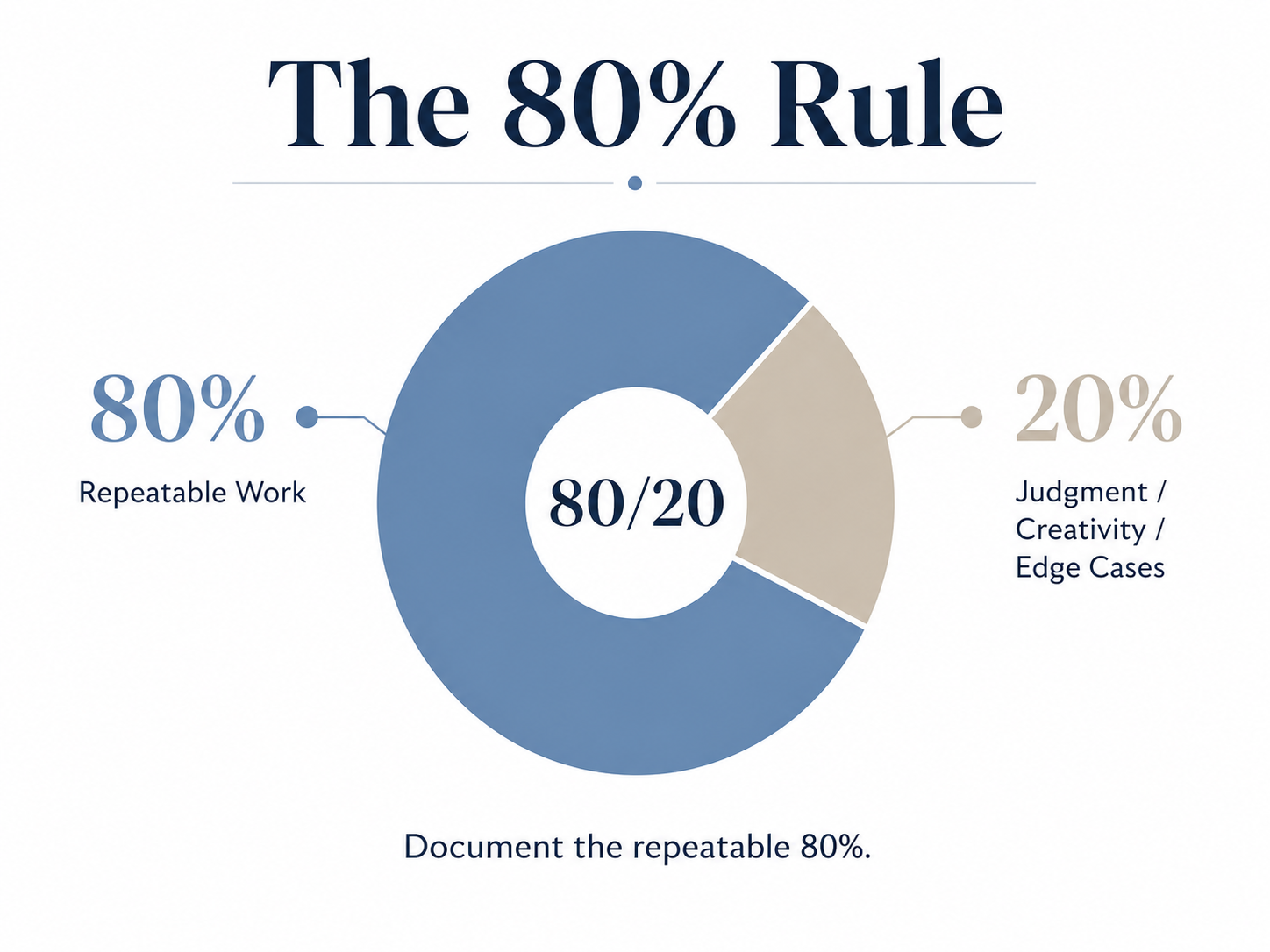
You don’t need to account for every edge case at the start. Write the version that covers 80 percent of situations and add to it over time. A working document that gets used is worth far more than a perfect document that never gets opened.
A Real Example of What Changes When You Write Things Down
Let me tell you about Priya, who ran a small online tutoring business with three part-time tutors working under her. She was the one students emailed when they wanted to enroll. She was the one who matched each student to the right tutor. She handled all billing questions and decided how to approach refund requests. Every situation went through her, every single day.
She started with just one process: how new student inquiries were handled, from the first email to the first session. She wrote it out in a document. Every step, the email templates she used, how she decided which tutor to assign and why, what happened when a time slot wasn’t available, how she followed up if someone didn’t respond. It took her maybe three hours.
Within a few weeks, one of her tutors was handling the entire intake process. Not perfectly at first. Priya revised the document twice based on questions that came up, and then the questions mostly stopped.
She told me later that the biggest surprise wasn’t the hours she got back. It was that she stopped thinking about work emails in the middle of the night. The process was somewhere outside of her head now, living in a document that anyone could open. That shift, she said, felt like putting something down she hadn’t realized she was carrying.
Where to Start When Everything Feels Equally Urgent
The hardest part of documenting your business is deciding what to start with. Everything feels like it needs attention and you don’t have spare hours to spare.
Here’s a useful filter: look at where you get asked the same questions most often. What do team members or clients need from you repeatedly, for essentially the same type of situation? Whatever you’re repeating most frequently is costing you the most mental energy. That’s where documentation gives you the fastest return.
Another way to find the right starting point is to pay attention to your most overloaded days. What are you holding in your head on those days? What keeps pulling your attention back when you’re trying to focus on something else? That list is your priority list.
A few areas that tend to deliver the most relief when documented early:
Client onboarding. How does a new client start working with you? What do they receive, when, and from whom? What happens in the first week? If this process lives only in your head, every new client relationship starts slightly differently, and you are essentially reinventing it each time. Documenting it once means you stop making those micro-decisions every time someone new comes in.
Recurring weekly tasks. What happens every week that follows a predictable pattern? Scheduling, invoicing, ordering, reporting. These are usually the easiest to start with because the pattern is already there. You’re just not writing it down yet.
How you handle problems. Most businesses deal with the same handful of recurring issues over and over. A delivery that arrives wrong. A client who is unhappy with something. A supplier who goes quiet. Having a written approach to your most common problems means they stop feeling like emergencies every time they come up, and they stop requiring your personal judgment to resolve.
Start with one. Write it down this week, not in a polished format, just in plain steps that someone else could follow. Then hand it to someone and see what happens. The gap between what’s in your head and what actually ends up on paper is usually smaller than you expect.
| If this keeps happening | Document this first |
|---|---|
| People ask you the same questions | A simple FAQ or decision guide |
| Every new client starts differently | Client onboarding checklist |
| Weekly tasks depend on your memory | Weekly recurring task checklist |
| Problems feel urgent every time | Common issue response process |
| Delegation creates more work | Step-by-step task SOP |
The Part Nobody Writes About: The Mental Relief
Most content about business systemization focuses on the operational side. Faster processes. Better delegation. Scalable growth. Those things are real and worth working toward.
But there’s a mental and emotional dimension to this that rarely gets talked about, and it might actually be the more important one.
When your business depends on you for everything, you carry a very specific kind of weight. It’s not just the tasks. It’s the cognitive overhead of holding all of them simultaneously: the context behind each client relationship, the history of past decisions, the exceptions and edge cases and preferences you have accumulated over years of doing this. Psychologists call this cognitive load, and it builds up quietly. Most people only notice how heavy it has become when they’re already approaching burnout.
When a process gets documented and actually gets used by someone else, something shifts. The process no longer lives only in you. It exists outside of you now, in a document that can be opened and followed without your presence. The knowledge has somewhere to live that isn’t your memory. And the effect of that is more noticeable than it sounds.
One of my clients runs a small physiotherapy practice with two other practitioners. When we documented the patient intake and follow-up processes, she described the feeling as “like finally putting something in a drawer instead of holding it in your hands.” That’s more accurate than most business frameworks ever manage to capture.
If you have been running everything from memory for a long time, you might not even realize how much you are carrying until something finally gets written down and someone else handles it without you.
The One Thing That Makes This Stick
Documenting systems is easy to start and easy to abandon. The documents get written, saved somewhere, and within a few weeks everyone goes back to the same habits: coming to you with questions, waiting for your input, expecting your involvement for everything.
What makes the difference is actually using the documentation, consistently, from the start.
When someone comes to you with a question that should be answered by a process you have already written, check the document before you answer. If the answer is there and they did not look, point them back to it. If the answer is not there, add it, and then point them back to it. This sounds simple but it requires real patience in the beginning because answering the question yourself is faster in the moment.
The problem is you will pay back that borrowed time in every identical question you answer for the next two or three years.
There’s also a mindset shift worth naming: moving from being the person who knows everything to being the person who makes sure the knowledge is somewhere accessible. These feel like the same job but they are not. One requires your constant presence. The other builds something that can outlast your attention on any given day.
A Good Next Step
If you can feel the cost of keeping everything in your head, that awareness is worth acting on now, not when the load gets unmanageable.
The Systemization Resource I’ve put together is a practical starting point for exactly this: identifying what to document first, writing processes in a way that actually gets used, and beginning to shift your business from something that depends on you to something that can run without you being involved in every step.
[Download the Systemization Resource here] and start getting your business out of your head.
If you want more context on the bigger picture, [What Is Business Systemization?] is a solid place to start, and [How to Build a Business That Runs Without You] goes further into what this actually looks like in practice for small business owners.
You built something real. It deserves a foundation that does not depend entirely on you remembering everything.
Sarah Moradi is a business consultant and educator who helps small business owners build systems so their businesses can grow without depending entirely on them. She works with founders who are ready to move from running everything themselves to running a business that runs itself.