Building a Client Pipeline: From Sporadic Projects to Predictable Work
If you have ever gone from fully booked to completely quiet in the same month, you already know what a missing client pipeline feels like. A client pipeline is simply the path someone travels from first hearing about you to becoming a repeat customer, and if that path only has one step (wait for a referral) then your income will always move in waves. Building a real pipeline means adding the missing steps: follow-up, a clear next offer, and a reason for past clients to come back.
I want to be honest about something first. Most small service businesses do not have a sales problem. They have a follow-up problem wearing a sales costume.
Why your client flow feels so random
Picture a mobile dog groomer named Elif. She built her whole client base through word of mouth. One neighbor tells another, someone posts in a local Facebook group, and suddenly her calendar is full for three weeks straight. Then it goes quiet. Not because people stopped needing groomers, but because nobody followed up with the client from two months ago whose dog is due again, and nobody reached out to the five people who asked about pricing and then went silent.
That silence is the real problem. Not lack of interest. Lack of a next step.
It’s an easy trap to fall into, because when work is coming in, there’s no obvious reason to build anything else. You’re busy, the calendar looks fine, and building a follow-up habit feels like extra admin nobody has time for. Then the quiet month arrives, and it feels like it came out of nowhere, even though the warning signs (unanswered inquiries, past clients who went cold, no plan for what happens after a project ends) were sitting there the whole time.
Here’s what I mean by the gap between current and desired. Elif’s current situation is: clients show up when they show up, and she reacts. Her desired situation is: she knows roughly how many bookings are coming in the next two weeks, because she has a system that keeps bringing people back around instead of leaving that to chance. The distance between those two things is the pipeline gap, and it is almost never fixed by “doing more marketing.” It is fixed by building the steps that are currently missing.
The four places a client pipeline actually breaks
When someone tells me “I don’t have enough clients,” I’ve learned not to take that at face value, because the real issue usually lives in one of four spots, and each one needs a completely different fix.
Visibility. Not enough people know you exist or know what you do. This is the only one that actual marketing solves.
Offer clarity. People see you, but they are not sure what they would actually be paying for, or who it is for. Confusion is quiet. People rarely tell you your offer is unclear, they just stop replying.
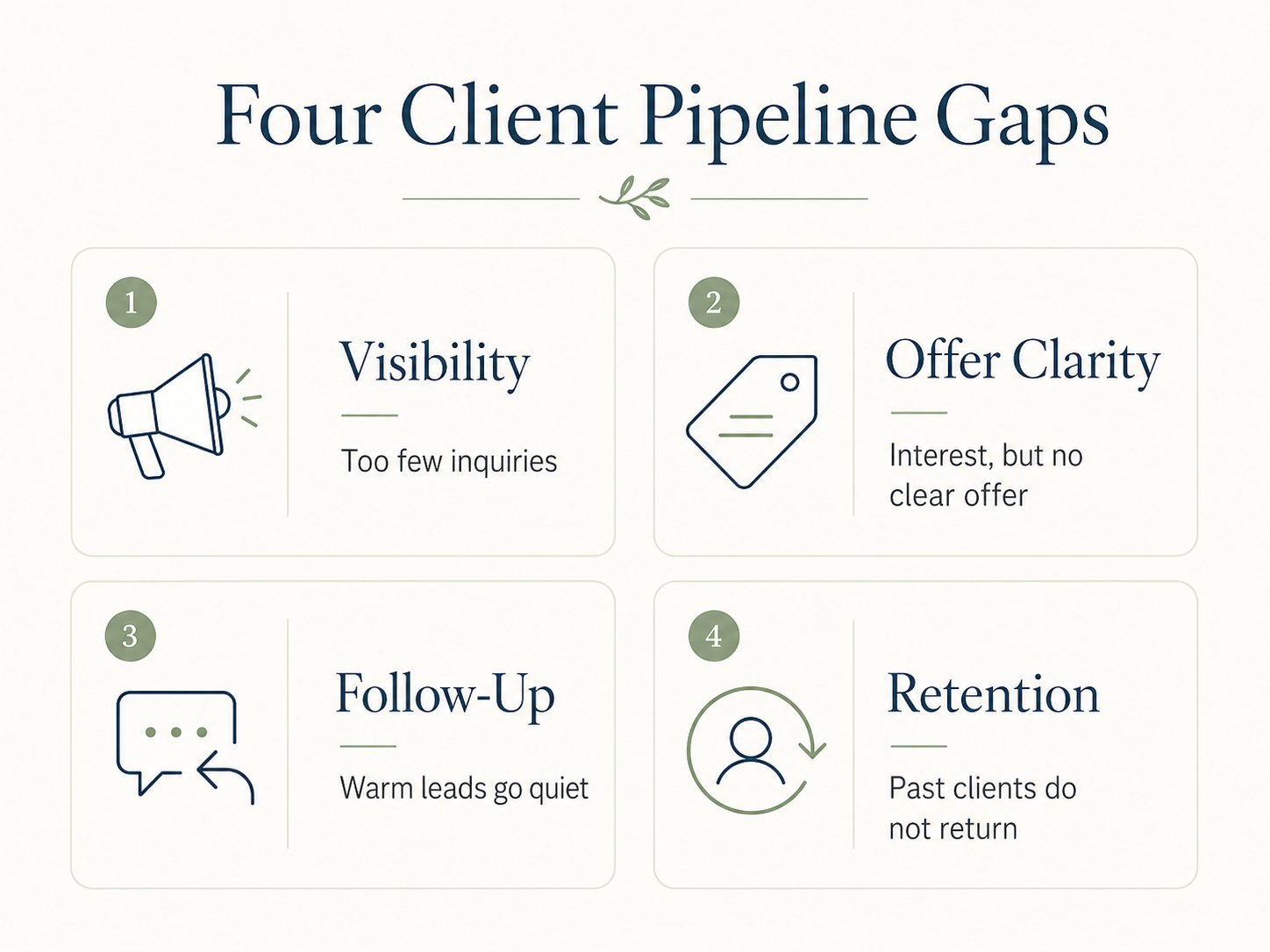
Follow-up. Someone shows interest, asks a question, maybe even books a call, and then the conversation dies because nobody nudged it forward. This is the most common gap I see, and it is the cheapest one to fix.
Retention. Past clients who were happy with your work never hear from you again, so they forget you exist by the time they need you a second time, or a friend asks for a recommendation.
Most business owners assume their problem is visibility, because that’s the loudest, most obvious thing to blame. In reality, a lot of “not enough clients” is actually “not enough follow-up with the people who already raised their hand.”
I get why visibility gets the blame first. Posting more, running an ad, showing up on another platform, these all feel like doing something. Fixing your follow-up feels smaller and less exciting by comparison, even though it’s usually where the actual money is sitting. I’ve watched business owners spend weeks on a new marketing push while five warm inquiries from the month before sat untouched in their inbox.
The four real stages of a client pipeline
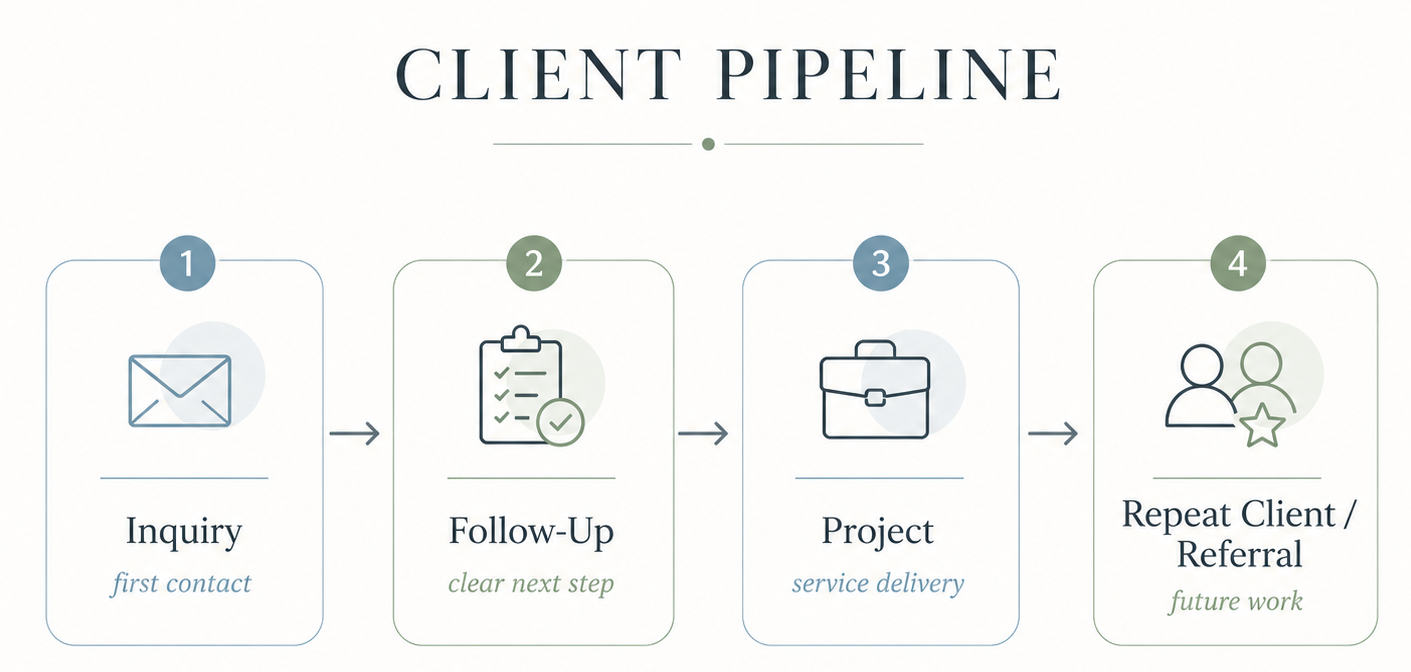
A working pipeline has four stages, and none of them require expensive software to start.
1. Inquiry. Someone reaches out, fills out a form, sends a DM, or asks a friend for your contact. This is the moment most businesses treat as the finish line, when it’s actually the starting line.
2. Follow-up. You respond quickly, answer the real question underneath their question, and give them a clear next step. Take a freelance graphic designer named Marco as an example. Someone messages asking “how much for a logo?” A weak response quotes a price and stops there. A better response asks what the logo is for, gives a price range, and proposes a 15-minute call. That single extra step turns a price-shopper into an actual conversation.
3. The project. You deliver the work. This part is usually fine for most service businesses, since it’s the part they trained for and care about most.
4. Repeat or referral. This is the stage almost everyone skips. After the project ends, there’s no check-in, no invitation to come back, no ask for a referral. The relationship just quietly ends, even when the client was thrilled.
Notice that stage four feeds back into stage one. A repeat client or a referral is a new inquiry that costs you nothing to generate, other than the two minutes it takes to send a message.
Building follow-up that doesn’t feel pushy
Follow-up gets a bad reputation because people picture aggressive sales emails. It doesn’t have to look like that at all.
For new inquiries, a simple rule works well: respond within 24 hours, and if someone goes quiet after your first reply, send one more message about a week later. Not “just checking in,” which says nothing. Something specific, like “still happy to answer questions about timing or pricing if that’s useful.” Marco started doing this and picked up three projects in one month from people who had gone quiet weeks earlier and simply needed a second nudge.
For past clients, a quarterly check-in works better than people expect. Elif sends a short message every few months to clients whose pets are due for grooming again, and mentions any seasonal offer she’s running. It takes her about twenty minutes a month and fills gaps in her calendar that used to sit empty.
For referrals, ask at the right moment, which is right after you’ve delivered good work and the client is happy, not months later when the feeling has faded. A simple “if you know anyone else who could use this, I’d appreciate the introduction” works better than any referral program with points and rewards.
A couple of quick answers
Do I need CRM software to do this? No. A spreadsheet with names, dates, and a note about the last conversation is enough for most solo service businesses. Software helps once you’re tracking more than you can remember, not before.
How long does it take to see a difference? Follow-up usually shows results within the first month, since it’s mostly recovering conversations that already existed. Retention and referrals take longer, closer to two or three months, because you’re waiting for the natural cycle of people needing your service again.

Turning one-off projects into recurring revenue
Here’s something worth sitting with. Every one-off project you finish is a pipeline that starts back at zero. You did the work, got paid once, and now you need a brand new inquiry to earn from that client again. If you want fewer feast-or-famine months, the fastest lever isn’t more leads, it’s turning some of your existing clients into recurring ones.
Marco started offering a small monthly retainer to clients who needed occasional design tweaks (a new social graphic here, a flyer update there) instead of quoting each request as a separate mini-project. Most of that work took him under two hours a month per client, but it meant three of his clients now paid him automatically instead of him having to win the work fresh every time. That’s not more hours. That’s the same hours, packaged differently.
Elif did something similar by offering a seasonal grooming plan: book four sessions in advance at a small discount instead of booking one at a time. Clients liked knowing it was handled, and she liked knowing four future bookings were already on the calendar instead of hoping the same client remembered to call again in six weeks.
Recurring revenue doesn’t have to mean a subscription business model. It can be as simple as a maintenance package, a standing monthly check-in, or a “come back every quarter” offer. The point isn’t to lock people into anything. It’s to give happy clients an easy way to keep working with you instead of making them start the whole inquiry process over from scratch every single time.
If you’re not sure which of your current clients would say yes to something recurring, that’s usually the client who’s already asked “can I just send you these as they come up?” at some point. That question is them telling you what to build.
When the real problem is somewhere else
If you’re already getting decent traffic, people finding your website or your posts, but conversations still aren’t turning into paying work, the pipeline itself might not be your issue. That’s usually a sign the breakdown is happening earlier, in how your offer is presented or how the initial conversation is handled. I wrote about that exact situation in Traffic but No Sales: Turning Eyeballs into Paying Clients, which walks through what to check before assuming you just need more visitors.
Figuring out which gap is actually yours
Here’s the part that trips people up. Visibility, offer clarity, follow-up, and retention all feel similar from the inside. They all show up as “I don’t have enough clients.” But the fix for each one is different, and guessing wrong just means another few months of the same feast-or-famine cycle while you work on the wrong thing.
| Gap | What it usually looks like |
|---|---|
| Visibility | Very few inquiries coming in |
| Offer Clarity | People ask questions but do not convert |
| Follow-up | Interested leads go quiet |
| Retention | Clients do not return or refer |
Not every sales problem is a visibility problem. Sometimes the real gap is follow-up, offer clarity, or retention.
This is exactly why I built the Business Clarity Mini Diagnostic Tool. It’s a simple Excel-based check-up, not a full business audit, that walks you through key areas of your business, including your sales process specifically, and helps you compare where you actually are against where you want to be. Instead of guessing whether your problem is marketing, follow-up, or something else entirely, you score each area, see where the biggest gaps sit, and land on your top three priorities. It won’t build the pipeline for you, but it will tell you which part of it actually needs your attention first, which is usually the harder question to answer on your own.
Where to start this week
Don’t try to build all four stages at once. Pick the one that’s currently doing the most damage. If leads go quiet after the first message, fix follow-up before anything else. If past clients never hear from you again, start there instead. If you’re honestly not sure which one it is, that uncertainty is worth sitting with rather than guessing your way past it, because building the wrong fix wastes months you don’t get back.
Send one follow-up message today to someone who went quiet. Send one check-in to a past client. Neither of those takes more than five minutes, and both are a smaller, more honest step than “build a pipeline.” It’s the kind of small, unglamorous move that actually changes the number at the end of the month, long before any bigger system gets built around it.