5 Hidden Diagnostic Clues You’re Missing in Your Business
Most business problems don’t announce themselves. They don’t send a warning email or show up as a red flag on your dashboard. They start small, easy to explain away, easy to blame on a bad week. And by the time the problem is obvious, it’s usually already expensive.
I’ve sat with enough business owners over the years to notice a pattern. The ones who catch trouble early almost never do it by staring at a spreadsheet. They notice something smaller first, a feeling that something is off, a small repeated annoyance, a client who used to respond fast and suddenly doesn’t. These hidden business problems rarely look dramatic. They look like nothing at all, right up until they aren’t.
If you’ve had that nagging sense that something in your business isn’t working the way it should, but you can’t quite name it, this article is for you.
The cost of ignoring these signs isn’t always visible right away either. A repeated small mistake doesn’t just cost you the redo. It costs you a bit of trust with that customer, and trust is slow to rebuild once it’s chipped. A slipping deadline doesn’t just push a project back a few days. It quietly resets what your clients expect from you going forward, usually downward. None of this shows up on a bank statement the week it happens. It shows up three or six months later, as fewer referrals, or a client who used to renew without asking questions and now hesitates.
Sometimes the first signs of a business problem are not dramatic. They show up as small delays, repeated confusion, lost follow-ups, or a quiet feeling that something is off. Before you try to fix everything, it helps to understand what kind of gap you may be dealing with. I explain the full diagnostic process in this guide: How to Diagnose Your Small Business Before You Waste Money Fixing the Wrong Thing
I won’t repeat that whole process here. What I want to do instead is slow down and look at five specific clues that tend to show up before a bigger problem does. None of them will feel urgent on their own. Together, they’re worth paying attention to.
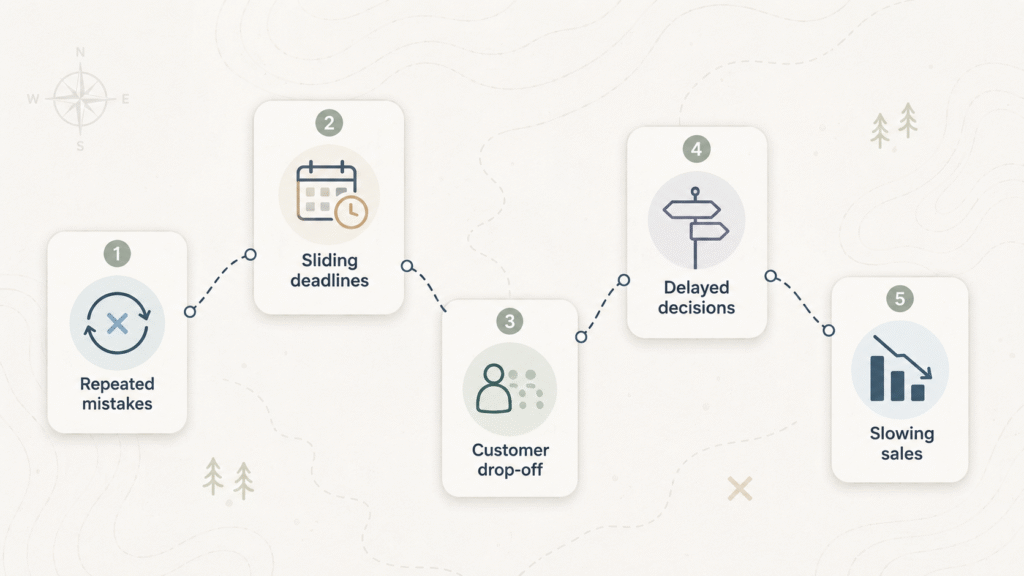
1. The same small mistake keeps happening
One mistake is normal. The same mistake showing up again, in a slightly different costume, is a signal.
A friend of mine runs a small custom framing shop. For months, she kept apologizing to customers for the wrong size mat board showing up on finished pieces. Each time, it felt like an isolated mix-up. A supplier error. A rushed afternoon. She fixed it, moved on, and didn’t think much of it.
It happened four times in two months before she sat down and actually mapped out her order process. The problem wasn’t the supplier. It was that measurements were written on sticky notes that sometimes got copied wrong when she or her part-time assistant re-entered them into the order form. Nobody had ever written down a standard way to record a measurement.
That’s how most repeated mistakes work. They rarely come from one careless moment. They come from a step in the process that was never actually defined, so everyone fills the gap with their own version of “close enough.”
If you notice yourself apologizing for the same kind of thing more than twice, stop treating it as bad luck. Ask where in the process that mistake keeps entering. Diagnosing small business issues almost always starts with this exact question: is this a person problem, or is this a process that was never built?
There’s an easy way to test which one you’re dealing with. Swap the person involved, even temporarily, and see if the mistake still happens. If it does, you’re not looking at a training issue. You’re looking at a gap in the process itself, and no amount of reminding people to “be more careful” will close it.
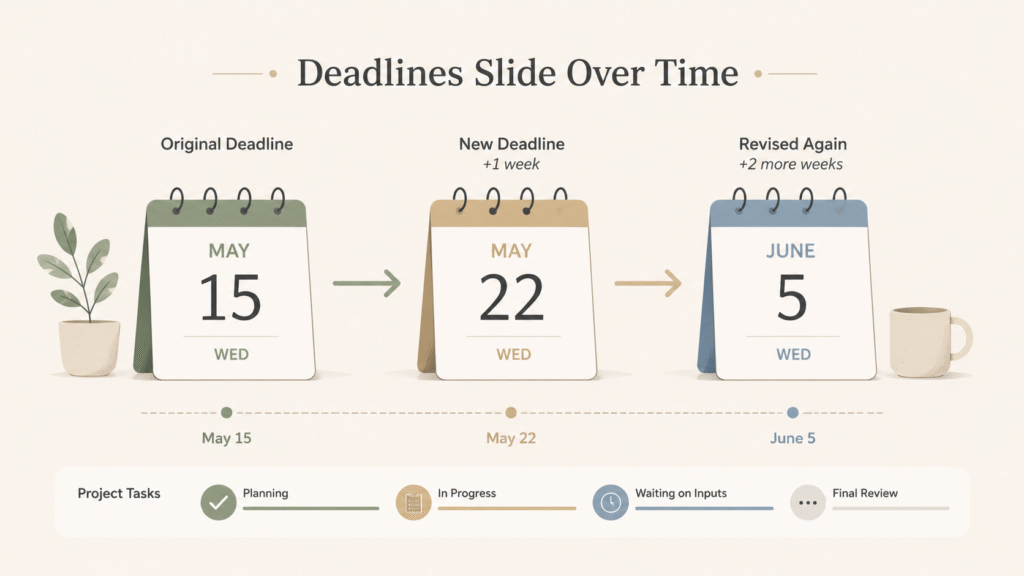
2. Deadlines keep sliding, just a little
A missed deadline here and there isn’t unusual. What’s worth noticing is when deadlines start drifting as a pattern, and the drift keeps getting normalized.
I think of a landscaping crew owner I know who used to promise clients a project completion date and hit it almost every time. Over about a year, “we’ll be done Friday” quietly became “we’ll be done by early next week,” and nobody on the team seemed to register the shift because each individual delay had a reasonable explanation. Weather. A supplier delay. A crew member out sick.
Individually, each excuse held up. Stacked together, they pointed to something else: the crew was booking more jobs than they could realistically finish on time, and nobody had adjusted the scheduling math to account for that.
Late deadlines are rarely about laziness or bad intentions. They’re usually about capacity, unclear priorities, or a scheduling system that was built for a smaller version of the business. If your delivery times have been quietly stretching, it’s worth asking whether you’re actually behind, or whether your estimating process stopped matching reality a while ago.
3. Customers who don’t come back, and you’re not sure why
This one is sneaky because sales can still look fine on the surface. New customers keep showing up. Revenue looks okay this month. But if you actually looked at your repeat customer rate over the last year, would it be going up, staying flat, or quietly dropping?
A woman I worked with sold handmade skincare products through a small online shop. Her monthly revenue looked stable for almost a year, so she assumed things were fine. When she finally pulled her order history, she realized her total customer count kept growing, but almost nobody was buying a second time. She was essentially running on a leaky bucket, replacing lost customers with new ones every month without noticing the leak.
New customers can hide a retention problem for a long time, sometimes long enough that fixing it becomes expensive. If customers aren’t returning, something in the experience isn’t matching what they expected, or the product delivered less value than the sale promised. That gap is worth naming early, not after growth slows down and there’s nothing left to mask it.
4. Decisions that keep getting pushed to “next week”
Every business owner delays a decision sometimes. That’s normal. What’s not normal is when the same decision keeps getting rescheduled, over and over, without anything changing about the information you’re waiting on.
This usually isn’t about laziness either. It’s often a sign that you don’t actually trust your own numbers, or you’re not clear enough on what “success” would even look like if you made the call. When the criteria for a decision are vague, postponing feels safer than choosing wrong.
If there’s a decision you’ve pushed off more than three times, ask yourself honestly what you’re actually waiting for. Sometimes you’ll realize you’re waiting for certainty that isn’t coming. Other times you’ll realize you don’t have the financial visibility to know if the decision is even a good idea, which points to a completely different gap than the one you thought you had.

5. Sales that have slowed down, without any obvious reason
This is the clue that tends to get the most panic and the least useful thinking behind it. Sales soften, and the instinct is to run a promotion, post more on social media, or drop the price. Sometimes that works. Often it just buys a few weeks before the same slowdown returns.
A slowdown with no clear cause is usually a symptom, not the actual problem. It can trace back to a marketing message that stopped matching who’s actually buying, a sales process with a step where people quietly disappear, or an offer that used to feel obviously worth the price and now feels like “maybe, I’ll think about it.”
The mistake I see most often is treating a sales dip as a marketing problem by default, when it’s just as likely to be a clarity problem, a pricing problem, or a follow-up problem. Guessing which one it is wastes time you don’t have.
A tailor I know spent almost two months boosting posts and offering discounts to fix a “marketing problem” that turned out to be something else entirely. Her leads were still coming in at roughly the same rate. What had changed was her close rate. People were inquiring, going quiet for a week, and then never responding to her follow-up message. The gap wasn’t visibility. It was a sales process with no plan for what happens after the first conversation. Once she built a simple two-touch follow-up, her numbers recovered without spending another dollar on ads.
These clues do not automatically tell you what to fix. They simply show you where to look. For a more structured check, you can use the Business Clarity Mini Diagnostic Tool to review eight key areas of your business.
Why small clues matter more than big alarms
None of the five signs above are emergencies by themselves. That’s exactly why they get ignored. A repeated mistake gets explained away. A slipping deadline gets blamed on a rough month. A quiet sales dip gets treated as “probably seasonal.”
But problems in a business almost never start big. They start as a small crack somewhere in customer understanding, offer clarity, sales process, marketing consistency, operations, financial visibility, or decision-making. Left alone, the crack doesn’t stay small. It widens, and it starts pulling other areas of the business down with it.
The good news is that once you know which area is actually cracking, the fix is usually smaller and less expensive than you’d expect. The hard part isn’t fixing the gap. It’s figuring out which gap you’re actually looking at, instead of guessing and fixing the wrong thing first.
I’ve watched business owners spend real money solving the wrong problem with total confidence. A new website when the actual issue was follow-up. A hiring decision when the actual issue was an undocumented process that would have broken the new hire too. Confidence isn’t the same thing as accuracy, and a diagnostic check is really just a way to slow down long enough to tell the difference.
If one or more of these signs felt familiar, do not rush into another random fix. Start with a simple check-up. Get the Business Clarity Mini Diagnostic Tool
And if you complete the diagnostic but still feel unsure what to prioritise, you can start with a focused clarity session: Book a Business Clarity Session
You don’t need to have this figured out today. You just need to stop guessing about where the real gap is, because that’s usually what’s costing you the most time and money.