How to Validate a Business Idea Before You Build It
Most people who start a business lose time and money on the same mistake: they build too soon.
They create a website, design a product, write a course, build an app, or map out a full marketing campaign, before they know whether real people care enough to pay for it. The idea sounded good. People said nice things. So they kept going.
Business idea validation is not about proving your idea is perfect. It is about collecting real evidence before you invest. It is about finding out whether the problem is real, whether people will pay, and whether you can actually reach them, before you build something no one asked for.
Done right, validation saves you months of effort and thousands of dollars. It also gives you the confidence to move forward when the signals are strong.
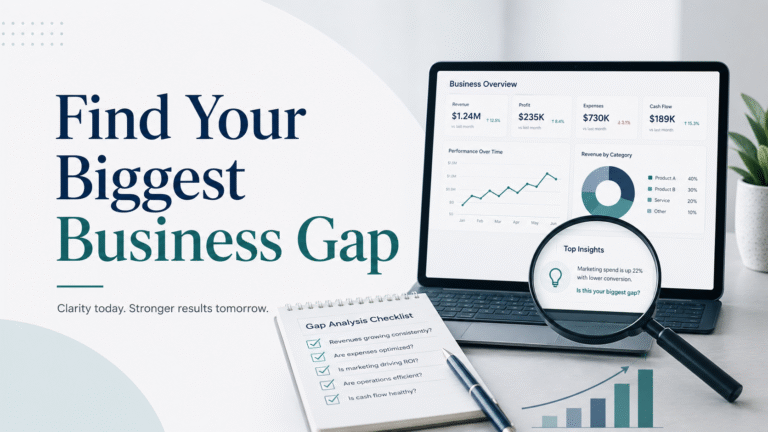
| Not sure if your idea is ready?Before you invest more time or money, take the Before you invest more time or money, take the Free Idea Validation Assessment to see where your idea is strong and where it still needs evidence. |
What Business Idea Validation Really Means
Validation means collecting evidence, not collecting opinions.
There is a big difference. Opinions are easy to get and easy to misread. Evidence takes more effort, but it tells you something real.
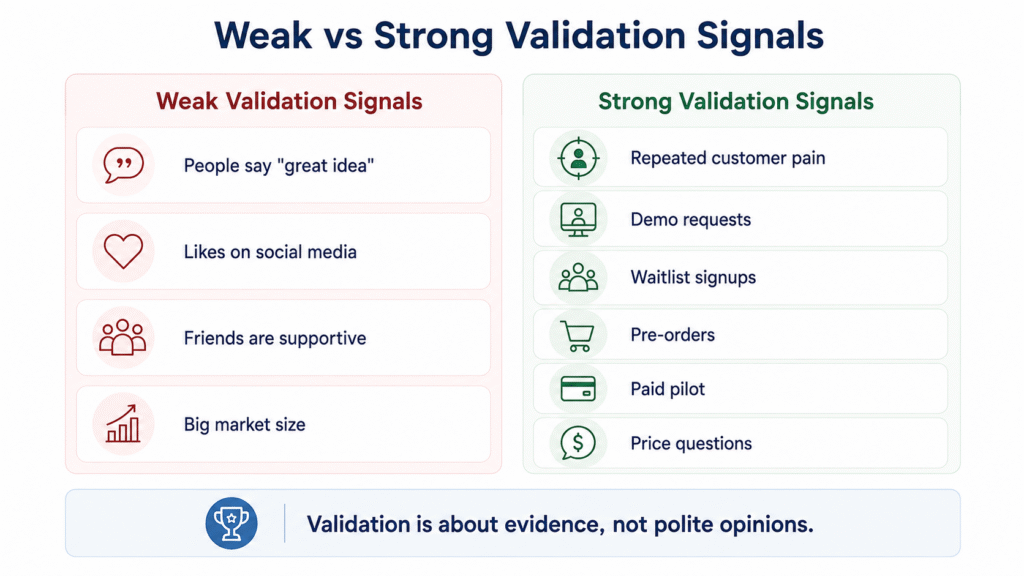
These are weak validation signals that feel good but don’t prove much:
- Someone says “great idea”
- A friend says “I would totally use this”
- A LinkedIn post gets lots of likes
- Family and colleagues are supportive
- You found a big market with lots of people in it
These are stronger signals that actually tell you something useful:
- Customers describe the problem in their own words during an interview
- You hear the same frustration repeated across multiple conversations
- People show you what they currently use to work around the problem
- Someone asks for a demo or requests early access
- People join a waitlist or pre-order before the product exists
- A customer pays for a pilot or early version
- Someone asks you how much it costs
The goal of business idea validation is to collect as many strong signals as you can, before you build the full solution.
Why You Should Validate Before You Build
Building feels productive. You can see progress. You can show people something. But building the wrong thing is one of the most expensive mistakes a small business owner can make.
Here is what happens when you skip validation:
- You spend money on tools, development, or design, then have to redo everything
- You spend months building something people don’t actually want
- Your offer is confusing because you never tested the message
- You launch to silence, no sales, no feedback, no momentum
- You attract the wrong customers because you never defined the right ones
- You add too many features because you were guessing what people needed
Testing first feels slower. It is actually much faster. You learn what matters early, when it is still easy to change direction.
Step 1: Clarify the Idea in One Sentence
A vague idea is almost impossible to test. If you cannot describe what you do clearly, neither can your potential customers.
Use this simple formula:
| I help [specific customer] solve [specific problem] so they can [specific outcome]. |
For example, instead of “I want to create a productivity app,” try:
“I help freelance designers manage client projects in one simple weekly dashboard so they can reduce missed deadlines and stop losing clients.”
If you cannot write that sentence clearly yet, that is your first validation gap. The Free Idea Validation Assessment can help you find it quickly.
Step 2: Define the Real Customer Segment
“Everyone” is not a customer segment. Neither is “small business owners” or “entrepreneurs.”
The more specific your segment, the easier it is to find them, talk to them, and create something they actually need.
Ask yourself:
- Who has this problem most often?
- Who feels the pain strongly enough to pay for a solution?
- Who already spends money or time trying to solve it?
- Who can you realistically reach?
- Who is most likely to act now, not someday?
The answers to these questions are the foundation of your validation process. If you are not sure who your ideal customer is, you are not ready to validate the product yet.
Step 3: Validate the Problem Before the Solution
Many people make the mistake of validating the solution too early. They show people a product mockup and ask, “Would you use this?”
The better first question is: “Is this problem real, painful, repeated, and important to the people I want to serve?”
In customer conversations, ask questions like:
- When does this problem happen? How often?
- What does it cost them, in time, money, or stress?
- What have they already tried to solve it?
- What happens if they do nothing and leave it unsolved?
- How urgent is it compared to other problems they face right now?
If the problem is real and painful, people will talk about it easily and in detail. If they struggle to explain it or say it is not that big a deal, that tells you something important.
| Still figuring out if the problem is real?The Free Idea Validation Assessment helps you identify exactly where your validation gaps are, so you know what to test next. |
Step 4: Look for Existing Alternatives
Competition is not always a bad sign. If people are already spending money to solve this problem, it means the problem is real enough to pay for.
Look for all the ways people currently deal with the problem you want to solve:
- Direct competitors with similar products or services
- Spreadsheets or manual workarounds they built themselves
- Hiring a person to do it for them
- Using a cheaper, simpler, or older tool
- Just living with the problem and doing nothing
“Doing nothing” is also a competitor. If people are not solving the problem at all, you need to understand why. Sometimes the problem is not painful enough to pay for. Sometimes the right solution just hasn’t existed yet.
Understanding alternatives tells you where you need to be meaningfully better, cheaper, simpler, or faster.
Step 5: Test Willingness to Pay or Commit
This is the step most people avoid, and it is the most important one.
People can like your idea without being willing to pay for it. Friendly feedback is not financial commitment. You need signals that go beyond words.
Look for these stronger commitment signals:
- Someone asks you how much it costs
- Someone joins a paid pilot or early access program
- Someone pre-orders before the product is finished
- Someone books a call or schedules a meeting
- Someone signs up for a waitlist and keeps following up
- Someone refers the idea to another person unprompted
| A common validation mistakeA consultant says people love her new offer. She gets enthusiastic responses in every conversation. But no one books a call. No one asks about the price. That is not validation, that is polite interest. It means the message, problem framing, price point, or target audience still needs more testing. |
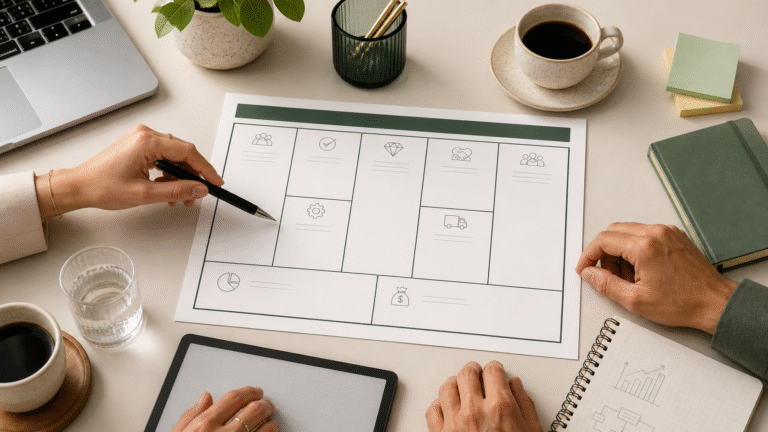
Step 6: Use the Business Model Canvas to See If the Idea Can Work as a Business
Once you know the customer is real and the problem matters, the next question is: can this idea actually work as a business?
This is where the Business Model Canvas becomes useful. It is a one-page visual tool that helps you map the full picture of your business model:
- Customer segments: who you are serving
- Value proposition: what problem you solve and how
- Channels: how you reach and deliver to customers
- Customer relationships: how you build and keep them
- Revenue streams: how you make money
- Cost structure: what it costs to run the business
- Key activities: what you must do to deliver value
- Key resources: what you need to have
- Key partners: who you need to work with
One important distinction: the Business Model Canvas does not replace validation. It organizes your assumptions and helps you see which parts of the business model are still untested.
Use it after you have gathered early evidence on the customer and problem, not as a substitute for talking to real people.
| Ready to map your business model?Download the Free Business Model Canvas Template or get the Business Model Canvas Playbook to map the full model step by step. |
Step 7: Identify the Riskiest Assumption
Every business idea is built on assumptions. Most of them feel obvious — until you test them and find out they are wrong.
Common assumptions that turn out to be false:
- Customers have this problem (they may not experience it the same way you think)
- Customers care enough to pay for a solution (they may prefer to live with it)
- I can reach them through LinkedIn or email (maybe they are not there)
- They understand my value proposition immediately (often they do not)
- The price I want to charge is acceptable to them
- I can deliver the promised result and still make a profit
The goal is not to test everything at once. It is to find the single assumption that would break the entire idea if it turns out to be false, and test that one first.
Step 8: Run a Small Validation Test
A validation test is not a full product launch. It is the smallest experiment that gives you useful information.
Here are practical examples of small validation tests:
- A simple landing page that describes the offer and collects signups or pre-orders
- A waitlist that shows demand before you build anything
- 5 to 10 structured customer interviews
- A paid pilot with 2 or 3 early clients at a reduced rate
- A pre-sale or deposit to confirm real intent
- A demo call to present the concept and measure response
- A simple manual version of the service before you automate anything
- A LinkedIn post that describes the problem and measures engagement
- A prototype or mockup review with real potential customers
The goal is not perfection. The goal is learning, before you build the full solution and commit your time, money, and energy.
Step 9: Make a Decision Based on Evidence
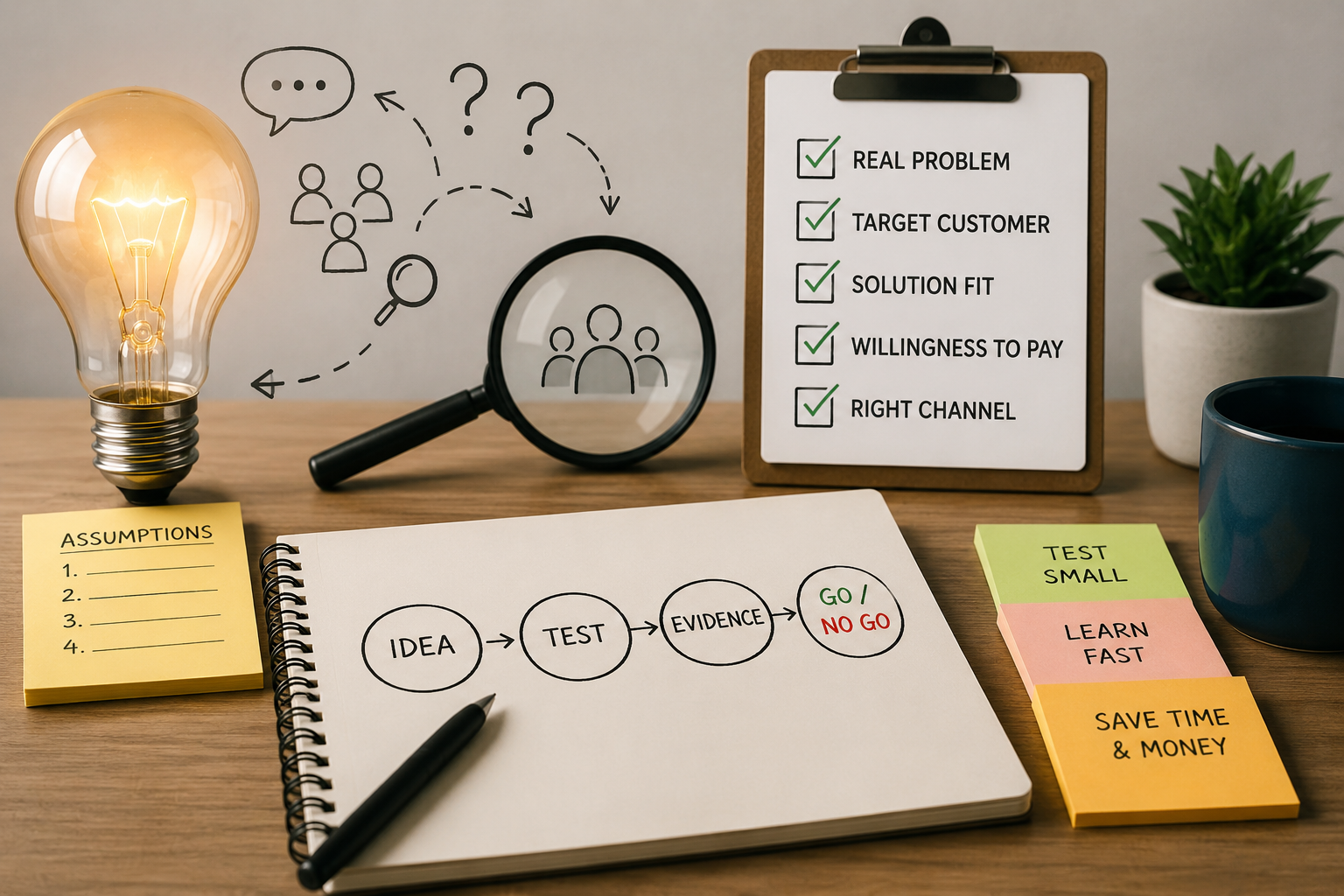
After your validation tests, you have four possible directions:
- Continue: the signals are strong, the problem is real, people are willing to pay, and the model can work. Move forward with more confidence.
- Adjust: some signals are positive but others are unclear. Change the customer segment, the offer, the price, or the message and test again.
- Test again: you did not get enough information. Run a different experiment with a clearer focus.
- Pause: the signals are weak, the problem is not urgent enough, or the business model does not work. Stepping back now is not failure. It saves months of effort.
Pausing is one of the most strategic decisions a founder can make. It protects your time, energy, and money for an idea that actually works.
| Want a structured way to score your idea?The Business Idea Validation Playbook gives you a scoring system and checklist to evaluate idea clarity, customer segment, problem evidence, alternatives, value proposition, willingness to pay, channel fit, business model, risks, and MVP test plan. |
Free vs Paid Resource: Which One Should You Use?
Depending on where you are in the process, here is a simple way to choose the right resource:
| Resource | Best For | Cost |
| Free Idea Validation Assessment | Quick first diagnosis of your idea — see your strengths and gaps fast | Free |
| Business Idea Validation Playbook | Deep workbook with scoring system, red flags, risk mapping, and action plan | Paid |
| Free BMC Template | Visual map of your business model — great once your idea has traction | Free |
| Business Model Canvas Playbook | Step-by-step guide to building a complete, structured business model | Paid |
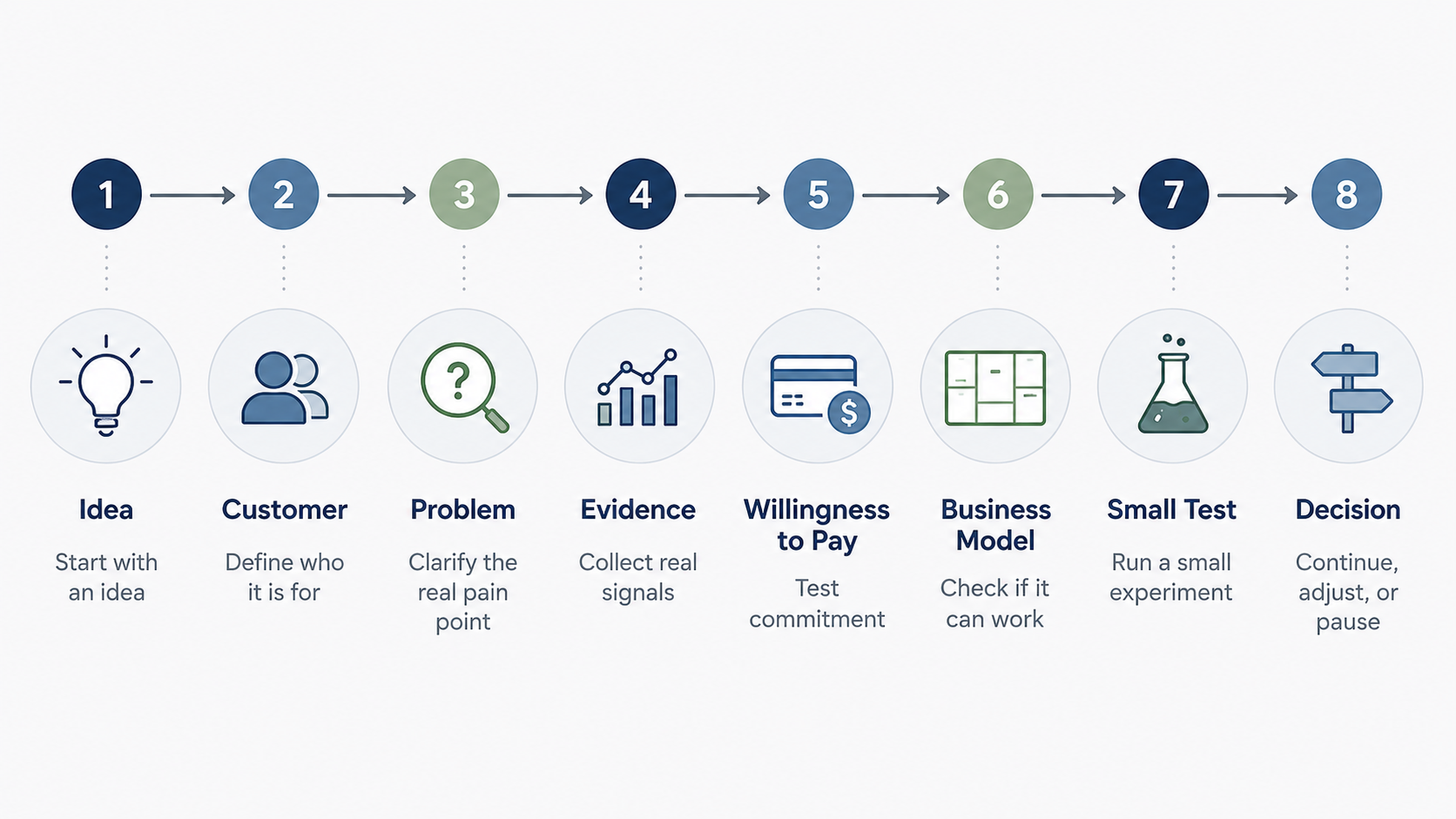
The Validation Flowchart
Use this visual as a quick reference for the full validation process:
Final Thoughts
You do not need to validate everything before you start. But you should validate the biggest risks before you build too much.
The most successful small business owners, freelancers, and consultants are not the ones with the best ideas. They are the ones who test fast, learn quickly, and adjust before the cost of being wrong gets too high.
Business idea validation is not about being cautious. It is about being smart with your time and your money, so that when you do build, you build something people actually want.
| Ready to validate your idea?→ Take the Free Idea Validation Assessment : find your biggest validation gap in minutes.→ Get the Business Idea Validation Playbook : a deeper workbook with scoring, red flags, risk mapping, and your next smart test.→ Download the Free Business Model Canvas Template — or get the Business Model Canvas Playbook to turn a validated idea into a complete, structured business model. |