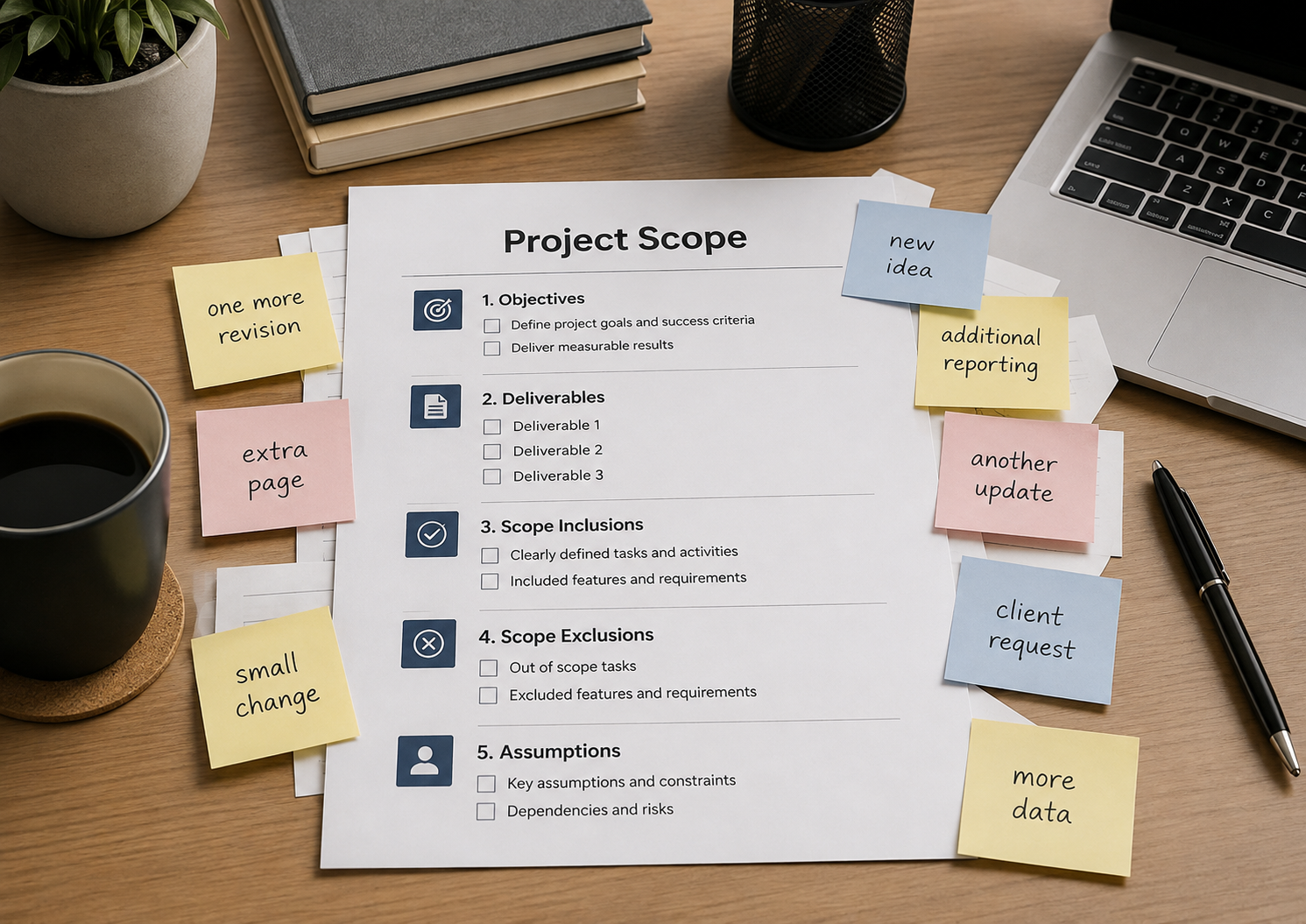
How to Prevent Scope Creep Before It Eats Your Profit
If a project that was supposed to take two weeks has turned into a month of work without a single extra dollar added to the invoice, the problem may not be a difficult client.
It probably started somewhere nobody formally talked about: the boundaries of the project.
That is what scope creep looks like. The work you originally agreed on slowly expands without anyone consciously deciding to expand it, until it becomes difficult to say exactly where the extra work began.
In this article, we will look at where that leakage starts, what it is really costing your business, and how to prevent it before the project begins without making clients feel like you are being cold, rigid, or unnecessarily formal.
Scope Creep Does Not Start in the Middle of a Project. It Starts at the Agreement
One thing many service business owners miss is that scope creep is rarely caused by one specific moment.
A client does not usually wake up one morning and decide to become unreasonable or start making excessive requests. Scope creep is often the result of an earlier decision: starting a project without defining the deliverables clearly enough.
Imagine a graphic designer agrees to create a “visual identity.”
That phrase may feel perfectly clear to the designer. To the client, however, it might include a logo, business cards, Instagram templates, billboard designs, and even an email letterhead.
Neither side is necessarily being dishonest or taking advantage of the other.
The client is simply building their own interpretation around the words you used.
When deliverables are not written in precise terms from the beginning, both sides start the project with a different picture in mind. The gap between those two pictures is exactly where extra work begins to leak into the project.
Five Places Where Extra Work Enters a Project
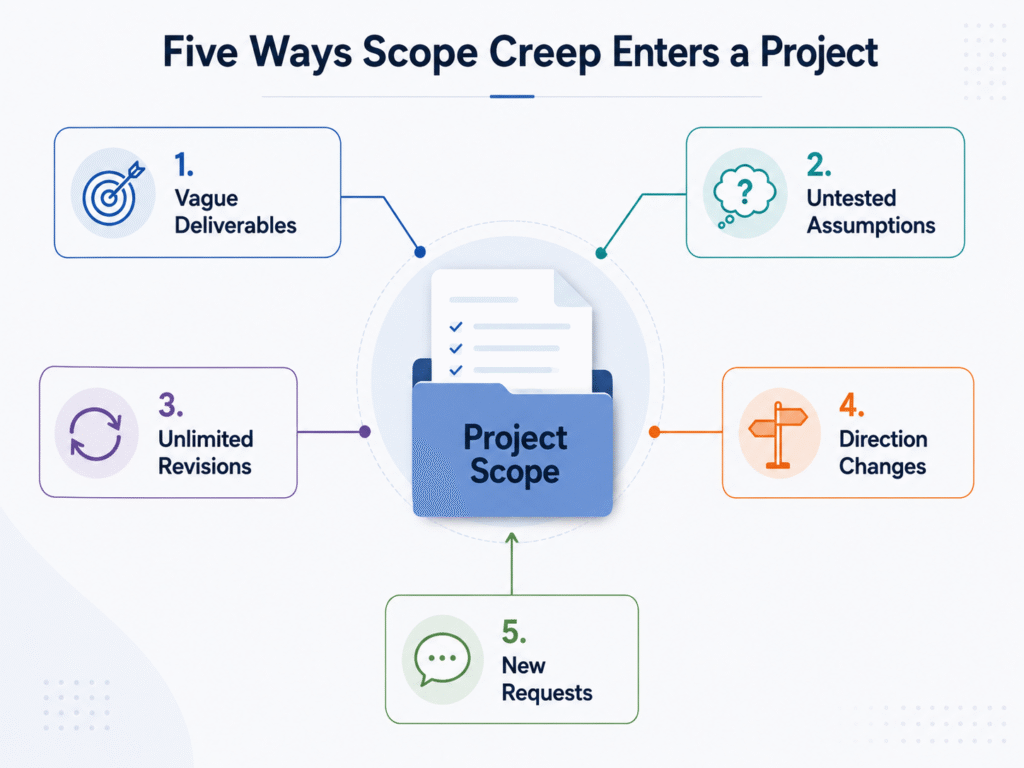
After years of working with service business owners, I see the same five entry points appear again and again.
Vague deliverables.
Phrases such as “website design” or “social media management” do not define much on their own. How many pages? How many posts per month? How many rounds of revisions?
Untested assumptions.
You assume the client will provide the copy and images. The client assumes you will create or source them. Neither side says the assumption out loud.
No revision limit.
If you never say “two rounds of revisions are included,” the client may reasonably assume revisions are unlimited. Why would they think otherwise if nobody has defined the limit?
Ignoring changes in direction.
There is a major difference between “Can you make this colour slightly lighter?” and “I have a new idea. Can we change the entire concept?”
If that difference has not been defined in advance, both requests can easily be treated as if they were the same kind of revision.
No formal path for new requests.
A client sends you a quick message saying, “By the way, there is one small thing…”
You answer, “Sure, no problem.”
At that moment, you may have accepted a new piece of work without changing the scope, price, or agreement.
The Real Cost of Scope Creep Is Bigger Than the Extra Hours
Many business owners treat scope creep as a minor inconvenience.
A few extra hours. An extra task. Nothing serious.
But the real cost goes much deeper than what appears on your timesheet.
First, it destroys project profitability.
If you priced a project based on a 30% profit margin and then spend 40% more time delivering it than expected, that margin no longer exists. The project may even become unprofitable.
Second, it distorts the way you price future projects.
You start making pricing decisions based on the hours you actually spent rather than the work that was originally agreed upon.
If project boundaries keep changing, you never get reliable information about how long a particular type of project really takes or what you should be charging for it.
Third, there is burnout.
A project you started with energy and enthusiasm gradually becomes work you resent.
What makes this worse is that the resentment often gets directed toward the client, even when the client has not technically done anything wrong. They have simply stepped across a boundary that was never clearly defined in the first place.
Questions You Should Answer Before Every Project Starts
This is usually the point where advice about scope creep turns into “write a stronger contract.”
But a stronger contract is not very useful if the project itself was never clarified first.
Before you even send the proposal or quotation, make sure you and the client can answer these questions:
- What exactly is the final deliverable? Not “logo design,” but “three initial concepts, two revision rounds, and final files supplied in PNG and AI formats.”
- How many rounds of revisions are included in the price, and what will additional revisions cost?
- How long after final delivery can the client request changes without an additional fee?
- Who is responsible for supplying copy, images, or other source material? What happens to the timeline if those materials arrive late?
- If the client changes direction halfway through the project—not a minor revision, but a new concept—how will that request be treated?
- How will out-of-scope work be priced: hourly, as an additional package, or as part of a separate project?
If you cannot answer all of these questions right now, that is probably where scope creep is waiting to enter your next project.
Three Simple Columns That Make Project Scope Clear
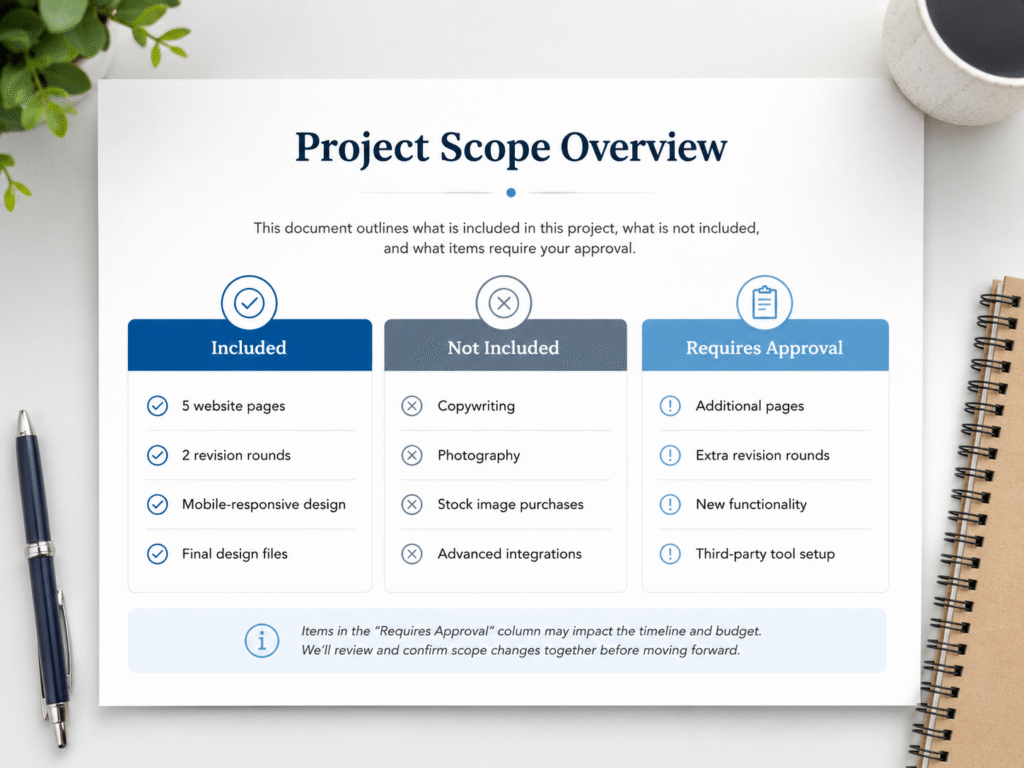
One simple tool I often recommend to clients is dividing the proposal into three clear sections instead of using one broad paragraph to describe the work.
Included.
Everything covered by the quoted price, listed with specific quantities and details.
Not included.
Anything the client might reasonably assume is part of the package but is not.
For example, a video editor might state: “Raw project files are not included. Only the final rendered video will be delivered.”
Requires approval.
Work that may become necessary during the project but cannot be predicted in advance. If it comes up, it needs to be priced and approved separately before work begins.
When these three sections are clear from the start, the client knows exactly what they are buying.
They also understand that if they ask for something beyond that scope, an additional fee is not a surprise or a sign that you are being difficult. It is simply part of the agreement you already made.
A Change Request Process That Takes Three Minutes, Not Three Days
A lot of small business owners dislike the phrase “formal process” because it sounds like bureaucracy and paperwork. It does not have to be.
A good change request process can be as simple as four steps. The client sends the request in writing. Even a short message is enough.
You reply the same day, or by the next business day, with an estimate of the additional time and cost. The client approves the change in writing before the work begins.
Once approval is received, you start the additional work. The important part is that the process should not feel punitive or overly rigid.
It should feel like a normal part of working together, not like a wall you suddenly put between yourself and the client.
What to Say When a Client Asks for Extra Work
Many business owners worry that saying “this is outside the scope” will make them sound difficult, inflexible, or greedy. In practice, most clients respond well when the message is clear and respectful. A simple response like this is usually enough:
“That is a great idea. This part falls outside what we originally agreed on, but I can add it as additional work for [amount]. Or, if you prefer, we can include it in the next phase of the project.”
There is no apology in that sentence and no defensiveness. You are simply stating the situation clearly and respectfully. A client who genuinely was not trying to take advantage of you will usually see this as completely reasonable.
And a client who regularly pushes boundaries will quickly understand that additional requests no longer automatically become unpaid work.
One Final Thought
Scope creep is often a symptom of a bigger problem rather than the problem itself. Sometimes the real issue is simply unclear project boundaries.
But sometimes the root cause is somewhere else: pricing that was wrong from the beginning, an offer that was too broadly defined, or the absence of a process that keeps the rest of the business organised.
Until you identify that root cause, even the strongest contract may only hide the symptom rather than solve the underlying problem.
If this article made you realise that your challenge goes beyond project scope, it may be worth looking at the wider structure of your business.
A useful next step is How to Scale Your Service Business with Templates and Automation, where I explain how to make your processes more repeatable and less dependent on memory, improvisation, or how organised you happen to feel that day.
And if you would rather have someone outside the business look at the situation and help identify where the real problem sits—scope, pricing, offer design, or the way the work itself is structured—you can complete the free pre-consultation assessment.
I review the responses myself and send you a short email with my initial observations and a suggested next step.
There is no obligation to continue. It is simply a small first step toward seeing your business more clearly.