Why Is My Business Profitable but Still Short on Cash?
You open your books and the business is profitable. You open your bank account and there’s barely enough to cover this week’s payroll. If you’ve typed something like “business profitable but no cash” into Google late at night, you’re not imagining the gap, and you’re not doing anything obviously wrong. You’re just looking at two different questions and expecting them to give you the same answer.
Profit and Cash Are Answering Two Different Questions
Profit tells you whether the business earned more than it spent over a period. Cash tells you what money has actually moved in and out of your account. If you use accrual accounting, revenue can be recognised when it’s earned even if the client hasn’t paid yet. That means your profit and loss statement can be completely accurate while the cash in your bank account tells a very different story this week.
I’ve sat with owners who were convinced their bookkeeper had made a mistake because the numbers “didn’t match.” Usually nothing was wrong with the books. The P&L was just built to answer a different question than the one they were actually asking, which was: can I pay everyone on Friday?
Where the Gap Actually Comes From
The mismatch isn’t random. It comes from a handful of specific, predictable places, and once you can name them, they stop feeling like bad luck.
Invoice Timing and Payment Terms
Net 30 sounds simple until you’re the one waiting on it. You finish a project in June, invoice immediately, and the client pays in July, sometimes later if they’re slow or the invoice gets stuck in someone’s approval queue. The revenue counted in June. The cash shows up in July or August. Everything you paid out in June, to your team, your suppliers, yourself, had to come from somewhere else.
And this is the part that trips people up: growth makes the gap worse before it makes it better. If you land two more projects next quarter, you’re spending more on labor and materials right now, in the weeks before those new clients pay. Your revenue line goes up, which feels like progress, and your cash position gets tighter at the same time, which feels like a contradiction. It isn’t. You’re just financing your own growth out of pocket for 30 to 60 days at a time, and nobody warned you that’s what “scaling up” actually costs in the short term.
Deposits Versus Full Project Value
A lot of businesses collect only a portion of a project’s value up front and the rest on delivery or later. That structure can work perfectly well, but it creates a timing issue: you may need to pay for labour, materials, software, or subcontractors long before the final payment arrives. Even when the project is profitable overall, the cash available while you’re delivering it can be much tighter than the project value suggests.
Expenses That Don’t Wait for Income
Payroll runs on its own schedule. So does rent, so do loan payments, so does that supplier who wants payment on delivery instead of net 30 like everyone else. None of these care whether your customer has paid you yet. They happen when they happen, and if that date lands before your cash-in date, you feel a squeeze that has nothing to do with whether the business is actually doing well.
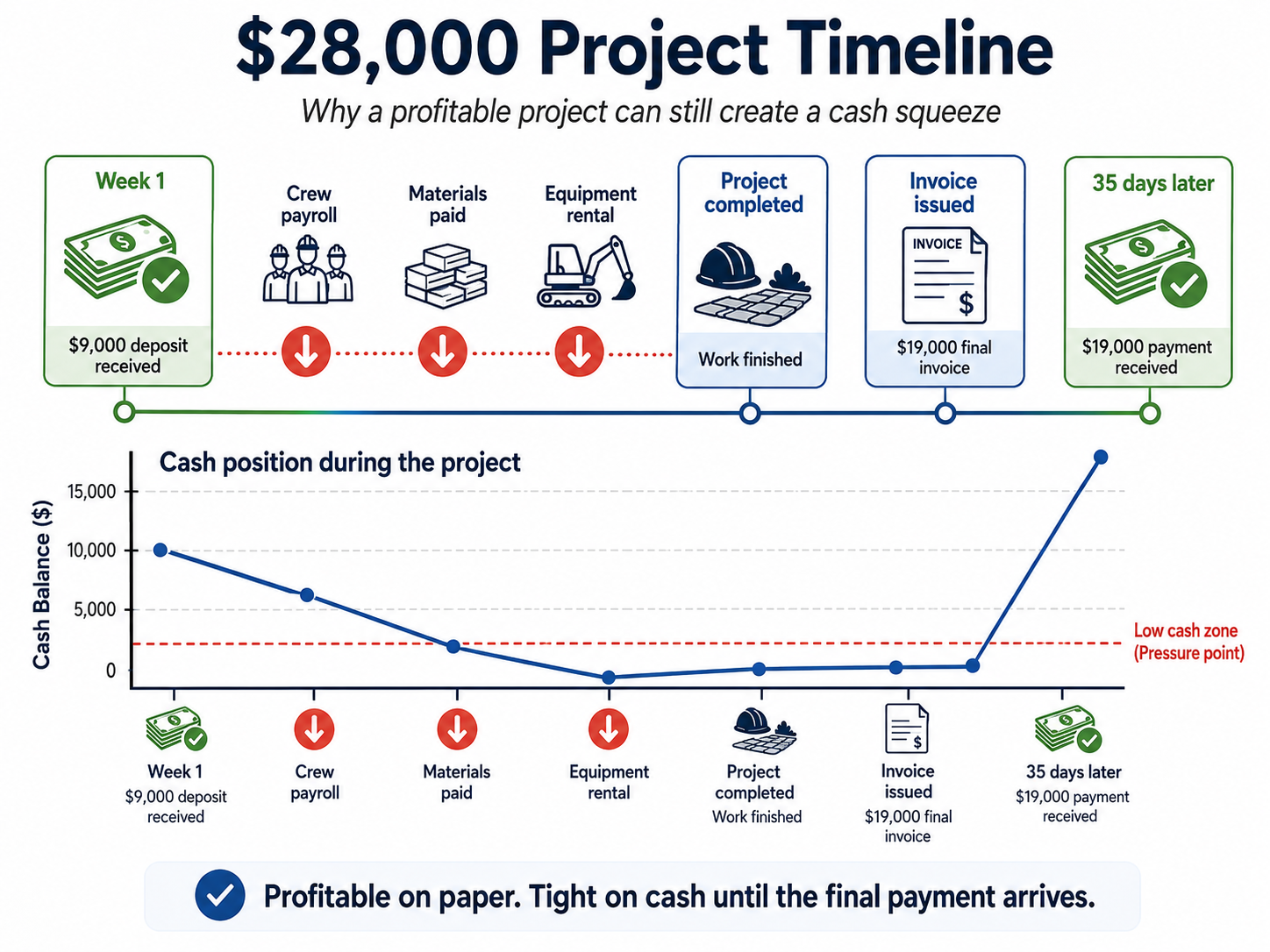
Here’s a concrete version of this. A residential hardscaping company lands a $28,000 patio and retaining wall project. They collect a $9,000 deposit up front, invoice the remaining $19,000 on completion, and the client pays it 35 days later, which is actually reasonable for that industry. Meanwhile, the crew gets paid weekly, the stone and gravel supplier wants payment on delivery, and the equipment rental is due before the job even starts. On paper, that project is profitable the day it’s finished. In the bank account, it’s a net cash outflow for over a month before the real payment clears. Multiply that by three or four overlapping projects at different stages, and you get exactly the kind of week where a profitable business can’t confidently cover its bills.
Why the Monthly P&L Doesn’t Warn You
Most financial reports are built around the month or the quarter, which is useful for taxes and for understanding trends, but it flattens out the exact thing that’s causing the stress. A month can average out fine even when week two of that month was genuinely dangerous. You don’t feel the average. You feel the week. And most owners have no report that shows them the week until they’re already living inside the tight one.
Your accounting software may already include some cash-flow forecasting tools. But that doesn’t necessarily mean the reports you look at every month are answering the question you actually have. A profit and loss statement tells you about financial performance over a period. It doesn’t automatically tell you whether you have enough cash on the 14th to cover payroll and the supplier invoice due the same day. You can have clean books and a healthy-looking P&L and still miss a short-term squeeze if you’re not looking specifically at when cash is expected to move.
What Not Seeing This Actually Costs You
This isn’t a small, technical accounting detail. SCORE has cited a U.S. Bank study attributing 82% of business failures to poor cash flow management. Separately, a JPMorgan Chase Institute study using data from 597,000 small businesses found that the median small business held just 27 cash buffer days in reserve. When the cushion is that limited, even a relatively short mismatch between when money comes in and when bills are due can create real pressure.
When you can’t see the gap coming, you end up making decisions under pressure instead of with a plan. That usually looks like putting a supplier payment on a credit card and eating the interest, calling a client to ask for early payment in a way that feels awkward for both of you, delaying a hire you actually need, or quietly not paying yourself that month so payroll clears for everyone else. Sometimes it’s smaller and just as corrosive: pushing back a marketing spend that was actually working, or turning down a piece of new work because you’re not sure you can carry the upfront cost of it, even though the project itself would have been fine.
None of these decisions are dramatic on their own. Repeated often enough, they wear down your relationships with vendors, your team’s trust that things are stable, and honestly, your own confidence in a business that is, on paper, doing fine. There’s also a quieter cost that doesn’t show up on any statement: owners who get burned by this a few times start avoiding their own financials altogether, because opening the books starts to feel like bad news waiting to happen. That avoidance is usually what turns a manageable timing gap into a real crisis, simply because nobody was watching it closely enough to catch it early.
A Narrower View: What the Next 12 Weeks Actually Look Like
The fix isn’t a better annual budget or a more detailed monthly report. Those still average things out. What actually helps is a week-by-week view, close enough to the present that you can see specific pressure points instead of a general trend.
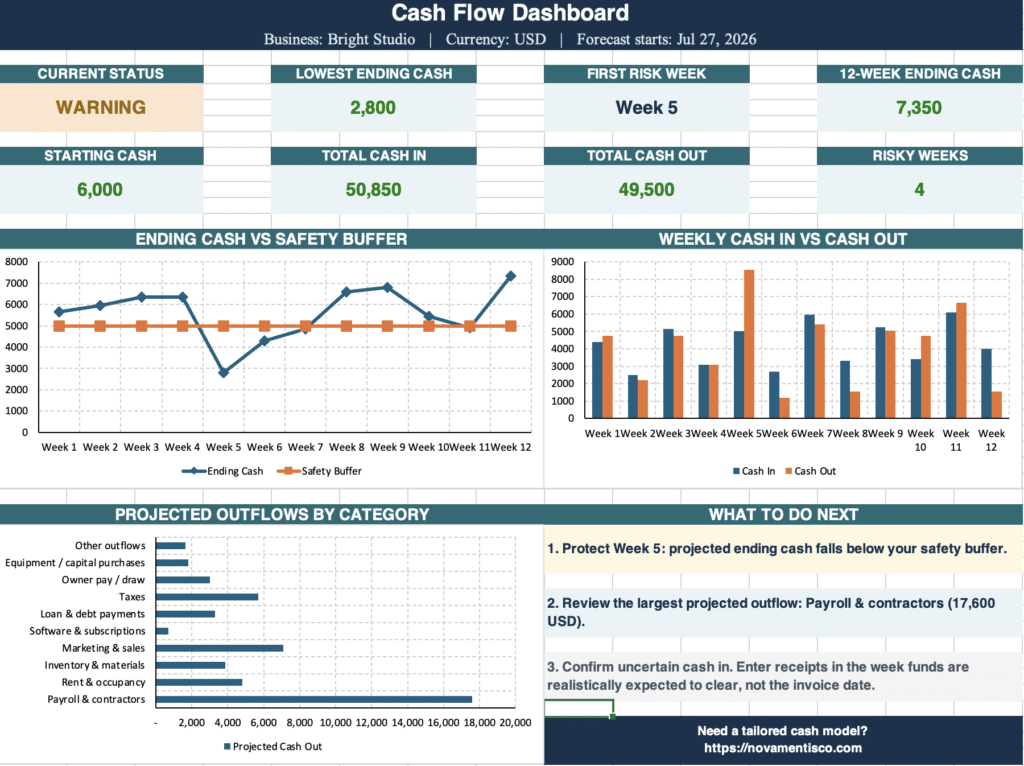
A simple 12-week forecast lines up, week by week, what cash you expect in (client payments, deposits, cash sales) against what cash you know is going out (payroll, rent, suppliers, loan payments, taxes). You start with what’s actually in the bank today, not a projected number, and you set a safety buffer, the minimum you don’t want to fall below. From there it’s just addition and subtraction, one week at a time, twelve weeks out.
What you get on the other end is genuinely different from a monthly report. You get a specific first week where your cash might dip below that buffer, a clear read on which category (payroll, a tax payment, a supplier bill) is putting the most pressure on that week, and enough runway to actually do something about it before it arrives. That’s the whole point. It doesn’t tell you whether the business is a good idea. It tells you whether you need to make a phone call to a client this week, move a purchase back ten days, or simply relax because the numbers hold up once you look closely. Most owners who build this out for the first time find the real gap is smaller and more specific than the vague dread they were carrying around. The stress was partly about not knowing which week, not the business itself.
What This Kind of Forecast Isn’t
To be direct about it: a 12-week cash view is not a substitute for your accountant, and it’s not tax, legal, or financing advice. It won’t tell you whether to take out a loan or restructure your pricing. What it does is give you visibility, the specific, dated kind, so that when you do need to have one of those bigger conversations, you’re having it three weeks early instead of the day before payroll is due.
If you’re thinking “I already use accounting software, isn’t that the same thing,” it’s a fair question. Some accounting platforms now include cash-flow forecasting features, so you may already have part of this capability. The useful distinction isn’t really software versus spreadsheet. It’s historical reporting versus deliberately looking forward, week by week, at when cash is actually expected to move. A simple 12-week forecast gives you one focused place to make those assumptions visible and adjust them as reality changes.
And if the hesitation is “I’m not a numbers person,” you don’t need to be. There’s no formula to learn and no finance background required. It’s addition and subtraction, one week at a time, using numbers you already know: what you’re owed, what you owe, and roughly when each of those will hit the bank. The skill isn’t math. It’s being honest with yourself about timing instead of hopeful about it.
Where to Go From Here
If any of this sounds familiar, the most useful thing you can do this week isn’t to overhaul your whole financial system. It’s to build one simple, forward-looking view and see what it tells you. I put together a free 12-Week Cash Flow Forecast that walks you through exactly this: enter your starting cash, your expected payments in and out by week, and it shows you your first risky week, your lowest point, and which category is putting the most pressure on your cash. It takes an afternoon, not a course.
Once you have that visibility, the next question most owners ask is how to stop living so close to the edge in the first place, which is a slightly different problem involving how much of a cushion you actually need and how to build it without starving the business of investment. I go into that in Cash Flow vs Cash Cushion: Building Stability into Your Service-Based Business.
But that’s a next step, not this one. This one is simpler: stop guessing which week is going to be tight, and start knowing.