Planning for Seasonal Slowdowns: Keep Your Business Moving in Lean Months
Every business owner I work with eventually asks some version of the same question. “Is it normal that my sales just stop for a few months?” They usually ask it with a slightly panicked look, like they just discovered their business has a flaw nobody warned them about. It doesn’t. Almost every business has a slow season somewhere on the calendar. The real problem isn’t that sales dip. It’s that most owners never plan for a seasonal slowdown until they’re already standing in the middle of one, wondering where the money went.
I’ve watched this play out the same way more times than I can count. A landscaping company owner spends spring and summer buried in work, barely has time to check email, and then November hits and the phone goes quiet. The stress that felt like “we’re too busy to think about this” in July suddenly becomes “why didn’t we think about this in July” by November. Same business. Same predictable pattern. Different reaction, only because nobody wrote anything down.
This article is about breaking that cycle. Not with vague encouragement to “stay positive during slow months,” but with an actual plan you can build before the dip hits, so the quiet season becomes something you manage instead of something that manages you.
Why Seasonal Slowdowns Catch Business Owners Off Guard
Most seasonal businesses aren’t actually unpredictable. A swim school knows summer will be packed and January will be quiet. A wedding photographer knows June and October bring bookings and February barely does. A holiday decor shop knows exactly which twelve weeks carry the whole year. The pattern is rarely a mystery. What’s missing is a system that turns that known pattern into decisions made in advance.
Busy season has a way of swallowing attention completely. When you’re fully booked, “planning for the slow months” feels like a problem for future you. Future you, unfortunately, is dealing with the actual slow month and has even less time and a lot more anxiety. Planning during the calm before the dip is uncomfortable because there’s no urgency yet. Planning during the dip is uncomfortable because there’s too much.
The fix isn’t motivation. It’s building the plan at the only point where you actually have the bandwidth for it, which is usually right when business is good.
Step 1: Look at Your Own Numbers, Not Assumptions
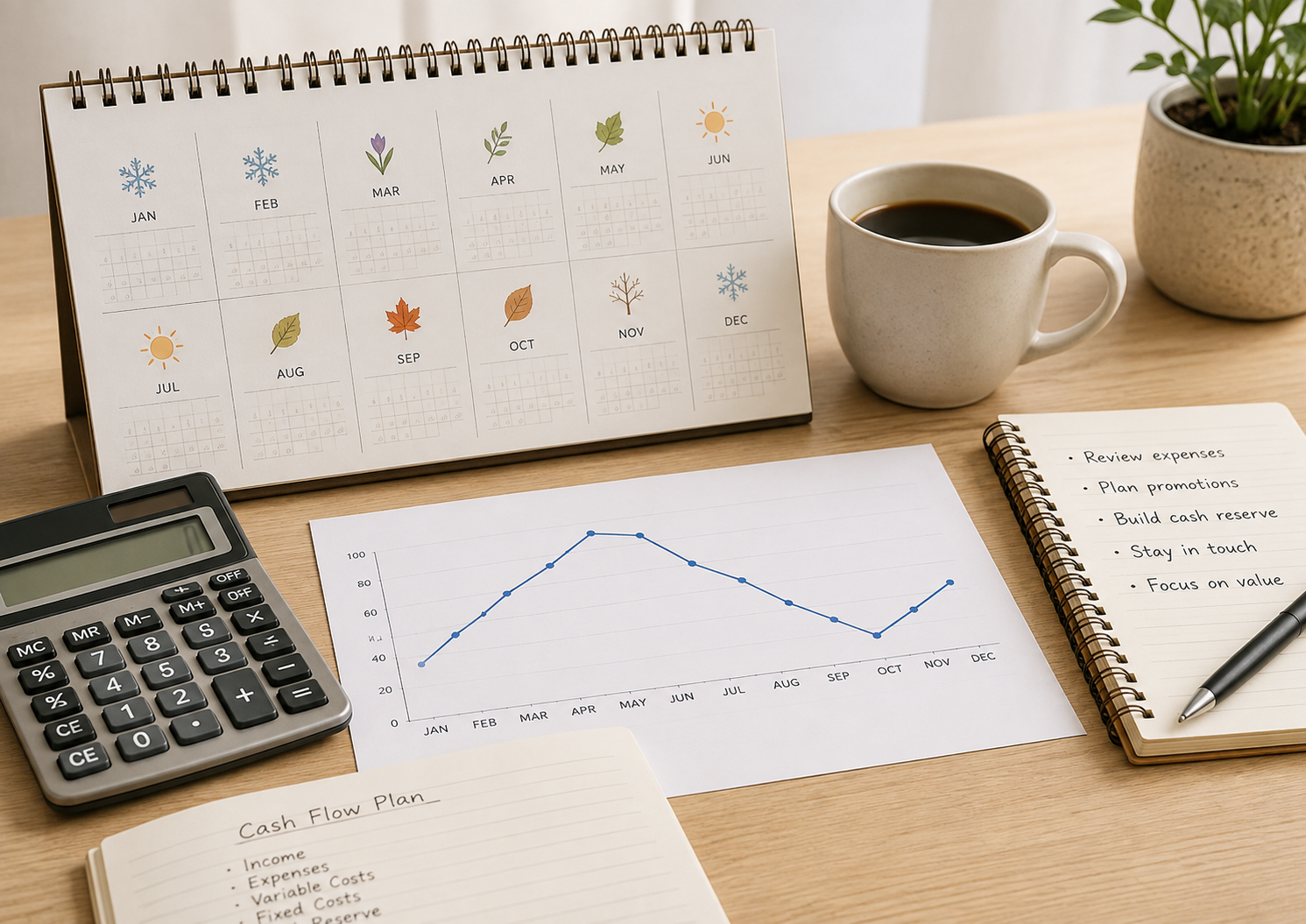
Before building any kind of seasonal plan, pull your actual sales data from the last 12 to 24 months. Not your gut feeling about “the slow season,” your real numbers, month by month. Owners are often surprised by what they find. Sometimes the slowdown they’ve been dreading for years is actually two rough weeks, not two rough months. Sometimes there’s a second, smaller dip nobody had noticed because they were too focused on the big obvious one.
Mark the months where revenue drops below your monthly average. Those are your true slow months, and they’re the ones you build a plan around, not the ones you assume based on how the year “feels.”

Step 2: Build Your Cash Buffer Before You Need It
This is the part everyone knows they should do and almost nobody actually does until they’re forced to. If your slow season historically costs you, say, 30% of a normal month’s revenue, that gap needs to come from somewhere. Either you set aside a cushion during the strong months, or you scramble to cover it during the weak ones, usually with a credit line, a discount campaign, or both.
For example, if your average monthly revenue is $10,000 and it usually falls to $7,000 during a three-month slow season, you are looking at a potential $9,000 revenue gap. You may not need to replace every dollar, but seeing the full gap helps you decide how much to save, which expenses to reduce, and whether you need an additional source of revenue during those months.
A simple rule that works for a lot of the business owners I’ve worked with: during peak months, set aside a fixed percentage of revenue into a separate account, treated the same way you’d treat a tax payment. Not optional, not “if there’s extra.” By the time the slow month arrives, the buffer is already sitting there instead of being something you’re trying to build from scratch while sales are already falling.
I go into this cash flow pattern in more depth in Feast or Famine Revenue, including how to figure out the right percentage for your specific business instead of guessing.
Step 3: Adjust Your Marketing Before the Dip, Not During It
Most businesses run the same marketing all year and then wonder why it stops converting the moment demand naturally drops. If nobody is searching for lawn care in January, no amount of ad spend on lawn care in January is going to fix that. The smarter move is to shift what you’re marketing, not just how hard you’re marketing it.
A few directions worth considering ahead of a known slow season:
- Shift the offer. A landscaping business can promote spring planning consultations in the winter instead of trying to sell mowing services nobody needs yet.
- Shift the audience. A wedding photographer’s slow season for new bookings can become the busy season for selling albums and prints to last year’s couples.
- Shift the channel. If paid ads get expensive and low-converting during your dip, that’s often the right window to lean harder into email, referrals, or past client outreach instead.
None of this works if it’s decided in the middle of the slow month. It has to be planned while you’re still busy, so it’s ready to go the moment demand starts turning down.
Step 4: Use the Slow Months on Purpose
Here’s the part that gets skipped the most, and it’s the one with the biggest long-term payoff. Slow months are the only stretch of the year most business owners have any real space to work on the business instead of just in it. That’s the window to update your processes, clean up your client onboarding, fix the parts of your workflow that have been held together with sticky notes since your busy season three years ago.
A photography studio owner I know spent her first two slow winters anxious and half-working, checking her phone constantly for bookings that weren’t coming. By her third year, she’d flipped it. Winter became the season she rebuilt her entire client intake process, renegotiated her supplier contracts, and finally organized five years of digital files that had been a mess since she started. Same slow season, completely different result, because she had a plan for the time instead of just waiting through it.
Your slow-season project list does not need to be ambitious. Choose two or three improvements that will make the next busy season easier, such as:
- Documenting one recurring process
- Improving your client onboarding
- Reviewing supplier costs and contracts
- Organizing business files and templates
- Preparing marketing content for the next peak season
The goal is to finish a few useful improvements, not fill every quiet week with more work.
If you don’t already have a short list of “things I’ll fix when I have time,” the slow season is exactly when that list should get made, and used.

Step 5: Don’t Panic-Discount Your Way Through It
When revenue drops, the instinct for a lot of owners is to slash prices and hope volume makes up the difference. Sometimes it does. Often it just trains your customers to wait for the discount every year, which quietly turns your slow season into a self-fulfilling cycle. If people know March always brings 30% off, why would they ever book in February at full price?
A better instinct, if you want to offer something during the dip, is to add value instead of removing price. A bonus service, a longer session, an extra deliverable, something that costs you less than a straight discount but still gives the customer a reason to buy now rather than waiting.
For example, a photographer might include five additional edited images instead of reducing the session price by 20%. A consultant might add a short follow-up call rather than discounting the main service. The customer receives something useful, while the business protects the value of its core offer.
Before Your Next Slow Season
You do not need a complicated seasonal strategy to get started. Before your next expected slowdown:
- Review the last 12 to 24 months of revenue
- Identify the months when sales usually fall
- Estimate the potential cash gap
- Start building a reserve during stronger months
- Prepare a seasonal offer or marketing shift
- Choose two or three internal projects for the quiet period
Even a simple version of this plan gives you better options when demand begins to slow.
The Real Point of Planning for a Slowdown
None of this is about eliminating your slow season. Some businesses are seasonal by nature, and that’s fine. The point is making sure the slow months are something you walk into on purpose, with a cash cushion already set aside, a marketing shift already planned, and a short list of things you’re going to fix while you finally have the time. That’s the difference between a business that survives its slow season and one that actually uses it.
If seasonal revenue changes make it difficult to plan ahead, start with my article on Feast or Famine Revenue. It will help you look more closely at your cash flow pattern and decide how much of a buffer your business may need.
You can also explore my free business resources for practical tools that help you plan, organize, and strengthen the way your business operates. If you are still setting up your business, the Checklist for Starting a New Business will help you put some of these foundations in place early.
The slow season is coming whether you plan for it or not. The real choice is whether you enter it with a few decisions already made or wait until the pressure begins.