Using Customer Feedback to Find Hidden Problems and Prioritise Improvements
Most small business owners are not short on customer feedback. They’re short on a way to read it.
If you run a small business, you already have reviews, DMs, emails, a few awkward conversations you’d rather forget, and maybe a survey you sent out once and never looked at again. Somewhere in that pile is the actual reason your business feels harder than it should. The problem is that raw customer feedback for small business owners rarely arrives in a useful shape. It’s messy, emotional, contradictory, and scattered across five different places. So most of it gets ignored, or worse, it gets reacted to at random.
This article is about the part in between: how to take that mess and turn it into a short, honest list of what to fix first.
Why feedback usually goes to waste
Here’s what I see over and over with clients. Someone leaves a harsh review. The owner spends the whole week fixing that one thing. Meanwhile, three other customers have quietly mentioned the same smaller issue in passing, and nobody connected the dots because those comments never sat next to each other.
Feedback goes to waste for a fairly boring reason: it’s never collected in one place, so patterns never get the chance to show up. One comment feels like an opinion. Five similar comments are a signal. But if they live in your inbox, your Instagram DMs, a text message, and someone’s memory of a phone call, you’ll never see the five. You’ll only ever see the one that happened most recently, which is usually the one you react to.
That’s the trap. Recency feels like urgency, but it isn’t the same thing.
There’s a second reason feedback gets wasted, and it’s less about organisation and more about ego. Negative feedback stings, so a lot of owners either dismiss it too fast (“that person just didn’t get it”) or absorb it too deeply and spiral over a single comment. Both reactions skip the useful step, which is simply asking whether this is a one-off or part of something bigger. You can’t answer that question in the moment. You can only answer it once you’ve got more than one data point sitting in front of you.
Where the real signal is hiding
Not all feedback carries the same weight, and treating it all equally is part of the problem. A few places worth paying closer attention to:
Direct complaints. These are the obvious ones, but they’re also the ones people tend to overreact to individually and underreact to as a group.
Refund or cancellation requests. People rarely explain the full reason when they ask for their money back. What they do say is usually the tip of something bigger.
Repeated questions. If customers keep asking the same thing before buying, that’s not curiosity. That’s confusion your marketing or your offer hasn’t cleared up yet.
What people don’t say. Silence after a first purchase, or customers who quietly stop responding, can be a signal worth investigating. It doesn’t prove that something is wrong, but when the same silence keeps happening at the same stage, it deserves attention.
I once worked with a woman who ran a small dog training business out of her garden. She had decent reviews, steady bookings, and a nagging feeling that something wasn’t working. When we sat down and actually pulled her feedback together, from Google reviews, a few Facebook comments, and notes she’d scribbled after phone calls, the pattern was obvious within twenty minutes. Almost nobody complained about her training methods. Nearly everyone, in one way or another, mentioned confusion about scheduling and rebooking. She’d been quietly worried her dog handling wasn’t good enough. The real gap was an admin problem she could have fixed in a weekend.
That’s often how it goes. The thing you’re anxious about and the thing your customers are actually pointing to may not match. The areas you lose sleep over and the areas making the customer experience harder can end up being two very different lists.
One more source worth mentioning, because it gets overlooked constantly: people who almost bought and didn’t. If someone asked several questions, seemed interested, then went quiet, that’s feedback too, even without a single word of complaint. Their hesitation is telling you something about your offer or your pricing that a five-star review never will. Most small business owners only track feedback from people who already paid them, which quietly cuts out half the useful information.
How to collect feedback without turning it into a project
You don’t need software for this, at least not at the start. A simple spreadsheet or even a notes document works fine. The goal isn’t a perfect system. It’s one place where every piece of feedback ends up, instead of five.
A few habits that make this easier:
- After any customer conversation, jot down one line about anything they praised, questioned, or complained about. Thirty seconds, no more.
- Once a week, copy over anything from reviews, emails, or DMs into that same document.
- Don’t edit or interpret yet. Just collect. Interpretation comes later and it goes faster when you’re not doing it in real time while also feeling defensive about a bad review.
That last point matters more than it sounds. You may need to respond to a complaint quickly, especially if it involves payment, delivery, or a service failure. But responding is different from deciding what to change. Record the feedback, deal with any immediate customer issue, and give yourself some distance before using it to make a wider business decision.
A question I get asked a lot at this point: what if there just isn’t much feedback to work with yet? Maybe you’ve got twenty customers total, not two hundred. That’s fine, and honestly it’s an advantage. With a small customer base, you can afford to reach out directly and ask a couple of specific questions instead of waiting for comments to arrive on their own. “What almost stopped you from buying?” and “What would make you tell a friend about us?” will get you further than any generic survey, and you’ll have your answers within a week instead of guessing for months.
Turning scattered comments into themes
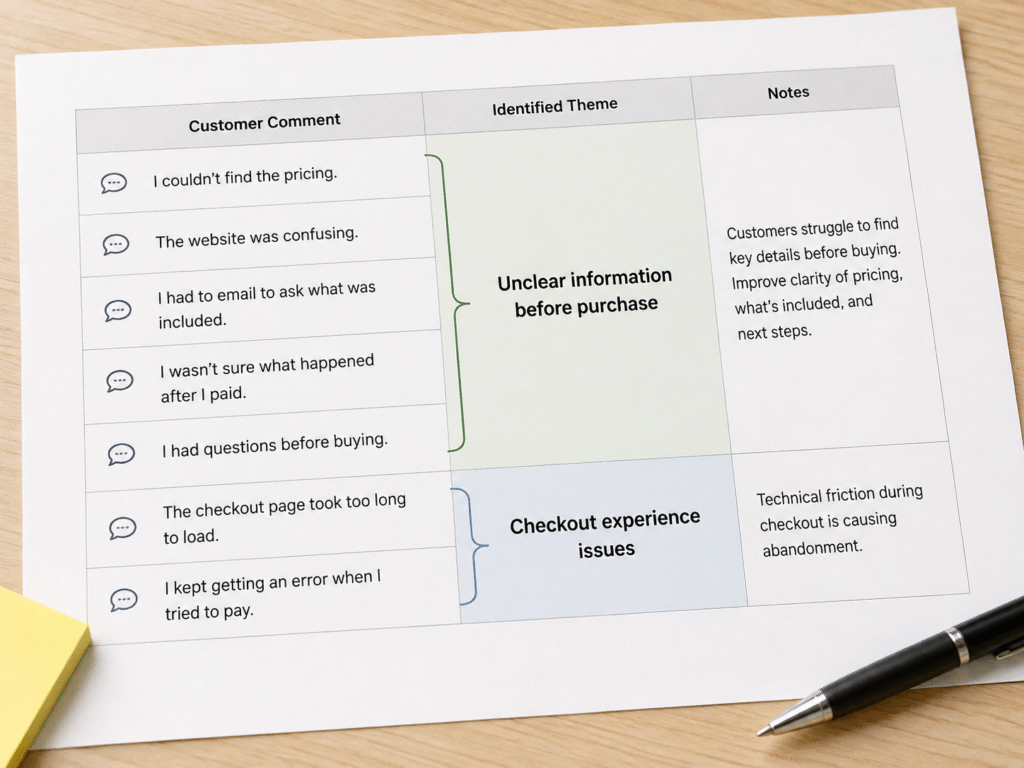
Once you’ve got a few weeks of feedback in one place, read through it and group similar comments together. A hidden problem is usually an issue customers experience repeatedly before the business owner recognises it as a pattern. Group comments by the underlying issue, not by their exact wording. “The website was confusing,” “I couldn’t find the pricing,” and “I had to email to ask what was included” are three different comments pointing to the same theme: unclear information before purchase.
Most small businesses end up with somewhere between four and eight themes once this is done. That number alone is useful information. If you’ve got twenty scattered one-off comments and nothing repeats, that tells you something different than if the same three themes keep showing up every single week.
Be careful with one common mix-up here: grouping by tone instead of substance. An angry email and a polite one can point at the exact same underlying issue, and a friendly comment can hide a real problem just as easily as a rude one can exaggerate a small one. Read past how something was said and focus on what’s actually being described. That’s harder than it sounds, especially with the comments that stung, but it’s where the useful information actually lives.
From themes to priorities: what to fix first
This is where most people either freeze or go the opposite direction and try to fix everything at once. Neither works. What helps is asking two questions about each theme:
How often does this come up? A theme mentioned once in three months is not the same priority as one mentioned by a third of your customers.
What does it cost you if it stays unfixed? Some issues are annoying but harmless. Others are quietly costing you sales, referrals, or repeat customers, even if nobody’s said so directly.
To keep this simple, give each theme two scores:
- Frequency: 1 for occasional, 2 for repeated, and 3 for frequent.
- Impact: 1 for minor inconvenience, 2 for noticeable friction, and 3 for likely lost sales, cancellations, refunds, or repeat business.
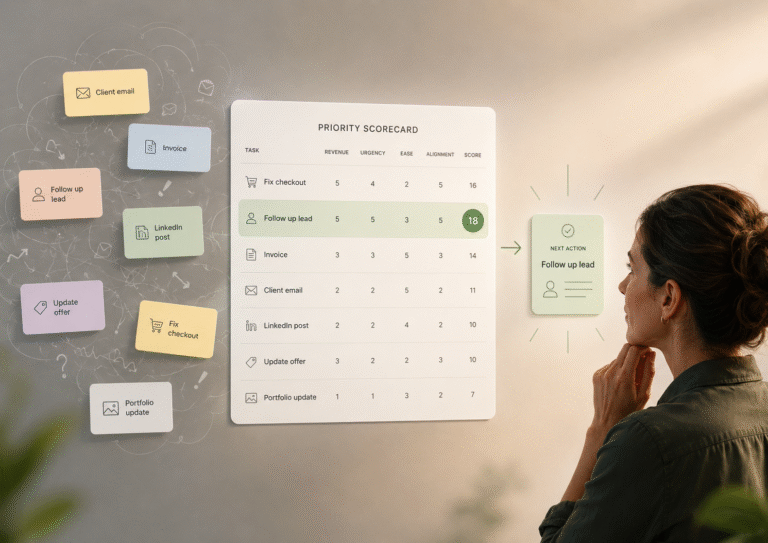
Add the two scores together. Start with the themes that score highest, then use your judgment if two themes have the same score.
Rank your themes by those two questions together, not separately. The loudest complaint isn’t automatically the most important one, and the most frequent issue isn’t always the most costly. A simple score won’t make the decision for you, but it will make your reasoning more visible and reduce the chance of fixing whatever happens to feel urgent that day. I’ve written more about that trap and how to avoid it in Stop Wasting Money on Random Fixes: Diagnose Your Business First, if you want to go deeper on that specific mistake.
| Theme | Frequency | Impact | Priority |
|---|---|---|---|
| Unclear pricing | 3 | 3 | Fix first |
| Slow replies | 2 | 3 | Fix next |
| Packaging complaints | 1 | 1 | Monitor |
Pick one theme. Just one. Decide what you’re going to change, and give yourself a real deadline. You can come back for the second theme once the first one is actually handled, not just noticed.
Your final decision should be specific enough to write in one sentence:
“The most repeated and costly issue is confusion about what happens after purchase. By Friday, we will rewrite the confirmation email and add a clear next-steps section.”
When feedback alone isn’t enough
Feedback is honest, but it’s also partial. It tells you what customers are experiencing, not necessarily why, and it won’t tell you anything about the parts of your business customers never see, like your pricing structure, your operations, or how clear your own priorities actually are.
That is where a little more structure can help. My Business Clarity Mini Diagnostic Tool applies a similar evidence-based approach across eight areas of your business. You answer practical questions about what is currently in place, review your scores, and identify the areas with the largest gaps. The tool then helps you explore why those gaps matter and choose one focused next step.
If organising customer feedback into themes helped you see one part of the business more clearly, the diagnostic gives you a structured way to review the wider picture.
A short, useful place to end up
You don’t need a dashboard. You don’t need to read every comment the day it arrives. You need one place where feedback collects, a weekly ten minutes to group it into themes, and the discipline to fix one thing before starting the next.
The business owners I’ve watched get real, lasting improvement from feedback aren’t the ones who react fastest. They’re the ones who wait long enough to see the pattern, then move on it without hesitating.
I also share one practical idea and one small action each week in Business Pulse, my free newsletter for small business owners who want more clarity and fewer random fixes.