Cash Flow vs Cash Cushion: Building Stability into Your Service-Based Business
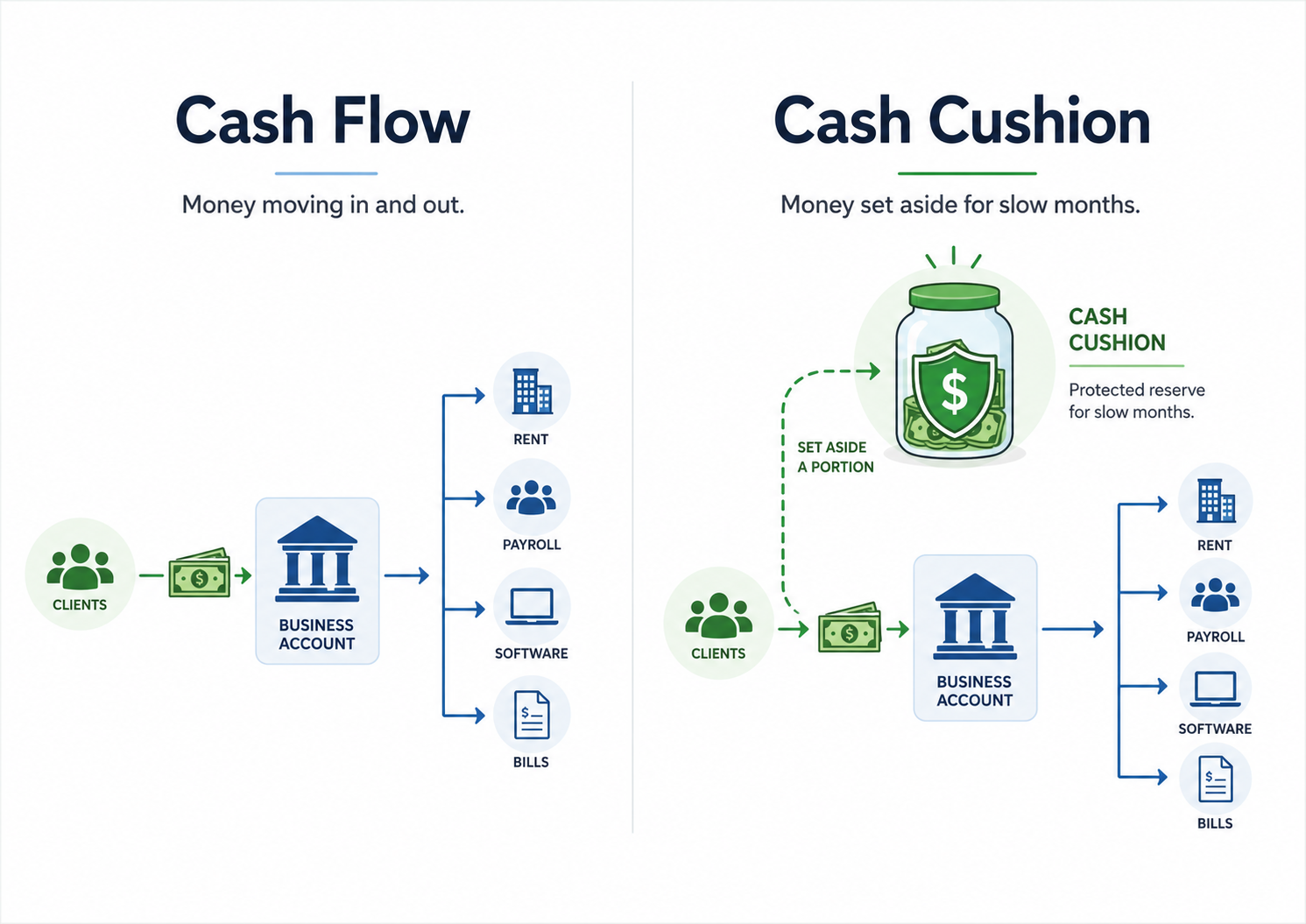
Cash flow is the money moving in and out of your business every month. A cash cushion is money that sits untouched, waiting for the month when that flow slows down or stops. Most service-based business owners spend years managing the first one and never build the second, which is usually the real reason a slow month feels like a five-alarm fire instead of a Tuesday.
I hear a version of the same sentence from almost every business owner I work with at some point: “I don’t understand it, some months I make great money and then I’m suddenly stressed about rent.” Nine times out of ten, the business isn’t actually struggling. There’s just no cash flow cushion sitting between “money came in” and “money is spent,” so every dollar gets treated the same way, whether it’s meant to cover this month’s bills or next quarter’s slow spell.
Cash Flow Keeps the Lights On. It’s Not Your Safety Net.
Cash flow is simple in concept: money comes in from clients, money goes out for expenses, and whatever is left is what you have to work with. That’s it. It’s a snapshot of movement, not a measure of security.
The trap is thinking that healthy cash flow means you’re financially safe. It doesn’t. A business can have excellent cash flow in June and be gasping in September, because cash flow only tells you what’s happening right now. It says nothing about what happens when a client cancels, a project gets delayed, or your busy season ends earlier than expected.
What a Cash Cushion Actually Does
A cash cushion is a separate pool of money, set aside specifically so that a slow month doesn’t touch your ability to pay yourself, pay your team, or pay your bills. It’s not meant to be spent on new equipment, a slightly-better office chair, or an opportunity that “will pay for itself.” Its entire job is to sit there and absorb a bad month.
Think of it less like savings and more like a shock absorber. A car without one still runs on smooth roads. The moment there’s a pothole, though, everyone in the car feels it. A business without a cash cushion runs fine during a good quarter and then feels every pothole (a late invoice, a canceled contract, a slow January) as a full-body jolt.
Why This Gap Hits Service Businesses Hardest
If your income depends on bookings, projects, or seasonal demand, this problem is almost guaranteed to show up eventually. I’ve worked with a landscaping business owner whose entire fall and winter were dead quiet compared to spring and summer, and a wedding photographer who booked nearly nothing in January and February no matter how good her marketing was. Neither of them had a bad business. They had a business with a predictable rhythm and no cushion built around that rhythm.
This is really the same issue I’ve written about before in Feast-or-Famine Revenue: Why Your Business Income Feels So Unpredictable, which digs into why service income swings the way it does. This article is the practical next step: once you understand why the swings happen, a cash cushion is how you stop reacting to them like a crisis every time.
Cash Flow Problem or Cushion Problem? A Quick Way to Tell
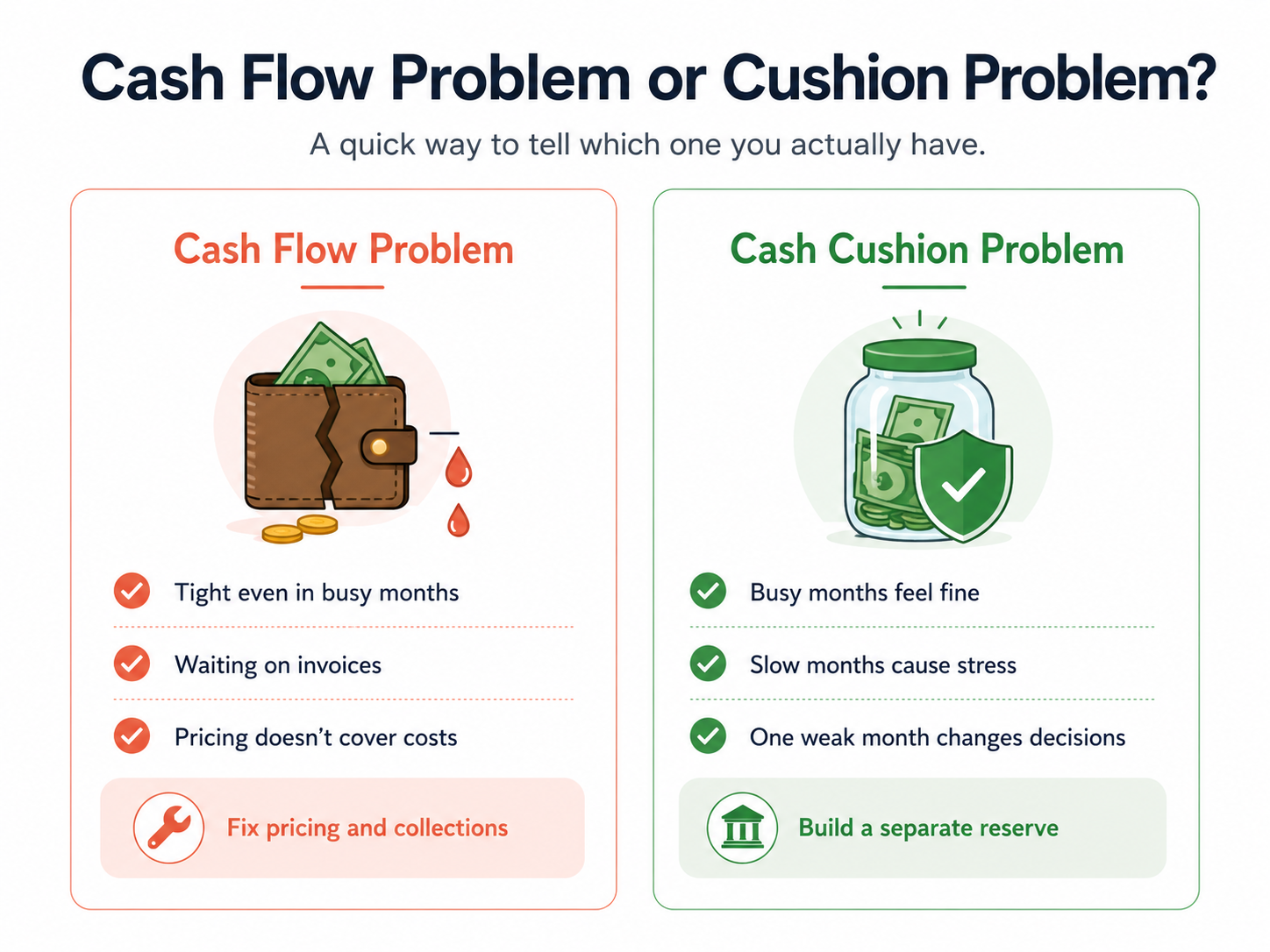
Before building anything, it helps to know which problem you actually have, because the fix is different.
You likely have a cash flow problem if money is tight even during your busiest months, if you’re regularly waiting on unpaid invoices to cover this week’s expenses, or if your pricing simply doesn’t cover your costs. That’s a pricing and collections issue, and no amount of saving fixes it.
You likely have a cushion problem if the busy months feel comfortable and the slow months feel like a scramble, if you’ve said “I’ll figure out savings once things settle down” more than once, or if a single slow month has ever made you consider taking on work you didn’t actually want. That second list is far more common than owners expect, and it’s a structural fix, not a pricing fix.
Building a Cash Cushion Without an Accounting Background
You don’t need spreadsheets you don’t understand or a finance degree for this. You need one decision and a little consistency.
Open a separate account. Not a savings sub-account buried inside your main checking, an actual separate account you don’t look at day to day. The friction of it being “somewhere else” is doing real work here.
Pick a small percentage, not a big one. Five to ten percent of what comes in each month is realistic for most service businesses starting out. I’d rather someone save five percent consistently for a year than try to save twenty percent for six weeks and quit out of frustration.
Automate the transfer the same day payment lands, before you look at the total in your main account and start mentally spending it. Money that has to be moved on purpose almost never gets moved.
Set a real target, not a vague one. “A cushion” isn’t a number you can measure. “Enough to cover two months of my slowest-season expenses” is. For most solo service providers I’ve worked with, that lands somewhere between $6,000 and $15,000, depending on how lean the business runs, but the target should come from your own slow-month expenses, not a number you saw in a blog post.
What Actually Changes Once the Cushion Exists
The financial part is obvious. The part people don’t expect is how much calmer their decisions get. When there’s no cushion, a slow month makes an owner say yes to underpriced work, drop their rates out of fear, or take on a client they already suspect will be difficult. All three decisions come from scarcity, and scarcity decisions tend to create more problems down the line.
With even a modest cushion in place, a slow month becomes something you can wait out. You still notice it. You just don’t have to bend your business around it.
The Mistake That Undoes All of This
The most common mistake I see is mixing the two accounts back together after a few good months. Business feels stable, the cushion account starts looking like “extra money just sitting there,” and it quietly gets absorbed back into general spending. Six months later, the slow season hits and the cushion isn’t there anymore.
The cushion only works if it stays boring. It’s not a reward for a good quarter. It’s not a slush fund for a great opportunity. It’s insurance, and insurance you’ve already spent isn’t insurance.
If you’re setting this up while your business is still young, or if you’re realizing your current setup never had a cushion built in at all, this is exactly the kind of structural piece covered in the Checklist for Starting a New Business. It walks through this alongside the other systems worth putting in place early, before a slow month forces the decision for you.
And if you want more of this kind of practical, no-fluff planning, my free business resources page has more tools built for exactly this stage of building a service business.