Feast-or-Famine Revenue: Why Your Business Income Feels So Unpredictable
If you run a small service business, you probably know this feeling. One month, you have more work than you can handle. Invoices going out, projects moving forward, a genuine sense that things are clicking. Then it stops. The next month is quiet in a way that starts to feel personal. You check your inbox more than usual, start wondering what changed, maybe consider lowering your prices just to get something moving again.
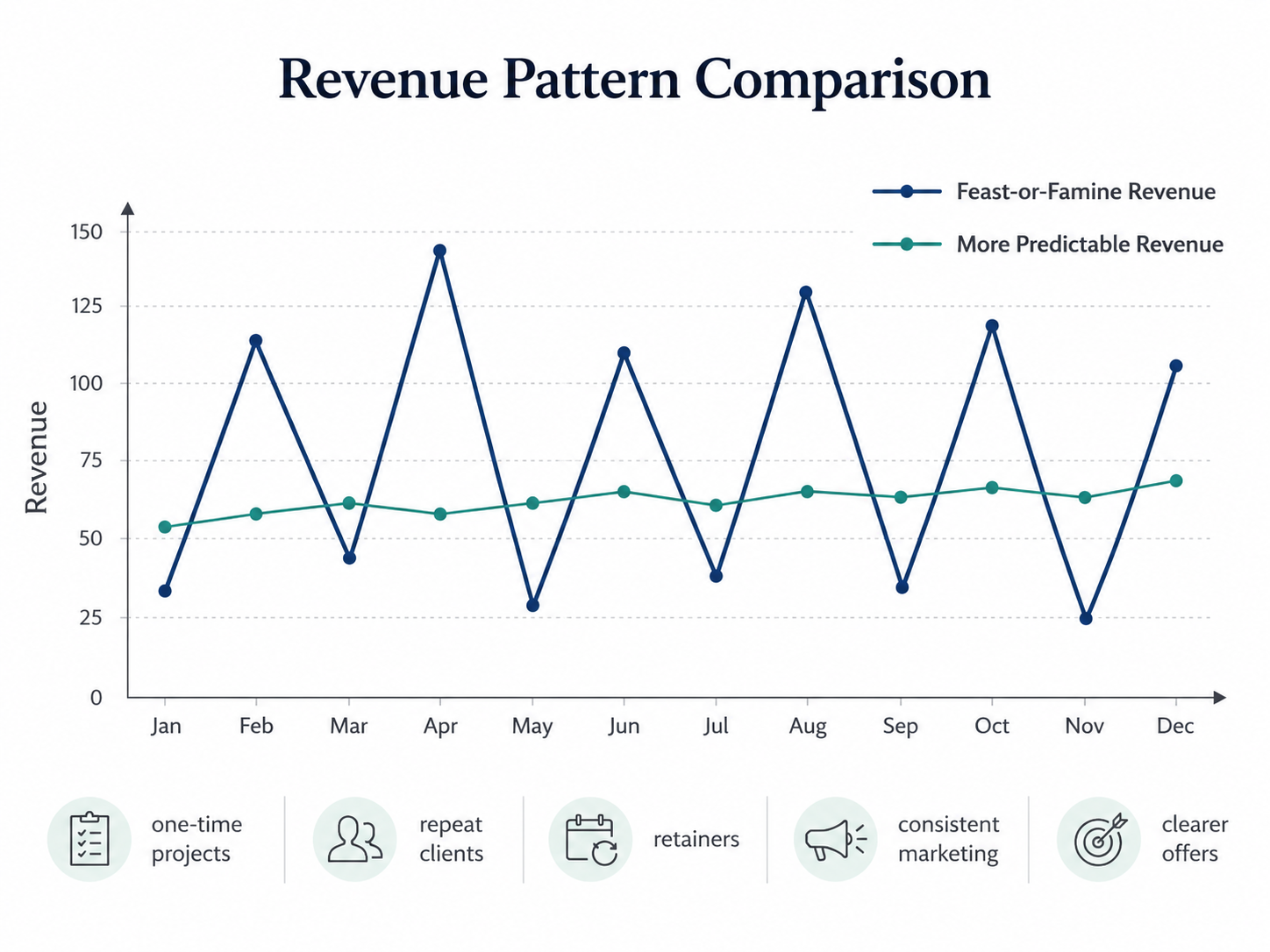
This is feast-or-famine revenue, and it is one of the most draining patterns in small business ownership. Most people assume it is a marketing problem, a slow season, or just the nature of working for yourself. Sometimes those things play a role. But for a lot of service providers, the instability comes from somewhere deeper than that.
It Looks Like a Cash Flow Problem. Often It Is a Business Model Problem.
Cash flow issues are real, and the stress of a slow month is not something to dismiss. But if you keep treating inconsistent revenue as only a cash flow problem, you will keep patching the same spot without ever understanding why the leak keeps coming back.
Many small business owners deal with feast-or-famine income not because they lack talent or drive, but because of how their business is structured. How they make money. What they sell. Whether clients have any reason to come back. Whether the offers themselves create any kind of regularity, or whether every single month starts from zero.
Looking at your income through a business model lens, rather than only a financial one, often reveals things that budgeting or saving cannot fix on their own.
Why the Pattern Actually Happens
There is no single cause, but in most small service businesses the feast-or-famine cycle tends to come from a combination of a few structural problems. Understanding which ones apply to your situation is more useful than any general advice about “consistency.”
You Are Mostly Selling One-Time Projects
This is the most common setup for freelancers and independent service providers, and it creates an almost guaranteed income rollercoaster.
Think about a photographer who books individual shoots. Each booking is a fresh sale to a new person. Or a web designer who builds one site per client and then moves on to find the next. The work is good, the clients are happy, but there is nothing built into the business that brings people back or keeps income flowing between projects.
Project-based work is not a problem in itself. The problem is when it is the only income structure. When every single euro or dollar you earn requires a completely fresh sale, you spend a huge amount of energy just staying in place. And the moment you get busy delivering, marketing stops, which sets up the next slow period almost automatically.
Your Clients Have No Clear Reason to Come Back
This is related to the first point but slightly different. Sometimes the service itself could support repeat business, but the way it is presented does not make that obvious or easy for the client.
A nutritionist who offers single consultations, for example, could also offer a structured four-month program. But if only the individual session is clearly described and priced, most clients will book that, receive their advice, and not return, not because they did not find it valuable, but because there was no natural next step presented to them. The business model did not make continuity easy.
This is worth thinking about separately from client satisfaction. Repeat business often has less to do with how happy clients are and more to do with whether the offer structure makes coming back simple and logical.
Your Revenue Streams Are Unclear or Disconnected
Some business owners have several income sources but none of them are particularly strong or structured. A workshop here, a one-on-one session there, some digital products, occasional affiliate income, maybe a retainer with one long-standing client. Each generates a little money, but nothing adds up to a reliable foundation.
When revenue streams are scattered, it becomes genuinely difficult to know which ones are worth investing time in. During a slow period, you are not sure which lever to pull. You try a bit of everything. That usually results in more exhaustion and less actual momentum.
If you want to think through how your revenue streams connect, or whether they do at all, this article on clarifying pricing and revenue streams using the Business Model Canvas is a useful starting point.
You Are Marketing Reactively, Not Consistently
A lot of small business owners market their services in waves. When things are busy, visibility drops because all the energy goes into delivery. When things slow down, marketing picks up out of urgency. The result is a cycle that practically creates the feast-or-famine pattern on its own.
Reactive marketing also tends to be less effective than consistent marketing, because potential clients who have seen you regularly are more likely to think of you when they are ready. Someone who discovers you for the first time during a panic post is less likely to buy immediately.
This is not a lecture about posting every day. It is just worth noticing whether your visibility in the market follows your workload instead of its own steady rhythm.
Your Offers Are Not Priced for How You Actually Work
Underpricing during slow periods is one of those habits that feels like a solution but often makes the problem worse. When things are quiet, dropping prices to attract clients quickly can bring in work that is not a good fit, that takes more time than it pays for, and that leaves very little buffer for what comes next.
There is also a less obvious version of this: offers that are priced reasonably but described so vaguely that potential clients cannot figure out what they are actually getting, which causes hesitation, longer decision cycles, and gaps in income. Clarity in how offers are packaged and described matters more than most business owners realize.
What Your Income Pattern Is Actually Telling You
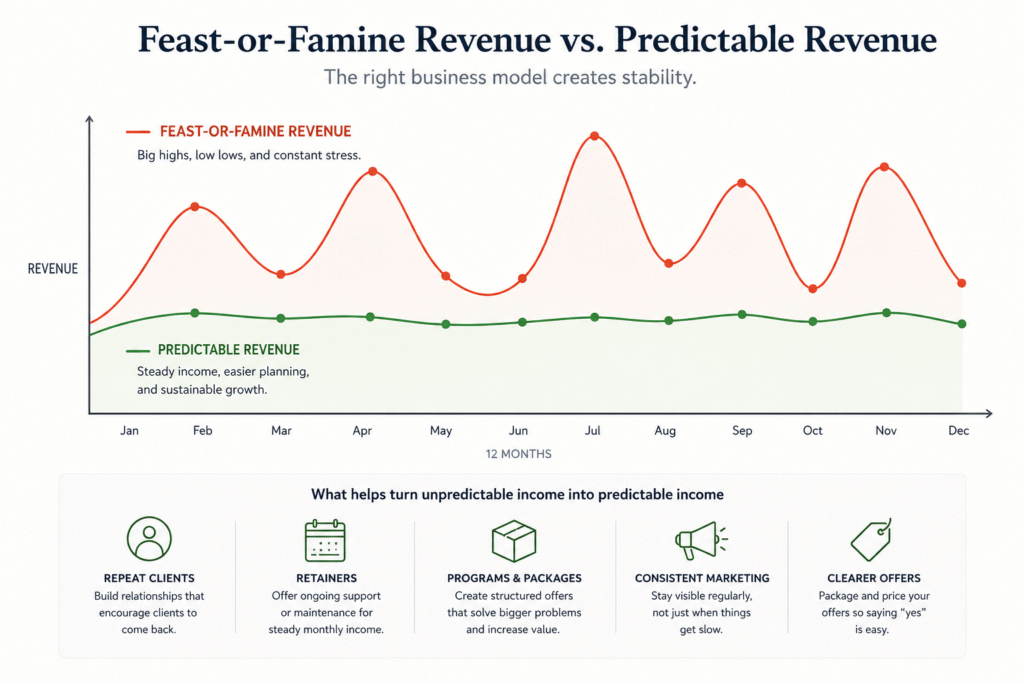
If you look back at your last twelve months of income, not just the recent weeks, a few things usually become visible.
Are there clear peaks tied to specific activities, like a launch or a promotion you ran? Are there slow periods that seem to repeat at the same time each year? Is most of your income coming from one type of work even though you offer several things?
These patterns are informative. A quiet stretch that follows a busy period often means there was no follow-up system in place once the work ended. Recurring income from a specific offer means that offer is working and probably deserves more attention. Scattered revenue with no clear driver usually suggests the business model needs simplification, not more marketing on top of what is already there.
Your income pattern is not just a financial record. It is a signal about what your business structure is actually producing, month after month.
Looking at the Business Model, Not Just the Bank Account
A business model is a description of how your business creates value, delivers it, and gets paid for it. It includes your offers, the people you serve, your revenue streams, your costs, and the channels through which people find you.
When revenue is unpredictable, one or more of those pieces is usually working against the others. A strong offer that is reaching the wrong audience. A good client base that is being offered something too fragmented to buy consistently. Revenue streams that are too irregular to support any kind of planning.
This is different from asking whether you are working hard enough or marketing enough. It is asking whether the structure of the business makes consistent income possible in the first place.
If you have a feeling that the instability in your income might go deeper than a bad month, this article on whether your business model might be falling apart can help you look at that question more honestly.
A Few Questions Worth Sitting With Before Trying a New Tactic
Before looking for a new marketing strategy or a different type of promotion, it can help to slow down and look at a few basic questions.
How does this business actually make money, in practice? Not in theory. Which specific offers are clients actually buying, and how often?
Do any of my revenue streams create repeat business naturally? Or does everything require a completely fresh sale each time?
Which of my offers are clearly defined and easy to explain? And which ones are vague enough that a potential client might just decide to wait?
Am I visible in the market consistently, or mostly when things feel slow? If the answer is mostly when things feel slow, that explains a lot about the timing of the quiet periods.
Do I have any sense of what the next two or three months might look like? Even roughly? If the answer is genuinely no, that is a signal worth paying attention to.
These are not complicated questions. They are the kind that tend to get skipped when things are busy and avoided when things are slow. Answering them honestly, just once, often shifts the way you look at your business.
A Practical First Step
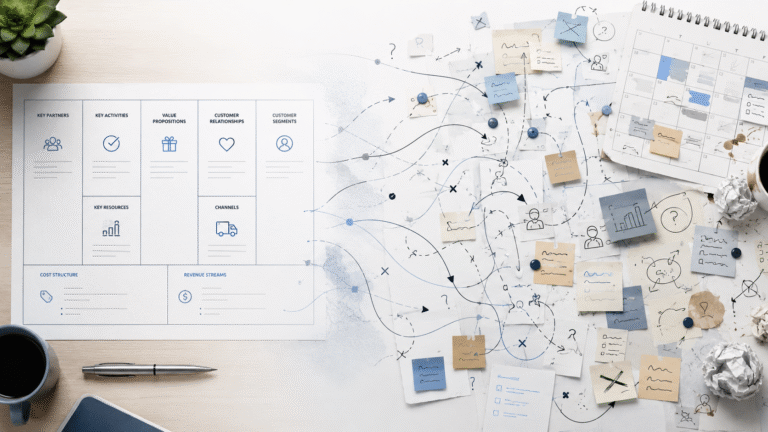
One of the most useful tools for reviewing your business model without it becoming an overwhelming project is the Business Model Canvas. It gives you a simple structure for looking at nine key pieces of your business at the same time: your customer segments, value proposition, channels, revenue streams, cost structure, and more.
It is not a complicated framework. The value is in having everything visible in one place, so you can start to see which pieces are connected, which ones are missing, and where the real gaps might be.
If you have never used it before, this step-by-step guide on how to fill out each section of the Business Model Canvaswalks through the whole thing with practical examples.
And if you want a ready-to-use space to do this thinking right now, the free Notion Business Model Canvas Template gives you exactly that. It is set up so you can fill in your own business details, review your current revenue streams and offer structure, and start identifying where the instability might be coming from.
Download the free Notion BMC Template
If You Want More Guided Support
Using the template is a good starting point. But some business owners find that after filling it in, they are still not sure what to prioritize or how to address what they have found. Sometimes the gaps are clear but the path forward is not.
For that, the Business Model Canvas Playbook goes deeper. It walks through all nine blocks with detailed explanations, guiding questions, real-world examples, and editable templates. It is designed for business owners who want to think through their model properly and come out the other side with a clearer picture of what needs to change.
And if you would rather talk through your specific situation with someone, the pre-session application form for a 1:1 Business Clarity Session is the place to start. It is a good fit when you have looked at your business model and you know something needs to shift, but you want a more personal review of your offers, revenue structure, or direction.
Frequently Asked Questions
What does feast-or-famine revenue mean? Feast-or-famine revenue refers to an income pattern where a business earns well during certain periods and struggles during others, with little consistency in between. It is common in service-based businesses, particularly those that rely on one-off projects, seasonal work, or inconsistent client outreach.
Is inconsistent business income normal for freelancers and service providers? Some variation is normal, especially in project-based work. But persistent instability, where slow months feel genuinely stressful and unpredictable, often points to structural issues in the business model rather than just market conditions or bad timing.
What causes feast-or-famine revenue in small businesses? Common causes include relying entirely on one-time projects, unclear or disconnected revenue streams, offers that do not create natural repeat business, reactive marketing that only happens during slow periods, and pricing that does not reflect how the business actually needs to operate.
How can I start to understand my income pattern better? A useful first step is reviewing your income over the past twelve months and identifying what drove your highest-earning periods. Then look at your current offer structure: which offers create repeat business, which ones require a completely fresh sale each time, and whether your revenue streams are clear enough to plan around.
What is the Business Model Canvas and how does it relate to income instability? The Business Model Canvas is a visual framework that maps out nine key elements of how a business creates, delivers, and captures value. It is useful for income instability because it helps you see whether the problem comes from unclear offers, weak revenue streams, the wrong customer segments, or channels that are not working. Reviewing your business through this lens often reveals things that are hard to see when you are focused only on the financial side.
Where should I start if my business income feels unpredictable? A practical starting point is downloading the free Notion Business Model Canvas Template, which gives you a structured space to review your own business model and start identifying where the instability might be coming from. From there, you can decide whether you need more guidance or a more personal review of your situation.