When Should You Book a Business Consultation? 5 Signs You Need Clarity
If you’re reading this, there’s a good chance you’re already wondering whether a business consultation is actually worth it, or whether you should just push through on your own.
That question alone tells me something important.
Most small business owners don’t look for outside help when things are fine. They come looking when something feels off, when the effort and the results don’t add up, when they’re exhausted by their own business, or when they’ve tried five different things and still feel stuck in the same place.
So here’s the honest answer: you don’t always need a consultant. But there are clear signs that trying to figure it out alone is costing you more than you realize, in time, energy, and money you’re leaving on the table.
Let’s look at those signs.
What Is a Business Consultation, Really?
Before jumping into the signs, let me clarify what a business consultation actually is, because a lot of people have the wrong idea.
A business consultation is not someone telling you what to do with your business. It’s a focused conversation where you get outside perspective on a specific problem, a structured way to think through your situation, and a clear direction for what to do next.
A good consultant asks the right questions, helps you see what you’ve been too close to notice, and gives you a realistic plan, not a generic one-size-fits-all answer.
That’s what a Business Clarity & Strategy Session is designed to do: look beyond the surface symptoms, identify the real issue, and help you leave with clarity, direction, and practical next steps.
5 Signs It’s Time to Book a Business Consultation
Sign 1: You’re Busy But Not Growing
You’re working full days. You’re responding to clients, managing tasks, handling problems as they come up. But at the end of the month, the numbers aren’t reflecting the effort you’re putting in.
This is one of the most common, and most draining, situations small business owners face. Being busy feels like progress. It isn’t. Activity and growth are not the same thing.
What this usually means: Your time is going into the wrong places, your processes aren’t set up to scale, or your offer and pricing aren’t aligned with the value you’re actually delivering. These aren’t things you can fix by working harder.
This shows up differently depending on your business type, but the pattern is the same:
- A freelance designer working 10-hour days but still earning the same monthly income as two years ago
- A clinic owner fully booked with appointments but constantly losing margin to no-shows and admin chaos
- A café owner whose tables are always full, but the numbers at the end of the month never seem to match the energy they’re putting in
- A small retail shop seeing steady foot traffic but struggling to turn that traffic into real profit
The business looks like it’s working. But the growth isn’t there.
If you’ve been busy for months (or years) without the results to show for it, that’s a signal worth taking seriously, not a reason to work even harder.
Sign 2: You’re Making Decisions in Circles
You decide to focus on one thing. Then something new comes up and you pivot. Then you second-guess that. Then you go back to the first plan, or try something else entirely.
You’re not indecisive. You’re working without a clear framework. When you don’t have a structured way to evaluate decisions, everything feels equally important (or equally uncertain), and you end up either paralyzed or constantly reacting.
What this usually means: You need a clearer business strategy, not just goals, but a real operating framework that tells you what to prioritize and why. Without that, every decision becomes a guess.
Here’s what this looks like in practice:
- A consulting firm owner who keeps switching between “I should focus on LinkedIn” and “maybe I need to run ads”, never staying with one long enough to see results
- A beauty salon owner who’s unsure whether to add new services, hire another technician, or just stay small, and has been “deciding” for six months
- A service business that pivots its pricing every few weeks because nothing feels right
You’re not indecisive. You’re making decisions without a framework, and that’s something a single focused session can actually fix.
A business consultation gives you outside perspective and a structured lens to look at your decisions through, so you stop going in circles and start moving in a direction.
Sign 3: You Know What the Problem Is, But You Can’t Seem to Fix It
This one is surprisingly common. You already know you need to delegate more. Or that your pricing is too low. Or that your client intake process is a mess. You’ve known it for a while.
But knowing the problem and actually solving it are two different things, especially when you’re the one running the business every day.
Sometimes you’re too close to see the full picture. Sometimes you don’t know where to start. Sometimes you start, hit resistance, and quietly go back to how things were.
This comes up in every type of business:
- A restaurant owner who knows they need to train their staff better, but every time they start, something urgent pulls them back into the kitchen
- A freelance consultant who knows their rates are too low, but raises them in their head every week and never actually does it
- A local service business (an accounting office, a legal firm, a marketing agency) that knows its client onboarding process is creating confusion, but hasn’t documented it because “it’s complicated”
What this usually means: You don’t just need information, you need a clear plan, an outside perspective, and someone to help you think through the “how” in a way that actually fits your specific business. That’s exactly what a structured consultation provides.
Sign 4: You’re the Bottleneck in Your Own Business
Nothing moves without you. Decisions wait on you. Tasks pile up because only you know how to handle them. You can’t take a week off without things falling apart.
If this sounds familiar, your business is running you, not the other way around.
This is a systems and structure problem. It doesn’t mean you’re doing anything wrong. It usually means you built your business around your skills and instincts, which worked in the beginning, but now that you’re trying to grow, the same approach is holding you back.
It looks like this across different industries:
- A clinic owner who is the only person who knows how to handle patient complaints, insurance issues, and supplier negotiations, because there’s no process for any of it
- A restaurant owner who can’t take a day off without getting twelve phone calls from staff who don’t know who has authority to make decisions
- A freelancer or creative whose entire client experience lives in their head, onboarding, briefs, revisions, invoices, none of it documented or delegated
- A retail shop owner who does the buying, the visual merchandising, the social media, and the staff scheduling, because no one else knows “the way things should be done”
What this usually means: You need to systematize your operations, build clear processes, and create a structure that lets your business run (at least partially) without your constant involvement.
This is one of the core things I help small business owners work through, and it’s rarely as complicated as it feels from the inside.
Sign 5: You’re About to Make a Big Decision and You’re Not Sure It’s the Right One
Maybe you’re thinking about hiring your first employee. Or launching a new service. Or restructuring your pricing. Or moving to a bigger space. Or finally walking away from a client relationship that’s draining everyone.
These decisions have real consequences, and making them without a sounding board, without someone who can help you think through the implications clearly, is a risk you don’t have to take.
For example:
- A small accounting office considering hiring a junior accountant, but unsure whether the current workload actually justifies it, or whether the real issue is internal inefficiency
- A wellness clinic thinking about adding a new service line, but without clarity on whether their current operations can actually support the expansion
- A freelance photographer ready to raise their rates, but unsure how to reposition their offer without losing existing clients
What this usually means: You don’t need to guess your way through a decision like this. One focused session before a major move can save you months of backtracking, and real money.
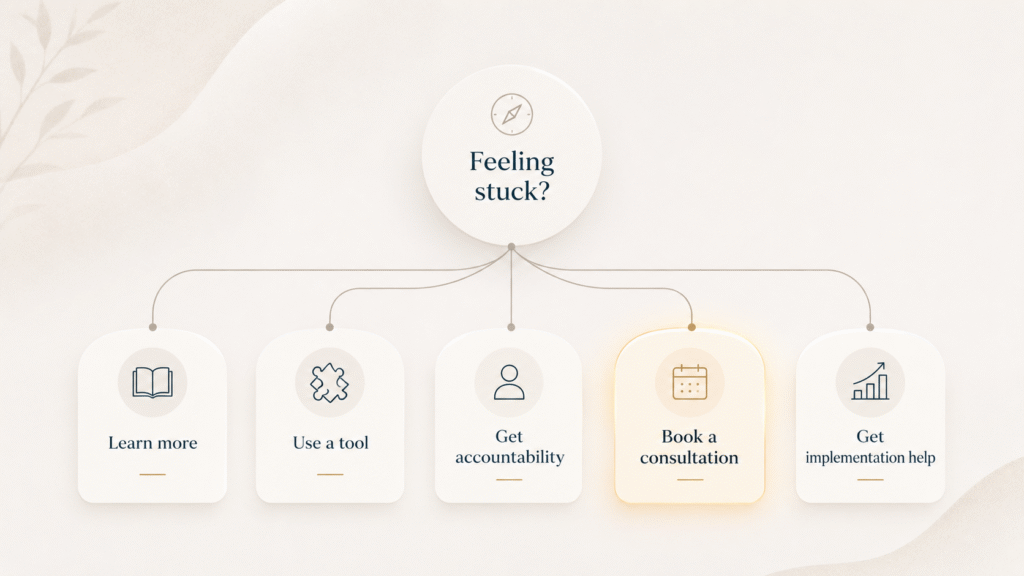
A Quick Self-Check: Do You Need Consultation, a Tool, or Just Time?
Not every problem needs a consultant. Here’s a simple way to think about it:
| Situation | What You Probably Need |
|---|---|
| You need information or education | A course, book, or free resource |
| You have a clear plan but need accountability | A peer group or coach |
| You’re stuck, unclear, or circling | A focused consultation |
| You need hands-on implementation help | An ongoing consultant or service provider |
| You just need a system or template | A tool or framework |
If you’re in the “stuck, unclear, or circling” row, that’s the clearest sign that a consultation is the right next step.
What Happens If You Don’t Get Clarity Now?
This is the part most people skip over.
If you stay stuck, things don’t just stay the same. They quietly get worse. The decisions you delay start stacking up. The systems you don’t build keep costing you time every single week. The growth you could have had six months ago is now six months further away.
There’s also an energy cost. Running a business without clarity is exhausting in a way that’s hard to explain to people outside of it. You’re working hard, but nothing feels solid. That wears on you.
Getting clear, even on one or two core things, changes how the whole business feels.
How a Business Clarity & Strategy Session Works (And Why I Ask You to Apply First)
My Business Clarity & Strategy Session is a focused 60-minute, one-on-one consulting session designed to help you step back, assess your current business situation, and understand the most important issue affecting your growth, structure, or decision-making.
This is not a generic advice call. It’s a structured conversation based on your real business situation, your answers in the pre-session form, and the specific challenge you want to work through. Depending on where you are, we might look at your business model, your offer, your systems, your priorities, or the decisions you’re facing.
Before we meet, I ask you to fill out a Pre-Session Application Form it takes about 15–20 minutes. This isn’t a formality. I review every application personally. If I don’t think this session is the right fit for your situation right now, I’ll tell you honestly, and point you toward something that might actually help.
I don’t take consultations to fill my calendar. I take them because I genuinely believe I can help.
If after reading this you recognize yourself in two or more of the signs above, the most useful next step is simple: fill out the application, tell me what’s going on, and we’ll figure out together whether a session makes sense.
If you already know you’re ready, you can go straight to book your Business Clarity & Strategy Session here.
Frequently Asked Questions
How do I know if my problem is serious enough to book a business consultation? If your problem is affecting your revenue, your time, or your ability to grow, it’s serious enough. You don’t need to be in crisis. Many of the most valuable sessions happen before things get critical, not after.
What does a business consultant for small businesses actually do? A good business consultant helps you see your situation more clearly, identify the real problem behind the surface symptoms, and give you practical next steps based on your actual situation, not a generic playbook. That’s the core purpose of the Business Clarity & Strategy Session.
What if I’m not sure what my real business problem is? That’s actually one of the most common reasons people apply. You don’t need to have it figured out before reaching out. The pre-session form and the session itself are both designed to help clarify what may really be going on. Many business owners find that answering the form questions alone already helps them see their situation more clearly.
Is the session guaranteed after I submit the form? No, and that’s intentional. I review every application personally to make sure the session can genuinely help your situation. If it’s not the right fit, I’ll let you know and suggest a better next step.
Will I get a full implementation plan in one session? This is a clarity and diagnosis-focused session, not a done-for-you service. You’ll leave with a clearer understanding of what’s really going on and practical next steps, but deeper implementation may require follow-up support, which we can discuss after the session if needed.
Can we continue working together after the session? Yes, that’s possible. If your situation needs deeper support and it feels like the right fit for both sides, we can talk about follow-up options after the session.
Final Thought
You don’t have to have everything figured out to reach out. You just have to know that something isn’t working, and be willing to look at it honestly.
That’s where clarity starts.