Is Your Business Model Falling Apart? How the Business Model Canvas Can Help
If your business feels scattered, inconsistent, or stuck, the problem might not be your marketing. It might be your business model. Here’s how to tell the difference, and what to do about it.
You’re Doing Everything Right. So Why Isn’t It Working?
You’re showing up. You’re posting on social media. You’ve adjusted your pricing. Maybe you’ve even hired someone to help with marketing. But the results are still inconsistent. Revenue goes up one month and drops the next. You’re busy, but you don’t feel like you’re building anything solid.
This is one of the most common, and most frustrating, places small business owners find themselves.
And here’s the uncomfortable truth: if you’ve tried multiple tactics and nothing seems to stick, the problem probably isn’t your tactics. It’s likely your business model.
The good news? This is fixable. And the Business Model Canvas is one of the clearest, most practical tools to help you see what’s broken and rebuild with intention.
What Is the Business Model Canvas, Really?
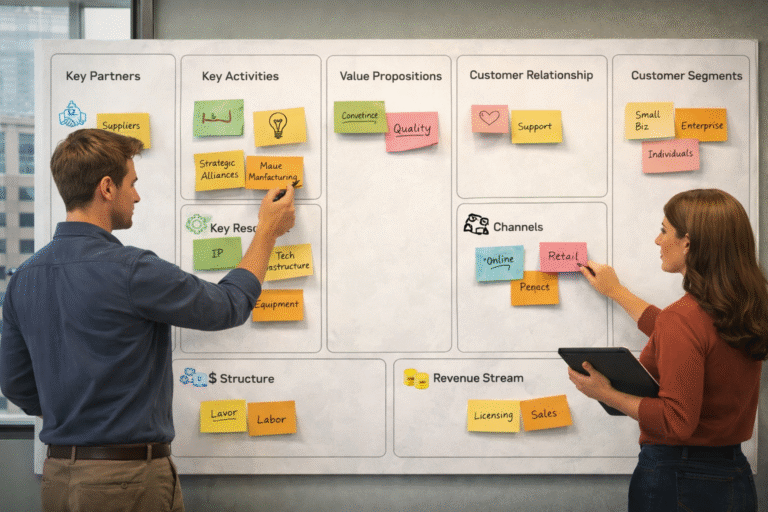
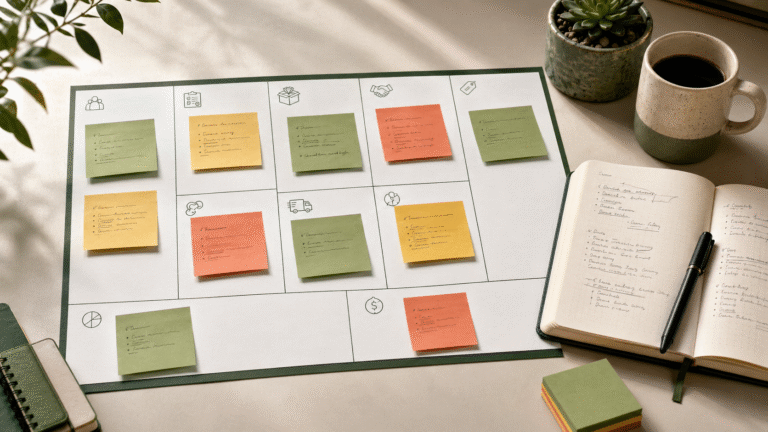
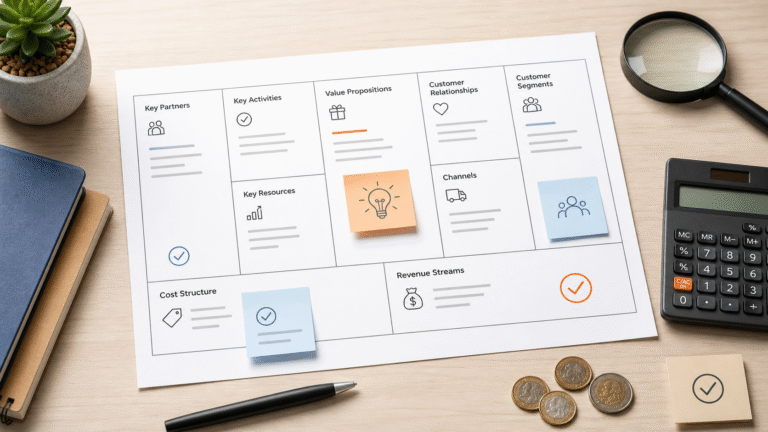
The Business Model Canvas (BMC) is a one-page visual framework that maps how your business creates, delivers, and captures value. It was developed by Alexander Osterwalder and is used by startups and established companies around the world.
But here’s what most people get wrong: the BMC isn’t just for big companies or tech startups. It’s one of the most powerful tools a small business owner can use, especially when something feels off but you can’t quite name it.
The canvas is divided into nine building blocks:
| Block | What It Covers |
|---|---|
| Customer Segments | Who exactly are you serving? |
| Value Propositions | What problem are you solving for them? |
| Channels | How do you reach and deliver to customers? |
| Customer Relationships | How do you interact with and keep customers? |
| Revenue Streams | How does the business actually make money? |
| Key Resources | What do you need to run this business? |
| Key Activities | What do you do every day to make it work? |
| Key Partnerships | Who do you rely on or collaborate with? |
| Cost Structure | What are your biggest costs? |
When all nine pieces are aligned, your business has clarity. When even one or two are unclear or mismatched, everything starts to feel harder than it should be.
How to Know If Your Business Model Is the Problem
Before you spend more money on ads or redesign your website, ask yourself these questions:
You probably have a business model problem if:
- You struggle to explain your business in 2–3 clear sentences
- You serve a wide range of clients but rarely feel like any of them are exactly right for you
- Your pricing doesn’t feel connected to the real value you deliver
- You have multiple offers but none of them generate consistent revenue
- Your costs are growing but your profit isn’t
- Every month feels like starting from scratch
These aren’t marketing problems. They’re structural problems, and no amount of content creation or ad spend will fix a structural problem.
The Most Common Business Model Mistakes Small Businesses Make
1. Undefined Customer Segments
Many small business owners try to serve everyone. “Anyone who needs [your service]” is not a customer segment. When you’re unclear about who you serve, your messaging becomes vague, your offers become generic, and your marketing never converts consistently.
2. A Weak or Uncommunicated Value Proposition
Your value proposition is not your tagline. It’s the specific outcome you deliver for a specific person with a specific problem. If customers can’t immediately understand why they should choose you, they won’t.
3. Misaligned Revenue Streams
This is one of the most overlooked issues. Some business owners price too low because they don’t understand the full value they deliver. Others have revenue streams that don’t match their cost structure, they’re working a lot but keeping very little. The BMC helps you see this clearly and fix it deliberately.
4. Doing Everything Themselves (Key Resources and Activities Mismatch)
When you’re the only key resource, your business can’t scale. The canvas helps you identify what truly needs your attention, and what doesn’t.
What Happens When You Map Your Business Model
When small business owners sit down and genuinely work through their Business Model Canvas, not just fill it in quickly, but think through it, something shifts.
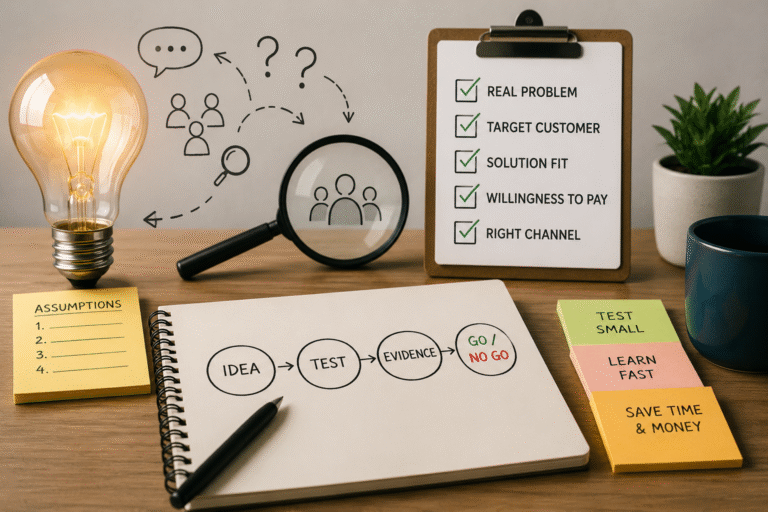
They stop asking “why isn’t my marketing working?” and start asking better questions: “Am I solving the right problem? Am I reaching the right people? Does my pricing reflect the value I actually deliver?”
Here’s a simple before-and-after to illustrate the difference:
Before mapping the business model:
- Offers feel scattered
- Pricing feels uncertain
- Marketing messages keep changing
- Revenue is unpredictable
After mapping the business model:
- Offers are aligned with customer needs
- Pricing reflects real value
- Marketing has a clear direction
- Revenue becomes more consistent and repeatable
This clarity doesn’t come from working harder. It comes from thinking more strategically about the structure of your business.
The Business Model Canvas Is Not Just for Big Companies
One of the most common objections I hear is: “This is for corporations. My business is too small for this.”
Actually, the opposite is true. The smaller your business, the more important it is to be intentional about your model. Large companies have teams, buffers, and resources to absorb mistakes. Small business owners don’t. Every misalignment costs time, money, and energy you can’t afford to waste.
The BMC is not a bureaucratic exercise. Done right, it’s a thinking tool that brings clarity — and clarity is exactly what small businesses need most.
How to Start: A Practical First Step
You don’t need a workshop or a consultant to start working on your business model. What you need is a structured space to think, and ideally, some real examples to learn from.
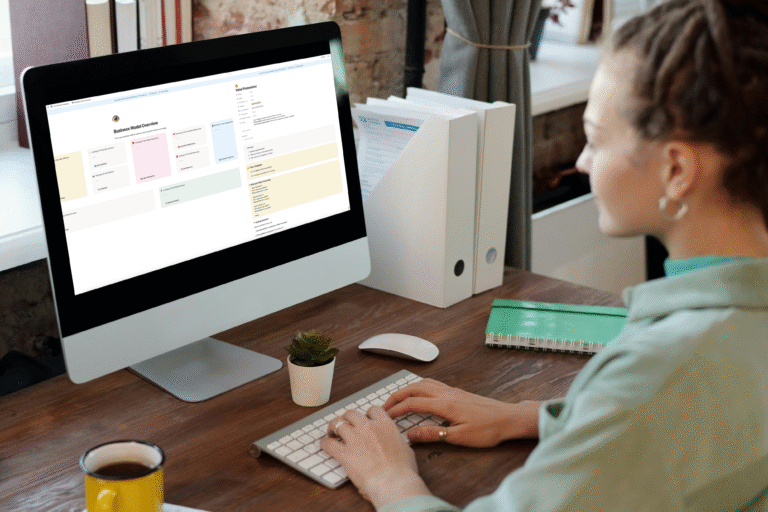
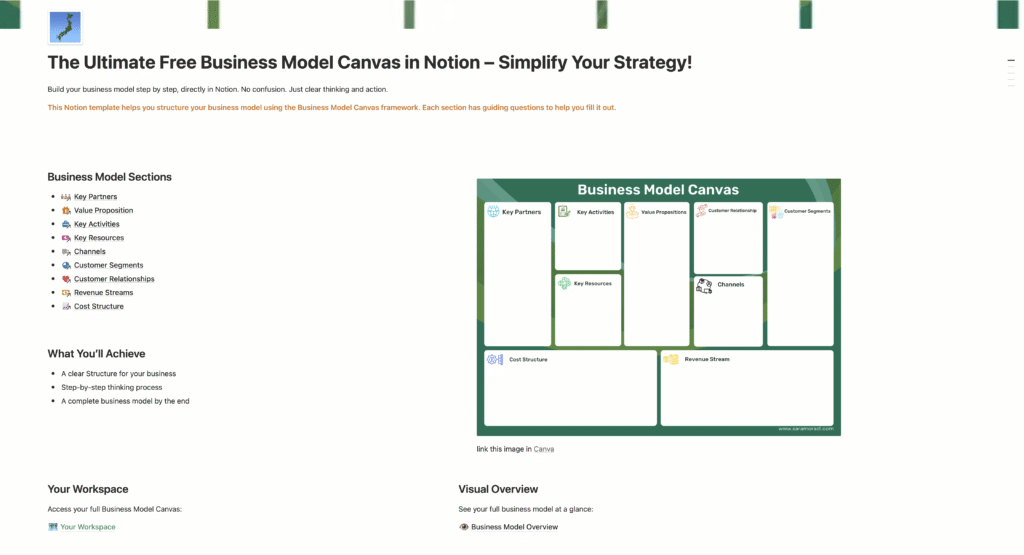
That’s exactly why I created the Free BMC Notion Template.
It’s not just an empty canvas to fill in. Inside, you’ll find:
- Key questions for each of the nine building blocks to guide your thinking
- Sample models from different industries so you can see what a completed canvas looks like in practice
- A clean, editable workspace to build your own model at your own pace
It’s free, and it’s a genuine starting point, not a teaser.
Ready to Go Deeper? The BMC Playbook
If you want to move beyond filling out a canvas and actually understand your business model at a deeper level, the BMC Playbook was built for exactly that.
The Playbook is a practical workbook, not a course, not a series of videos, but a structured, guided experience that helps you:
- Work through each block of your business model with real depth
- Challenge your own assumptions with strategic questions
- Use provided data and examples to sharpen your thinking
- See 5 fully completed business model examples across different business types
It’s designed for small business owners who want to think clearly about their business, not just fill out a template.
The Real Cost of Ignoring Your Business Model
Every month you spend working inside a broken or unclear business model is a month of wasted effort. Not because you’re not capable, but because even the most capable people can’t build something solid on a shaky foundation.
The Business Model Canvas doesn’t promise overnight results. What it does promise is clarity. And clarity is where real growth begins.
If something in your business feels off, trust that feeling. The problem is probably deeper than your marketing, and the solution is simpler than you think.
Frequently Asked Questions
What is the Business Model Canvas used for in small businesses? The Business Model Canvas helps small business owners map the nine key elements of their business, from customers and value propositions to revenue streams and costs, in one visual framework. It’s used to identify misalignments, clarify direction, and make strategic decisions with more confidence.
How is the Business Model Canvas different from a business plan? A business plan is a detailed written document often used for investors or banks. The Business Model Canvas is a one-page visual tool used for internal clarity and strategic thinking. It’s faster, more flexible, and easier to update as your business evolves.
Can I use the Business Model Canvas for a service-based business? Absolutely. The BMC works for any type of business, service-based, product-based, freelance, or agency. In fact, service businesses often benefit most because their model can be less visible and harder to evaluate without a structured framework.
How often should I review my business model? At minimum, once a year. But many business owners find it useful to revisit their canvas whenever they’re launching a new offer, entering a new market, or going through a period of slow growth.
What’s the difference between the Free Template and the BMC Playbook? The Free Notion Template gives you an editable workspace with guiding questions and industry examples to get started. The BMC Playbook is a deeper, guided workbook that takes you through the thinking process step by step, with strategic prompts and five fully completed business model examples to learn from.