Stop Wasting Money on Random Fixes: Diagnose Your Business First
Before you invest in a new tool, hire someone, or launch another marketing campaign, stop. The real problem in your business might not be what you think it is.
Most small business owners I talk to have the same story. They try something new a course, a new social media strategy, a rebrand, a business coach, and for a while, it feels like progress. Then a few months later, they are back in the same place. Stuck, frustrated, and lighter in the wallet.
The issue is almost never a lack of effort. It is a lack of diagnosis.
What Is Business Diagnostics and Why Does It Come First?
Business diagnostics simply means taking a structured look at what is actually happening in your business, based on evidence, not guesses, before deciding what to fix.
Think of it the way a doctor approaches a patient. A good doctor does not hand you a prescription the moment you walk through the door. They ask questions, run tests, look at the results, and then decide on a treatment. The diagnosis happens before the intervention.
Most small business owners skip this step entirely. They feel a symptom, slow sales, low visibility, constant overwhelm, and immediately reach for the nearest solution. New website. More content. Different pricing. Another tool.
Sometimes it works. Often it does not. And when it does not, the frustration compounds.
Business diagnostics is the step that tells you which problem is actually worth solving, and in what order.
Why Most Business Owners Skip Diagnosis (And Pay for It Later)
There are a few reasons we jump to solutions before diagnosing:
Solutions feel productive. Doing something feels better than sitting with uncertainty. Launching a new offer, posting every day, or signing up for a new platform creates the feeling of movement.
Symptoms are visible, root causes are not. When sales drop, it feels like a marketing problem. But maybe the offer is unclear. Or the follow-up process is broken. Or the wrong customers are being attracted in the first place. The symptom points one way; the root cause is often somewhere else entirely.
We assume we already know the problem. After years in your own business, you develop strong opinions about what is working and what is not. Those opinions are often right. But they are sometimes based on pattern recognition rather than real evidence.
Here is what I see repeatedly: a business owner spends $2,000 on ads because they believe visibility is the problem. Traffic improves. Sales do not. Because the real issue was offer clarity — and ads only amplified the confusion.
Or someone hires a VA to handle operations, hoping it will reduce stress. It helps for a month. Then stress comes back, because the root cause was an unclear business model, and delegation did not fix that.
Random fixes without diagnosis are expensive in time, money, and energy.
The 8 Areas That Usually Hide Small Business Problems
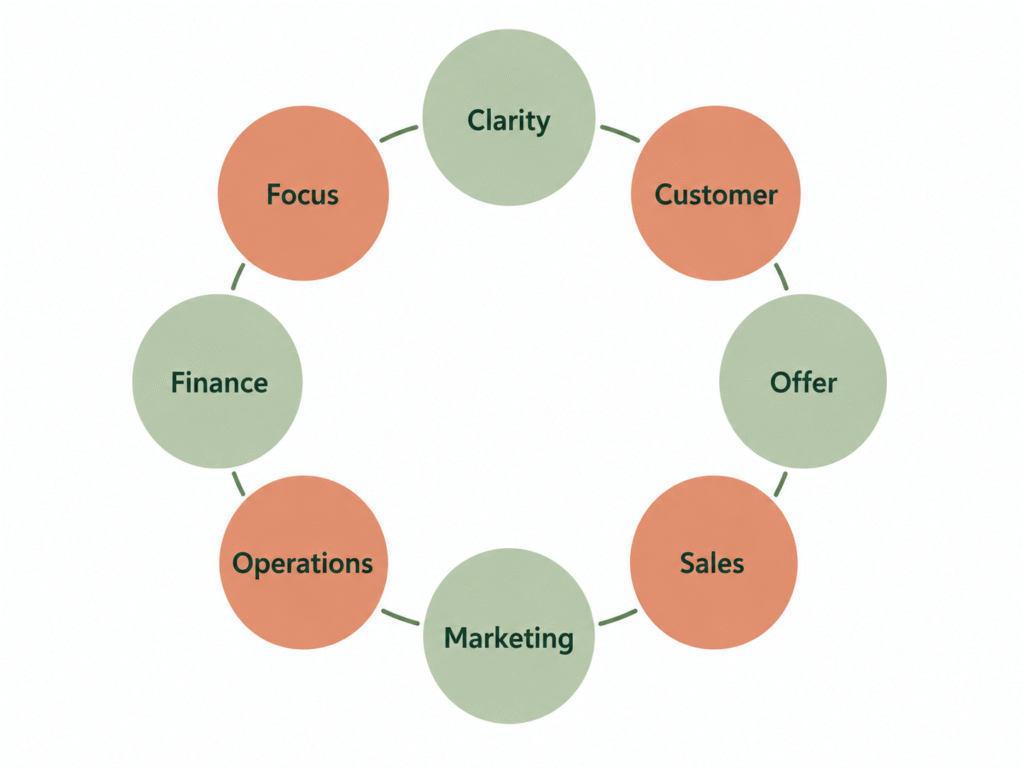
In my work with small business owners, I have found that most problems trace back to one or more of these eight areas:
1. Business Clarity: Do you have a simple, focused direction? Can you describe what your business does, who it helps, and what problem it solves, in one clear sentence?
2. Customer Understanding: Do you truly understand your ideal customer’s real problem, their frustrations, and what outcome feels valuable to them?
3. Offer Clarity: Is your product or service easy to understand? Do customers know exactly what they get, and does the price feel connected to the value?
4. Sales Process: Do you have a consistent, repeatable path from first contact to payment? Or does selling feel random and stressful?
5. Marketing Consistency: Do you show up with one clear message, to one focused audience, through one main channel, consistently?
6. Operations and Systems: Are your repeated tasks documented and reliable? Or does everything depend on you remembering every detail every day?
7. Financial Visibility: Do you know your revenue, costs, and real profit? Or are you making decisions based on bank balance feelings?
8. Decision-Making and Focus: Do you have a clear priority this week? Or are you reacting to whatever feels most urgent?
A business rarely struggles in all eight areas at once. But without a diagnostic check, it is easy to fix the wrong one first, or try to fix everything at the same time, which usually means nothing improves properly.
What Happens When You Diagnose Before You Fix
When you take the time to look honestly at your business through a structured lens, a few things happen that do not happen with random fixes.
You stop wasting money. When you know the real gap, you invest in something that actually addresses it. Marketing money spent before offer clarity is cleared is almost always wasted. Systems built before business direction is clear often get abandoned.
You feel less scattered. One of the most common things clients tell me after a proper diagnostic process is that they feel calmer. Not because their business is perfect, but because they finally know what to focus on. Clarity itself is a relief.
You make faster decisions. When you have evidence about where you are and where you want to be, choosing your next step becomes much simpler. You are not choosing between ten possible improvements. You are choosing the one that will actually move the needle.
You stop confusing symptoms with root causes. Slow sales might be a marketing problem. Or it might be an offer clarity problem. Or a follow-up problem. Or a niche problem. Diagnosis tells you which one. And fixing the right thing produces lasting results instead of a temporary boost.
A Simple Way to Start: The Evidence-Based Business Checkup
You do not need a week-long consulting project to diagnose your business. You need a structured set of honest questions, and the willingness to answer them based on what is actually true, not what you hope is true.
This is exactly what I built the Business Clarity Mini Diagnostic Tool for.
It is a simple, practical spreadsheet tool that walks you through 80 evidence-based questions across the eight business areas above. For each area, you answer Yes, Partly, or No. The tool calculates your current score, shows you your biggest gaps, and guides you toward one focused next step.
It is not a full business audit. It is a clarity check, the kind of honest snapshot that helps you stop guessing and start acting on evidence.
What the tool does:
- Shows you your score in each of the eight business areas
- Highlights your biggest gaps clearly
- Helps you explore why each gap matters
- Guides you to define one small, specific action you can take this week
It takes about 30–45 minutes the first time. And the clarity it creates often saves hours of misdirected effort in the weeks that follow.
Is This Tool Right for You?
This tool is a good fit if:
- Your business has been running for at least a few months but feels stuck or inconsistent
- You have tried different fixes and are not sure why they are not sticking
- You want a structured way to see your business clearly, without hiring a consultant just yet
- You make decisions based on gut feeling more than actual data about your business
- You are ready to be honest with yourself about where the real gaps are
It is not a magic solution. It is a starting point. And in my experience, the starting point is exactly where most small business owners are missing something.
The Most Expensive Thing in a Small Business Is Clarity You Do Not Have
Every decision you make without a clear picture of your business has a cost. Sometimes it is money spent on the wrong fix. Sometimes it is months of effort going in the wrong direction. Sometimes it is the constant low-grade stress of not knowing what to focus on.
A $5 diagnostic tool is not a guaranteed answer to every problem in your business. But it is a structured, honest starting point, and starting with the right diagnosis is always cheaper than repeating the wrong fix.
If you have been fixing symptoms instead of root causes, this is a good place to start.
Frequently Asked Questions
What is the business diagnostics first step? The first step in business diagnostics is an honest, structured assessment of your current situation across key areas, such as clarity, customer understanding, offer, sales, and operations, before deciding what to fix. Starting with evidence instead of assumptions saves time and money.
Why do small business owners waste money on random fixes? Most business owners skip the diagnostic phase and jump directly to solutions because symptoms feel urgent and visible, while root causes are harder to see. This leads to spending money on fixes that address the wrong problem.
How do you diagnose a business problem before fixing it? Use a structured framework that covers the core areas of your business, clarity, offer, customer understanding, sales, marketing, operations, finance, and decision-making. Assess each area honestly, identify your biggest gaps, and choose one focused action based on evidence.
What is the Business Clarity Mini Diagnostic Tool? It is a $5 spreadsheet-based tool created by Sarah Moradi that guides small business owners through 80 evidence-based questions across 8 key business areas. It calculates your current scores, shows your gaps, and helps you choose one practical next step.
How long does a business diagnostic take? A basic diagnostic check can take as little as 30–45 minutes using a structured tool. This is enough to give you a clear picture of your biggest gaps and your next step, without a lengthy consulting process.