Building a Business Model for Coaches & Consultants with the BMC
If you’re a coach or consultant, you’ve probably felt this before: you’re great at what you do, clients get results, but you can’t quite explain how your business works in a clear, repeatable way.
That’s exactly where the business model canvas for coaches comes in. It gives you a one-page visual map of your entire business so you can stop guessing and start building with intention.
In this guide, I’ll walk you through how to use the Business Model Canvas (BMC) specifically for a coaching or consulting business, with practical examples from the industry, not generic startup advice.
What Is the Business Model Canvas?
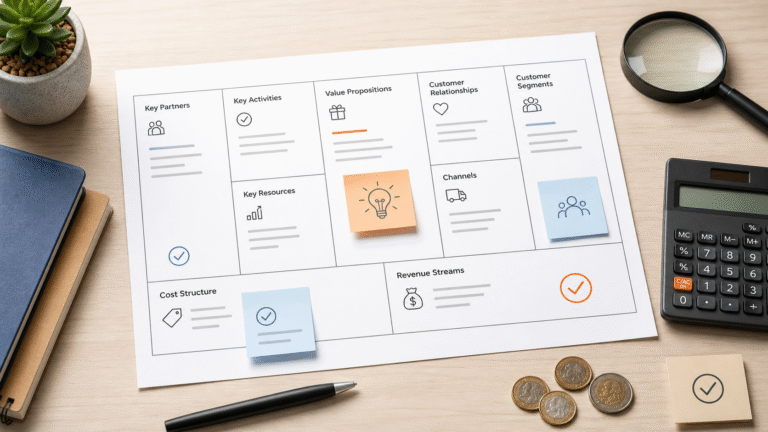
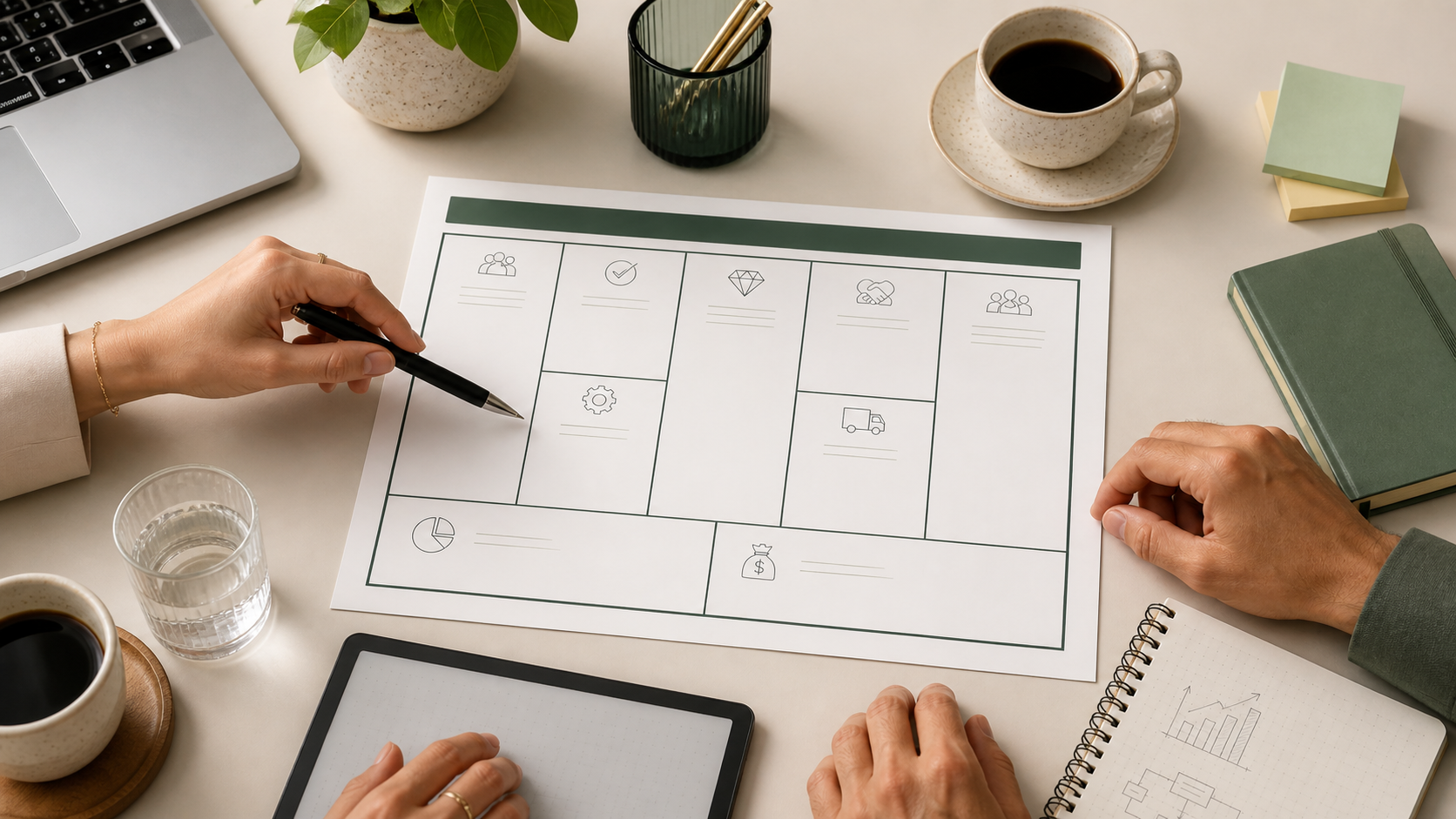
The Business Model Canvas is a one-page strategic tool developed by Alexander Osterwalder and Yves Pigneur. It breaks your business into 9 building blocks that work together to show how your business creates, delivers, and captures value.
Think of it as a business blueprint on a single page. Instead of a 30-page business plan nobody reads, you get a living document you can update as your coaching business grows.
It is not something you fill out once and forget. The best way to use it is to revisit it regularly, test your assumptions, and refine each block as you learn more about your clients, your offer, and your market.
Why Coaches and Consultants Need a BMC
Most coaches skip business planning altogether, or they overcomplicate it with spreadsheets that never get touched again.
The problem isn’t motivation. It’s clarity.
When you don’t have a clear coaching business model canvas, you end up:
- Taking on clients who aren’t the right fit
- Underpricing your services because your value proposition is fuzzy
- Running on referrals alone with no repeatable marketing system
- Burning out because your delivery model isn’t designed for scale
The BMC solves this. It forces you to get specific, about who you serve, what you offer, how you reach them, how you deliver value, and how you make money.
For service-based businesses, this clarity matters even more because the business often depends heavily on the founder’s time, expertise, energy, and reputation.
The 9 Building Blocks: Applied to a Coaching Business
Here’s how each block of the BMC translates to a coaching or consulting business.
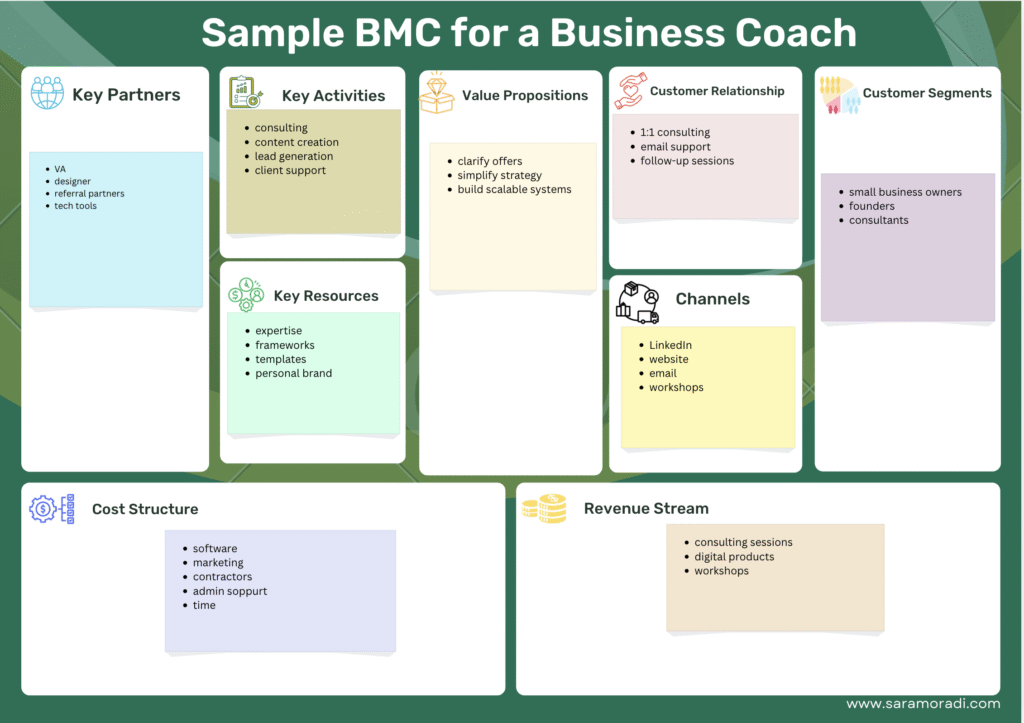
1. Customer Segments: Who Do You Actually Serve?
This is not “everyone who wants to grow.” Be specific.
Quick answer: Your customer segment is the narrow group of people who have the exact problem you solve, defined by role, industry, life stage, or struggle.
Examples for coaches:
- First-time managers in tech companies (leadership coach)
- Female founders scaling from $100K to $500K (business coach)
- Consultants trying to productize their services (business model consultant)
Your BMC task: Write one sentence describing your ideal client. If you can’t, that’s the first thing to fix.
2. Value Propositions: What Problem Do You Solve?
This is the heart of your coaching business model canvas.
Quick answer: Your value proposition is the specific outcome your client gets from working with you, not your method, your outcome.
Weak value prop: “I help people reach their potential.”
Strong value prop: “I help executive coaches package their 1:1 method into a group program they can sell 3x a year.”
Notice the difference? Specific beats inspirational every time.
A strong value proposition should answer one clear question: why should this client choose you instead of another coach, consultant, course, or free resource?
3. Channels: How Do Clients Find and Buy From You?
Channels are every touchpoint between you and your client, from discovery to evaluation, purchase, and delivery.
Quick answer: Channels include how clients find you (SEO, LinkedIn, referrals), how they evaluate you (your website, a free resource), how they buy (discovery call, checkout page), and how they access your service or content.
For most coaches, the most sustainable channels are:
- Organic content (blog, podcast, YouTube)
- LinkedIn or Instagram
- Email list
- Referral network
- Webinars or free workshops
- Strategic partnerships
The key is not to be everywhere. The key is to choose channels your ideal clients actually use, and then make the journey from “I found you” to “I trust you” as smooth as possible.
4. Customer Relationships: How Do You Engage Clients?
This block defines the type of relationship you build, and how much of you it requires.
Quick answer: Customer relationships range from high-touch (1:1 coaching) to automated (self-paced course). The key is matching your delivery model to your energy and revenue goals.
| Model | Touch Level | Scalability |
|---|---|---|
| 1:1 Coaching | High | Low |
| Group Program | Medium | Medium |
| Online Course | Low | High |
| Membership | Medium | High |
Most coaches start with 1:1 and never transition because they haven’t mapped this out. The BMC makes the trade-offs visible.
It also helps you think beyond delivery. Customer relationships include onboarding, follow-up, support, retention, referrals, and the overall experience your clients have with your business.
5. Revenue Streams: How Do You Make Money?
Quick answer: Revenue streams are all the ways money flows into your business, retainers, packages, courses, templates, workshops, or affiliate income.
Common revenue streams for coaches:
- Monthly retainer (1:1 clients)
- Signature group program (cohort-based)
- Digital products (guides, playbooks, templates)
- Speaking or workshops
- Done-with-you consulting
- Licensing your framework or methodology
- Membership or subscription-based support
A healthy coaching business usually has 2–3 streams, not one.
This does not mean adding random offers. It means building revenue streams that are connected to your core expertise and aligned with how your clients prefer to buy.
6. Key Resources: What Do You Need to Deliver?
Quick answer: Key resources are the assets your business can’t function without, your personal brand, your methodology, your tools, your team (even if it’s a VA), your client database, and your intellectual property.
For coaches, your most important resource is usually your intellectual property, your frameworks, your process, your proprietary approach. If you haven’t documented it, it’s not really a resource yet.
Other key resources might include:
- Your website and email list
- Your client onboarding system
- Your coaching curriculum
- Your templates and worksheets
- Your reputation and testimonials
- Your CRM, booking system, or delivery platform
The important question is: what resources help you deliver your value proposition consistently?
7. Key Activities: What Must You Do Every Week?
Quick answer: Key activities are the recurring actions that keep your business running, client delivery, content creation, sales calls, community engagement, research, program improvement, and relationship building.
Be honest here. If you’re spending 80% of your time on delivery and 0% on marketing, your pipeline will dry up. The BMC helps you see that imbalance at a glance.
For a coaching or consulting business, key activities may include:
- Delivering client sessions
- Creating content to build trust
- Running discovery calls
- Improving your framework
- Following up with leads
- Creating workshops or resources
- Collecting client feedback
- Building referral relationships
Your key activities should directly support your value proposition. If they do not, you may be busy, but not necessarily building the right business.
8. Key Partnerships: Who Helps You Deliver?
Quick answer: Key partnerships are the people, tools, or platforms you rely on, collaborators, referral partners, software, contractors, communities, or experts who help your business run smoother, better, or more efficiently.
Examples:
- A VA who handles onboarding and scheduling
- A podcast that features your work
- A platform like Kajabi, Notion, or Zoom where you deliver your programs
- Referral partners in adjacent niches
- Designers, copywriters, or tech support professionals
- Business communities where your ideal clients spend time
For coaches and consultants, partnerships are often underestimated. But the right partner can reduce your workload, expand your reach, or improve the client experience.
The key is to know whether a partnership is simply transactional, like paying for software, or strategic, meaning it supports your long-term growth.
9. Cost Structure: What Does It Cost to Run Your Business?
Quick answer: Cost structure includes all your fixed and variable expenses, software subscriptions, contractor fees, ad spend, coaching tools, content production, platform fees, professional development, and your own time.
Many coaches underestimate costs, especially the cost of their time. If you’re spending 20 hours a week on free discovery calls, that’s a cost too.
Common costs for coaches and consultants include:
- Website hosting and email marketing tools
- Booking and payment systems
- Course or community platforms
- Design, editing, or admin support
- Coaching certifications or training
- Advertising or content production
- Time spent on unpaid calls, proposals, and follow-up
A clear cost structure helps you price better, protect your energy, and understand whether your business model is actually sustainable.
Common Mistakes Coaches Make on Their BMC
Even with the right framework, coaches fall into a few predictable traps:
- Being too vague on customer segments: “entrepreneurs” is not a segment
- Confusing activities with value propositions: “I do 1:1 sessions” is not a value prop
- Leaving revenue streams as a single line: diversification starts with seeing what’s possible
- Ignoring cost structure: especially their own time
- Treating the BMC as a one-time exercise: it should be reviewed regularly
- Writing nice ideas instead of testing assumptions: your canvas should be refined through real client feedback
The BMC is not about creating a perfect document. It is about making your business model visible so you can improve it.
How to Fill Out Your Coaching BMC (Step-by-Step)
Here’s a simple sequence to follow:
- Start with Customer Segments: anchor everything to a real person
- Move to Value Propositions: what does that person desperately want?
- Define Revenue Streams: how does that value become income?
- Map Channels: how do they find you, trust you, and buy?
- Clarify Customer Relationships: what’s your delivery and support model?
- List Key Resources and Activities: what do you need and do?
- Add Partnerships: who supports you?
- Close with Cost Structure: what does it all cost?
This order matters. Most people start with revenue or activities and end up confused. Starting with your client grounds the whole canvas in reality.
A practical tip: use a digital template or print your canvas and work with sticky notes. This makes it easier to move ideas around, test different versions, and update the model as your business evolves.
FAQ
Can I use the Business Model Canvas if I’m just starting out?
Yes, in fact, it’s most useful before you launch. It helps you validate your model before investing time and money.
How is the coaching business model canvas different from a regular BMC?
The structure is the same, but the content is very different. Coaches need to think about scalability of delivery, intellectual property as a key resource, and often multiple revenue streams tied to the same core expertise.
How often should I update my BMC?
Review it at least once a year, and more often if you are testing new offers, changing your niche, shifting your pricing, or moving from 1:1 work to a more scalable model. For fast-changing businesses, a quarterly review can be even more useful.
Do I need business model software or can I use a template?
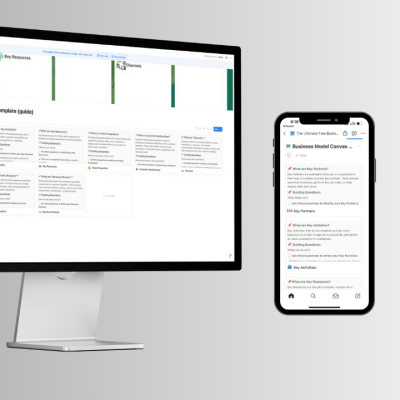
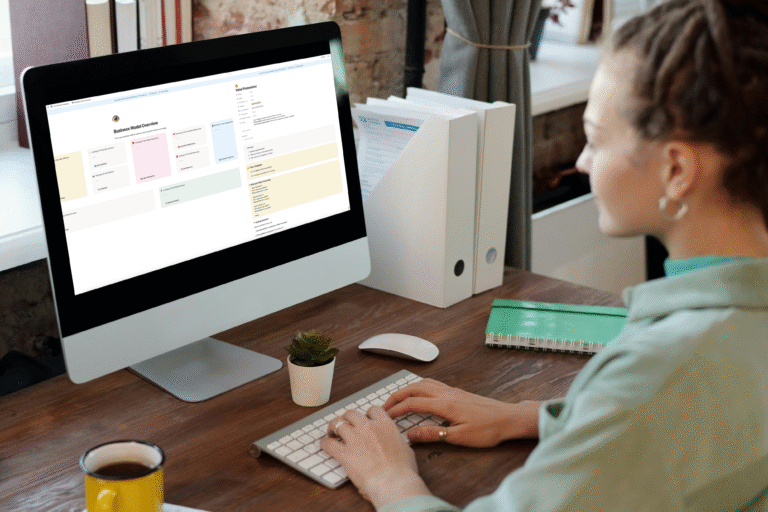
A good Notion template, Canva template, or printable canvas works perfectly. You don’t need expensive software, you need clarity, the right prompts, and a habit of reviewing your model regularly.
Ready to Build Your Coaching Business Model?
If you want a step-by-step guide you can adapt to your coaching or consulting business, with clear explanations, guided questions for each building block, practical examples, and templates you can actually use, check out the Business Model Canvas Playbook.
It walks you through every section of the canvas so you’re not staring at a blank template wondering what to write. You can use it to clarify your offer, refine your client segments, map your revenue streams, and build a business model that is more structured, sustainable, and easier to communicate.
And if you want to get started right now for free, grab the Free BMC Notion Template : a ready-to-use digital canvas you can fill in today.
Your business deserves a model as strong as your coaching. Let’s build it.
Sara Moradi is a business educator and systemization consultant who helps small business owners build clarity, structure, and scalable systems. She teaches the Business Model Canvas through practical, no-fluff frameworks designed for real-world service businesses.