Should You Standardize Your Service or Keep It Custom?
If every project starts from a blank page, you’re not really running a service business. You’re repeating a very skilled first date, over and over, with a different client’s name on it each time. Every proposal gets rebuilt, every scope gets reconsidered, and every delivery process depends on what you remember from the last project. That’s the question hiding under “should I standardize or stay custom.” It’s not about which model sounds more professional. It’s about deciding which parts of your service deserve to stay flexible and which parts are just costing you time because you never wrote them down once and reused them.
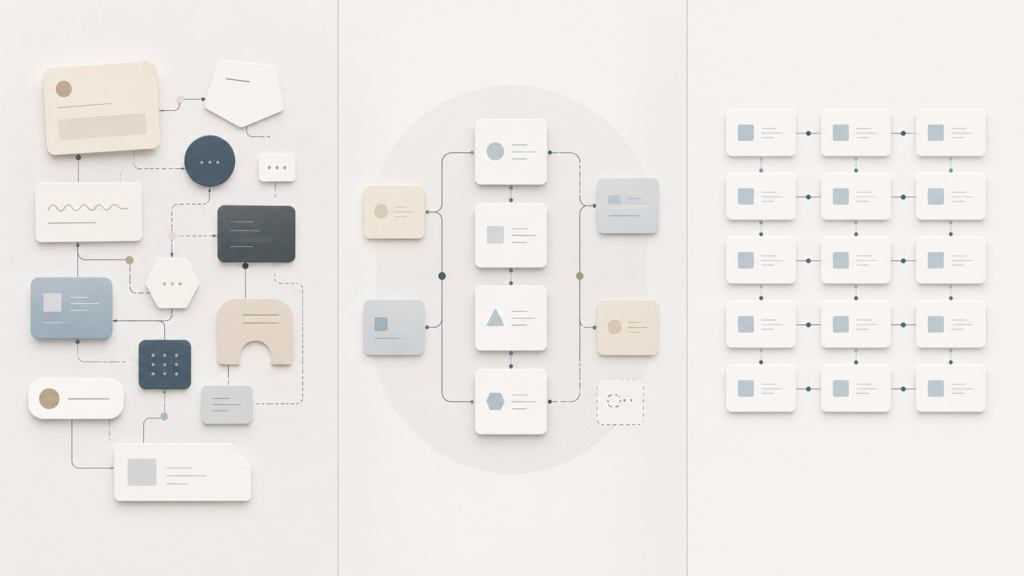
Most people frame this as a choice between two extremes: fully custom (the “we build everything around you” model) or fully productized (the “here’s the package, pick a tier” model). In practice, almost nobody lives at either end. The real decision is where on that line your service should sit, and that depends on things like how much your clients actually vary, how repeatable your process already is, how risky delivery gets when you skip structure, and how much of your week you’re personally willing to keep spending on things a system could handle.
Three models, and what they actually cost you
Fully custom. Everything is built from scratch for each client: scope, pricing, process, deliverables. This is where most service businesses start, and for good reason. In the early stage you don’t know your process well enough to standardize it, and every client teaches you something. The cost shows up later. Sales calls run long because there’s no simple answer to “what do you actually do.” Pricing becomes a negotiation instead of a decision. And because nothing is documented, you can’t hand delivery to anyone else without sitting next to them for the first ten projects.
Fully productized. One offer, fixed scope, fixed price, same process for everyone. This model is attractive because it promises simpler sales, clearer pricing, and more repeatable delivery. It works well when your clients genuinely have the same problem and the same starting point. It works badly when your clients are different enough that forcing them into one box either underdelivers for the complex ones or overcharges the simple ones. A wedding planner who tries to sell one fixed “full wedding package” will eventually take on a client whose family situation, budget, and venue logistics make that package a bad fit on day one, and either the client feels unheard or the planner quietly does extra unpaid work to make it fit.
Hybrid. A fixed core, with defined room for variation. For many service businesses, this becomes the most practical middle ground. A bookkeeper for e-commerce sellers might have a locked monthly process (same categories, same reconciliation steps, same reporting template) but leave the advisory conversation open, because that part genuinely changes based on how the client’s business is growing. The structure handles the 80% that repeats. The flexibility handles the 20% that’s actually the reason the client hired a person instead of software.
What “staying custom” is really costing you
Custom feels safer because it feels more responsive. Nobody gets told “sorry, that’s not in the package.” But there’s a quieter cost that doesn’t show up until you try to grow past yourself.
When nothing is standardized, three things happen at once. Scoping every project takes longer than it needs to, because you’re solving the same structural questions fresh each time. Pricing gets inconsistent, because without a repeatable baseline you’re essentially estimating from memory and mood. And delegation stops being possible, because there’s no process to hand off, only a way of working that lives in your head.
I’ve watched this play out with a graphic designer who did fully bespoke branding packages for years. Every client got a custom scope document, custom timeline, custom pricing. She was excellent at the work. She was also the only person who could quote a project, because pricing depended on a feel for scope that never got written down anywhere. When she tried to bring on a second designer, there was nothing to hand them except “watch how I do it.” The bottleneck wasn’t the new designer. It was that the process had never been made transferable.
What over-standardizing costs you
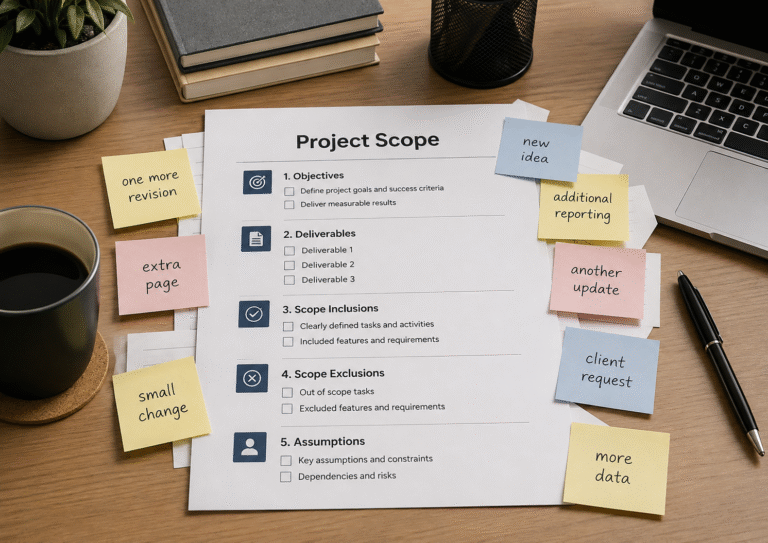
The opposite mistake gets less airtime, but it’s just as real. When you force a genuinely varied client base into one rigid package, you either lose the clients who don’t fit, or you keep them and quietly do unscoped extra work to make the package work anyway, which is the worst version of custom: you’re doing custom labor at productized prices.
This is where the internal instinct that “my work is too custom to templatize” often has a grain of truth in it. If your clients truly differ in ways that change the actual outcome they need, standardizing the whole thing isn’t discipline, it’s a mismatch. The fix usually isn’t to abandon standardization. It’s to be more precise about which layer of the service actually needs to flex.
The same tension often shows up elsewhere in the business model: what looks clean on paper can break once real customers start moving through it. I explored that problem in When Your Business Model Works on Paper But Not in Practice.
The variables that actually decide this
Instead of asking “should I standardize,” ask these questions about your specific service:
- Client variation. Do your clients genuinely need different outcomes, or do they just think they’re unique because nobody’s shown them a repeatable path?
- Repeatability. If you looked at your last ten projects, what percentage of the steps were identical regardless of client?
- Delivery risk. What happens if a step gets skipped or done differently? Is it a minor inconsistency, or does the client’s result actually suffer?
- Margins. Are you pricing based on a real cost-to-deliver, or are you guessing because every project is different enough that you can’t compare them?
- Sales clarity. Can a stranger understand what you sell in one sentence, or does it take a 45-minute call to explain?
- Founder capacity. How much of your week is spent doing things that don’t require your specific judgment, and could run on a documented process instead?
A useful rule is to separate repetition from judgment.
Good candidates for standardization are usually activities that are:
- repeated frequently,
- similar across clients,
- costly when done inconsistently,
- and unlikely to benefit from your personal judgment every time.
Good candidates for customization are usually activities where:
- the client’s context materially changes the decision,
- expert judgment creates much of the value,
- or variation directly affects the outcome.
In other words: standardize repetition. Preserve judgment.
A personal trainer building online coaching programs is a good example of how this plays out cleanly. The workout structure, check-in schedule, and progress tracking can be almost entirely standardized, because the delivery mechanics don’t need to change client to client. What should stay custom is the actual programming decisions based on someone’s injury history, schedule, and goals. Standardize the container. Keep the judgment call flexible.

A simple way to test it
Take your last five to ten client engagements and list every step from intake to final delivery. Mark each step as either “identical every time,” “similar with small tweaks,” or “genuinely different depending on the client.”
Then give each category a default action:
- Identical every time → document and standardize it.
- Similar with small tweaks → create a default process with defined options.
- Genuinely different → keep the expert judgment flexible.
If most of your steps land in the first two categories, you have more room to standardize than you think, and you’re probably losing hours every week reinventing things that don’t need reinventing. If most steps land in the third category, standardizing the whole offer will hurt you, but you can likely still standardize the wrapper around it (intake, timeline, reporting, communication cadence) even while the core work stays bespoke.
This is exactly the kind of thing that’s hard to see clearly while you’re inside the business, and much easier to see once it’s laid out on one page next to your customer segments, revenue streams, and delivery costs. That’s the whole point of mapping the model out instead of just feeling your way through it.
Where this fits into your bigger model
Deciding how standardized your service should be isn’t a standalone decision. It touches your pricing, how you talk about the offer on a sales call, what you can realistically delegate, and how consistent your margins are month to month. That’s why this question tends to get clearer once you see it next to the rest of your business model instead of on its own.
Standardization decisions get easier when you can see three things together: who you’re serving, what value they’re actually paying for, and what activities are required to deliver it.
If you haven’t mapped those connections yet, the free Notion Business Model Canvas template gives you a useful place to start. It gives you one page to look at your customer segments, value proposition, key activities, and revenue streams together, so you can see more clearly where flexibility creates value and where it may simply be adding complexity.
You don’t need to pick fully custom or fully productized this week. You need to know, honestly, which parts of your service create the outcome your clients are paying for, and which parts are simply work you haven’t systemized yet. Start there, and the rest of the decision gets a lot easier to make.