
When Your Business Model Works on Paper But Not in Practice: How to Find the Disconnect
You sat down and did the work. You mapped your customer segments, wrote out your value proposition, picked your channels, worked out your pricing. On paper, all of it made sense. Then you launched, or relaunched, and the business still felt harder than it should.
If your business model is not working the way you expected, even after you followed the process correctly, you’re not imagining things. And you’re also not alone. This is one of the most common situations I see in small service businesses: the canvas looks right, but the business doesn’t behave the way the canvas says it will.
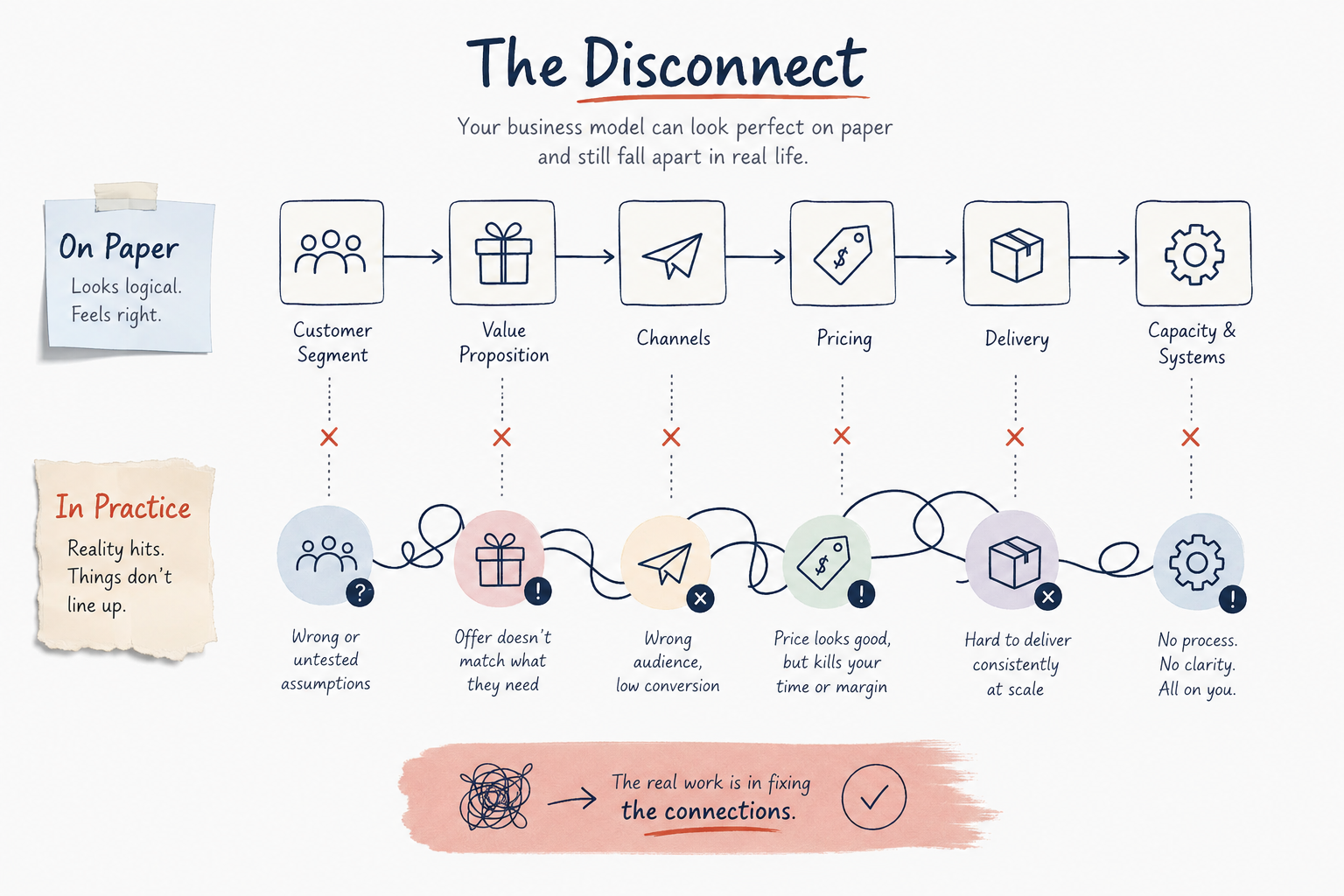
Usually, the canvas isn’t the problem. Even the individual boxes on it are rarely the real problem. What actually breaks a business model is the space between the boxes, the connections that only reveal themselves once you’re running the business day to day, with real clients, real schedules, and real constraints.
Why a Business Model Can Look Right and Still Fall Apart in Practice
A business model canvas is a snapshot of your assumptions on the day you filled it in. It’s not proof that those assumptions are correct. It’s a starting hypothesis, and hypotheses hold up in some places and fail in others once they meet real customers.
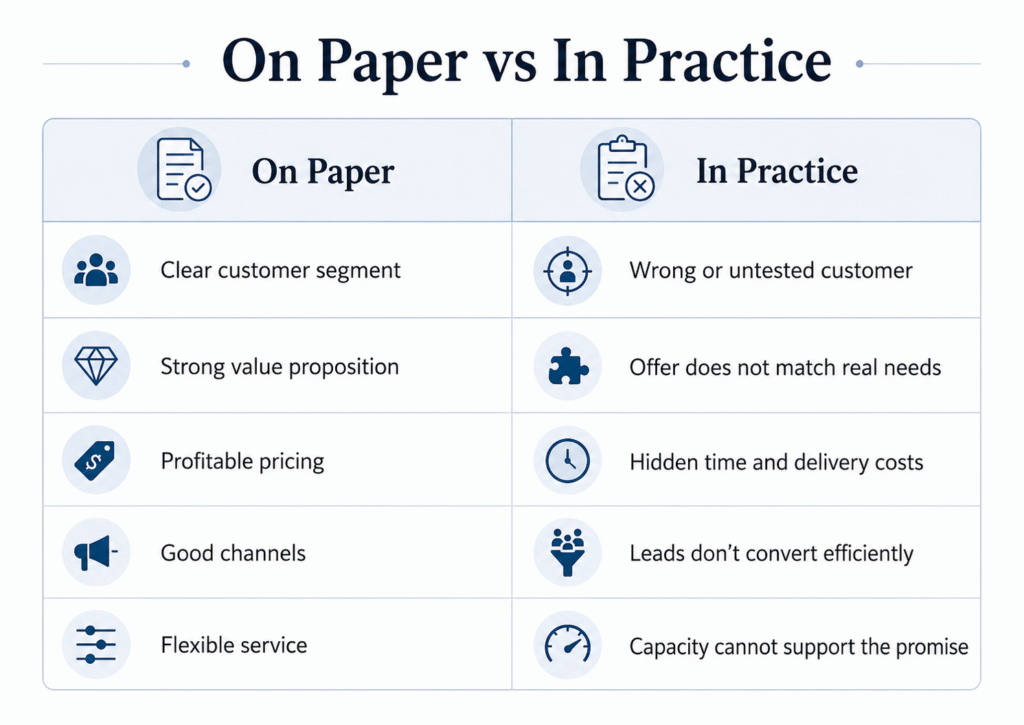
Take a wedding planner I worked with a while back. Her canvas looked solid: engaged couples in their late twenties to mid-thirties as her customer segment, a value proposition built around stress-free planning, referrals and Instagram as her main channels, and a service price that left a healthy margin on the spreadsheet. Every block held together logically.
In practice, most of her bookings came through vendor referrals, not Instagram. Her “stress-free” promise fell apart on event day itself, because she handled everything alone with no assistant and no backup plan for the small emergencies every wedding has. And her pricing, while profitable in theory, never accounted for the extra unpaid hours she spent handling last-minute changes for anxious clients.
None of these problems came from a wrong box. They came from blocks that didn’t actually support each other once real clients, real days, and real limits entered the picture.
Common Signs Something Is Off, Even Though the Model Looks Fine
Before you assume you need to redesign your entire business model, check whether what you’re feeling matches a pattern I see often:
- Your calendar is full, but your bank account doesn’t reflect it
- You keep adjusting your offer, but the results stay roughly the same
- Clients love the work, yet referrals aren’t turning into steady bookings
- You’re the bottleneck for almost everything that happens in the business
- Slow months keep surprising you, even though the pattern repeats every year
If any of this sounds familiar, it doesn’t mean your business model is fundamentally wrong. It usually means one or two connections between blocks have quietly broken, while everything else still looks fine on paper.
If you’re not even sure whether the issue is inside your business model at all, or whether it’s a marketing problem in disguise, Is Your Business Model Falling Apart? How the Business Model Canvas Can Help walks through how to tell the difference. But if you already know your model looks reasonable and something still isn’t clicking, keep reading, because that’s exactly where most business owners get stuck.
The Real Problem: Assumptions That Were Never Tested
Every business model is built on assumptions about who your customer is, how they buy, and what they actually value. Most owners write down answers that sound plausible on day one. Very few go back and check whether those answers turned out to be true.
A residential cleaning business owner I spoke with had assumed her ideal client was a busy working professional in their thirties who wanted a light weekly clean. That assumption shaped her pricing, her channels (mostly local Facebook groups and neighborhood ads), and her whole weekly schedule. It made sense at the time.
After a year of actual bookings, the picture looked different. Her best clients turned out to be older homeowners who wanted a deep clean every two months, not a light clean every week. They paid more per visit, cancelled less, and referred more often than anyone in her original target group. Her first assumption wasn’t careless. It was simply never tested. And because nobody challenged it, her channels, her pricing, and her schedule stayed built around the wrong customer for a full year.
This is the pattern behind a lot of “business model confusion.” The value proposition gets written for an imagined customer instead of the real one. The channels get picked based on where you assumed the customer would be, not where they actually are. And once one assumption is off, everything built on top of it drifts a little further from reality.
Where Execution Quietly Breaks Down
Even when your assumptions about the customer are close to correct, the model can still fail once it meets daily operations.
Channels that don’t work in practice. A channel can look efficient on paper and be nearly unusable in real life. Paid ads might bring in leads, but if those leads take three follow-up calls to convert while your referrals convert on the first call, your “channel” box is technically filled in, but it isn’t doing the job you assumed.
Pricing that looks profitable on paper. A mobile pet grooming business I came across had priced each appointment around a 45-minute grooming session. In practice, driving between homes, calming down nervous animals, and rebooking last-minute cancellations added close to two unpaid hours to a normal working day. The number on the spreadsheet was correct. The number in real life wasn’t even close.
Capacity constraints nobody planned for. A driving school built its value proposition around flexible scheduling: mornings, evenings, weekends, whatever worked for the student. On paper, that flexibility was the whole pitch. In practice, the owner had two instructors and one car. Flexibility that sounds appealing in a business model turns into a scheduling nightmare the moment you notice the resources behind it don’t actually exist.
Delivery problems that show up under pressure. A service can be delivered beautifully when you only have three clients a week. The same process can fall apart at ten, not because the service changed, but because nothing behind it was built to handle more volume.
None of these are reasons to throw out the canvas. They’re evidence that a specific connection, between value proposition and capacity, or between pricing and real hours worked, was never checked against reality.
The Operational Systems Nobody Put on the Canvas
The Business Model Canvas is intentionally high-level. Key Activities and Key Resources describe what your business does and needs in broad strokes. They don’t describe how work actually moves from one person to the next, how a new team member gets trained, or what happens when the owner is unavailable for a week.
This is where a lot of service businesses lose the thread. A cleaning company owner hires her first two employees to keep up with demand. The business model itself hasn’t changed on paper: same customer segment, same channels, same pricing. But without a training process or a clear standard for what a “clean” actually means, service quality becomes inconsistent almost overnight. Clients notice. Referrals slow down. And the owner starts questioning her pricing or her marketing, when the real issue is that nobody wrote down how the work gets done when she isn’t the one doing it.
Operational systems are the quiet layer underneath the canvas. When they’re missing, every other block has to work harder to compensate, and eventually, one of them gives.
Why the Connections Matter More Than the Boxes
Here’s the idea worth sitting with: a business model canvas rarely fails because a box is wrong. It fails because the relationships between the boxes don’t hold up once the business is actually running.
Most business owners can spot a weak box on their own. Pricing feels too low. Messaging feels unclear. What’s much harder to see alone is how the boxes contradict each other. A value proposition built on personal, hands-on attention doesn’t survive contact with a cost structure that assumes volume. A customer relationship style built on quick, informal texting doesn’t match a delivery process that requires three days of lead time. These contradictions don’t show up when you’re filling in the canvas. They show up months later, as friction, delays, and complaints that seem to come out of nowhere.
This is exactly the layer that’s hardest to see on your own, because it never lives inside a single box. It lives in the questions between boxes: does your value proposition match what your channels can realistically deliver? Does your pricing match your actual capacity? Does the way you relate to customers match how your team really works day to day? I built the Business Model Canvas Connections guide specifically to help business owners test these relationships against each other, not just double-check that each block is filled in correctly.
A Practical Checklist You Can Run This Week
You don’t need to redo your entire business model to start closing the gap. Try this instead:
- Pick your three most recent clients. Do they actually match the customer segment you wrote down, or are they a different type of person entirely?
- Look at where your last five bookings actually came from. Compare that to the channels box on your canvas.
- Calculate the real hours behind your most common service, including the parts you usually don’t count: travel, admin, rework, follow-up.
- Ask whether your value proposition still holds true on your hardest week, not your best one.
- Look at your cost structure and ask what breaks first if you got 20% busier next month.
If two or three of these turn up a mismatch, you’ve found where the disconnect actually lives, and you now know exactly where to focus first.
Before changing anything else, it helps to see your current business model laid out clearly, as it actually runs today, not as you hope it runs. That’s exactly what the Free Business Model Canvas Notion Template is for. Map your business honestly first. Most of the fixes that actually work start from that honest snapshot, not from another round of guessing.
The Real Cost of Leaving the Gap Alone
When a business model doesn’t match reality, the usual response is to change something else instead: new branding, a discount, a different ad platform, a new hire. Sometimes one of those changes helps a little. Often it doesn’t, because it wasn’t aimed at the actual disconnect.
Every month spent fixing the wrong thing is a month where the real problem keeps compounding. Pricing built on the wrong hours keeps eating into margin. A value proposition that doesn’t match your capacity keeps creating clients who are disappointed for reasons that have nothing to do with the quality of your work. None of this fixes itself with more effort. It gets fixed by finding where the model and the day-to-day reality stopped agreeing with each other, and adjusting that specific connection.
Where to Go From Here
A business model that looks good on paper is a reasonable starting point, not a finished plan. The real test happens once real clients, real schedules, and real limitations get involved, and that’s where most of the useful information about your business actually shows up.
Start by mapping where you actually stand right now, using the Free Business Model Canvas Notion Template. If you’ve already done that and you can feel that something still isn’t lining up, the Business Model Canvas Connections guide will help you test the relationships between your blocks directly. And if you want a complete, structured way to design, test, and improve your business model from the ground up, the Business Model Canvas Playbook is built for exactly that.
Your business model doesn’t need to be perfect before you launch or grow. It needs to be honest about where it currently stands. That’s the difference between a plan that looks good and a business that actually runs the way it’s supposed to.