
Traffic but No Sales: Turning Eyeballs into Paying Clients
Getting visitors but not customers? The fix is probably simpler than you think. But only if you’re looking at the right problem.
There’s a specific kind of frustration that comes from checking your website analytics, seeing real numbers, and still finishing the month with very little to show for it. People are coming. You can see it clearly. But most of them leave without doing anything, no inquiry, no purchase, no message asking about your services.
If you’ve been in this situation, you’ve probably already figured out that “post more content” isn’t the answer. And you’re right. Posting more sends more people into a broken funnel. It doesn’t fix the funnel itself.
So let’s talk about what might actually be going wrong.
First, a Reframe That Changes Everything
Most business owners in this situation assume the answer is more traffic. More visitors means more chances for someone to buy, right?
Sometimes. But when you’re already getting a steady stream of visitors and very few conversions, adding more traffic is a bit like trying to fill a bucket with a hole in the bottom. Until you figure out where the water is going, pouring more in faster doesn’t help.
Here’s a rough benchmark worth knowing: a service business with reasonably well-targeted traffic should see somewhere between 1% and 5% of visitors take a meaningful next step. That could be filling out a contact form, booking a call, or making a purchase. If you’re getting 500 visitors a month and almost no inquiries, that’s not a volume problem. That’s a conversion problem. And those two things have very different solutions.
Where Funnels Actually Break: The Three Most Common Failure Points
In my work with small business owners, the traffic-without-sales problem almost always traces back to one of three places. Sometimes two of them at the same time. Rarely all three, though when that happens, it usually means the whole approach needs a reset rather than a quick patch.
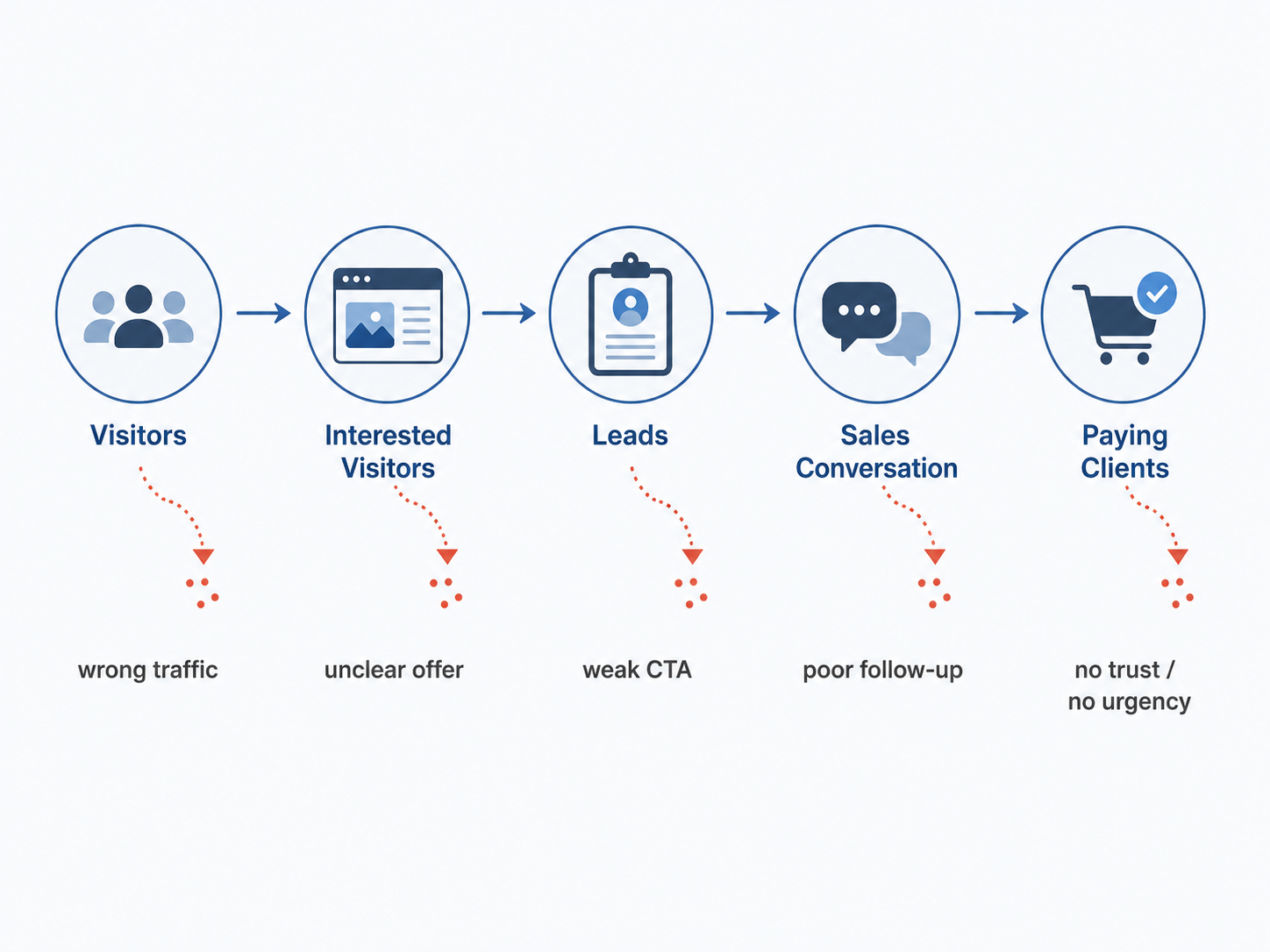
1. The Offer Isn’t Landing the Way You Think It Is
This one is uncomfortable to hear, but it’s also the most fixable.
An offer can be genuinely good and still fail to convert, simply because visitors don’t understand what they’re getting, who it’s for, or why it matters to them specifically. The problem isn’t the product or service itself. It’s how it’s being communicated.
Take a small photography studio offering “authentic, emotion-filled portraits for families.” That sounds appealing in a general way. But it tells a visitor almost nothing about what the experience actually involves, what’s included, how it works, or what makes this studio worth booking over another one nearby. The photographer might be exceptional. The experience might be completely unlike anything else available. But if the words on the page don’t show that in a way the visitor connects with, they’ll scroll through the gallery, appreciate the photos, and close the tab to compare prices somewhere else.
What usually needs to happen here is a more specific, grounded description of what the client actually gets and what changes for them. The kind of language that makes someone feel genuinely understood, not just informed.
2. The Path From Interest to Purchase Is Too Long or Too Confusing
Even when the offer is clear, a lot of traffic gets lost simply because the next step isn’t obvious enough.
This is more common than people realize, and it shows up in subtle ways. A visitor finds something that resonates and then has to figure out what to do about it. Do they email you? Fill out a form? Book directly? Call? Come in person? The more ambiguous that path is, the more people will tell themselves they’ll come back later. Most of them won’t.
This happens especially with service providers who have invested real thought into their website design but buried their contact information, made the booking process three clicks longer than it needs to be, or used generic CTAs like “Learn More” where something more specific would work far better.
The fix here is almost always about simplification rather than redesign. One clear next step, visible without scrolling, repeated consistently throughout the page. That alone moves numbers more than most people expect.
3. There’s No Real Follow-Up System
This is the revenue leak that most small businesses have but rarely acknowledge out loud, because talking about it means admitting that interested people came through and were left without a response, or with a slow one.
Someone fills out a contact form and gets a reply two days later, or never. Someone sends a message with a genuine question and gets an answer but no follow-up when they go quiet. Someone attends a discovery call or event and doesn’t hear from you again.
Sales data across essentially every industry shows that most purchases don’t happen on the first contact. Not in product businesses, not in service businesses. People need time, sometimes a gentle nudge, and often a bit more information before they commit. If your follow-up approach is “wait for them to reach out again,” you’re likely losing a significant share of people who were actually interested but needed one more touchpoint to move forward.
How to Actually Figure Out Which Problem You Have
The fastest way to identify what’s happening is to trace the journey backwards from where the drop-off occurs.
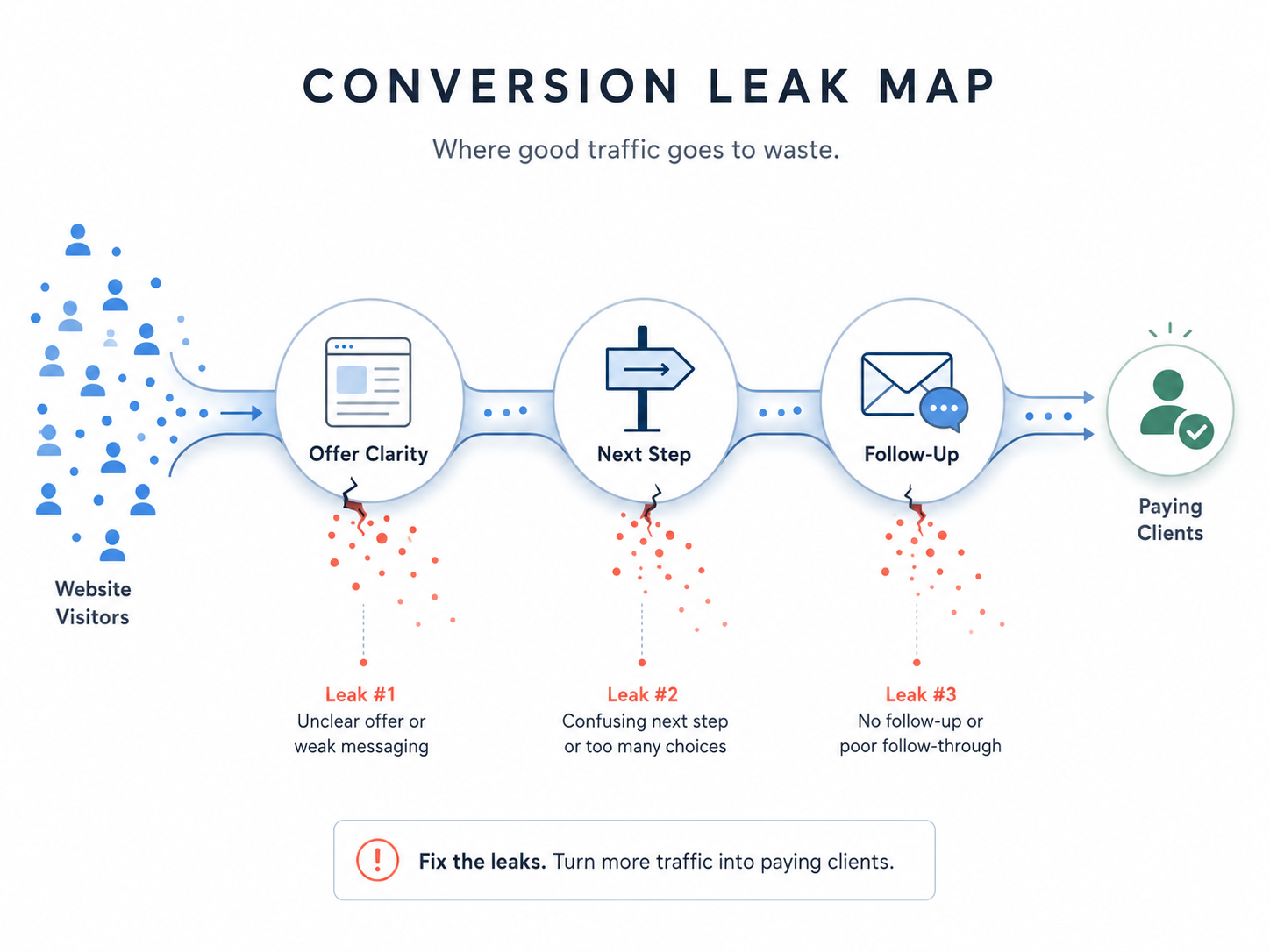
Start with your analytics. Are people landing on your site and leaving almost immediately, or are they staying for a while and still not converting? If they leave right away, the problem is likely at the first impression: offer clarity or traffic targeting. If they browse but don’t take action, the issue is more likely your call-to-action or the path to the next step.
Look at your inquiry-to-close ratio. If you get a reasonable number of inquiries but very few turn into paying clients, the funnel itself might be working. The problem is more likely in the sales conversation or follow-up process. That’s a meaningfully different fix.
Check which pages have the highest exit rates. A services page with a high exit rate is telling you something worth paying attention to. People reached it, looked at it, and left without acting.
Ask a few people who said no. Almost nobody does this, but it’s one of the most useful things you can do. A short, genuine note to someone who inquired but didn’t move forward, asking simply what made them hesitant, will give you more specific and actionable information than a month of analytics data. Most people are surprisingly willing to answer if you ask directly and without pressure.
Check the alignment between your traffic source and your offer. If you’re attracting a broad audience but your offer serves a specific type of person at a specific stage, there’s a mismatch that better copywriting alone won’t fully resolve. You need the right people seeing the right message, not just more people seeing any message.
If you’re reading this and realizing the issue could be in several places at once, that’s exactly where a diagnostic conversation helps. Before you rebuild your website, change your offer, or spend more on ads, it’s worth getting a clearer read on where the leak actually is.
What Most Business Owners Do Instead (and Why It Usually Doesn’t Help)
When sales aren’t coming in, the instinct is almost always to change something visible. A new logo. A website redesign. A different posting schedule. A new offer launched before the current one has been given a real chance to work.
These aren’t bad moves in themselves. Sometimes a website genuinely does need work. But when they happen without first diagnosing the actual problem, they rarely produce results and often cost significant time and money for no measurable return.
I wrote about this pattern in detail in [Stop Wasting Money on Random Fixes], because it shows up in small businesses constantly, and the consequences compound quickly when margins are tight and time is limited.
The deeper issue is that without a diagnostic lens, every problem looks like a marketing problem. And marketing is the easiest thing to throw effort at because it feels productive. You’re posting, you’re running ads, you’re trying new things. But if the funnel is leaking, all of that effort is feeding a broken system. More input, same disappointing output.
A Practical Audit You Can Do This Week
Before changing your marketing budget or launching anything new, work through this on your current setup:
Step 1: Read your own website like a complete stranger. Set aside everything you know about your business and ask yourself honestly: does this page, in the first ten seconds, make it clear what’s being offered, who it’s for, and what someone should do next? If the answer isn’t a clear yes, that’s your starting point.
Step 2: Time your own inquiry process. Walk through the exact steps a potential client would take to contact you or book with you. Count how many steps it takes. Note where it starts to feel like effort. Most people will drop off if the process feels even slightly complicated.
Step 3: Write down your follow-up system in two sentences. If you can’t do that, you probably don’t have a system. “I respond when people reach out” is a reaction, not a process. There’s a meaningful difference between those two things.
Step 4: Review your last ten inquiries. How many turned into clients? If fewer than half did, the issue is likely in the sales conversation or follow-up. If the number is close to zero, the targeting may be off: you’re attracting people who aren’t ready to buy or who aren’t the right fit for the offer.
Step 5: Check what happens after someone shows interest. Map it out. What do you send? When? What’s the next touchpoint if they don’t respond? What happens at the two-week mark? If you’re looking at a blank page for most of those questions, the follow-up gap is probably costing you more than any marketing problem.
If this audit reveals one clear problem, fix that specific thing and give it 30 days before changing anything else. The mistake most people make is changing several things at once and then having no idea which one (if any) actually worked.
When the Problem Is Hard to See From the Inside
There’s a particular kind of business problem that’s genuinely difficult to diagnose on your own. Not because you’re not capable, but because you’re too close to it. You know your offer, your clients, your story. What’s almost impossible to see clearly is how all of it looks to someone who knows none of that.
That outside perspective is often the most valuable thing a consultant actually brings. Not a list of general best practices that apply to every business, but a clear read on what’s specifically happening in your funnel and why, based on your actual setup.
If you’ve been going through a cycle of trying things, not seeing results, and not knowing what to try next, the most useful thing isn’t another article or another tool. It’s a specific, honest look at your particular situation.
Related: if you’ve started to wonder whether the revenue problem is bigger than a funnel issue, [Is Your Business Model Falling Apart?] addresses a pattern I see often where people assume they have a marketing problem when the issue is actually structural.
Frequently Asked Questions
What does “traffic but no sales” actually mean?
It means people are visiting your website or seeing your content, but very few or none of them are taking the next step to buy or inquire. It’s a conversion problem rather than a visibility problem, and it usually comes from one of three sources: an unclear offer, a confusing path to the next step, or a missing follow-up process.
How do I start converting website visitors into clients?
Begin by diagnosing where the drop-off is happening before you change anything. Check whether visitors can understand your offer in the first ten seconds, whether the next step is easy and obvious, and whether you have a reliable follow-up process for anyone who shows interest but doesn’t immediately commit.
Why is my marketing getting views but no sales?
Often because the marketing is doing its job but the funnel it leads people into has a gap somewhere. The issue could be messaging, offer clarity, the call-to-action, or the follow-up. Sometimes it’s a targeting mismatch: the audience being reached isn’t actually your buyer, or they’re at the wrong stage of readiness.
How do I fix a small business sales funnel?
Audit each stage separately. Where are people landing? What action are they being asked to take? How quickly are they followed up with? What happens if they say not yet? Fixing the right stage will always matter more than a full overhaul, and it’s far less disruptive.
When does it make sense to work with a business consultant on this?
When you’ve done your own audit, made a few targeted adjustments, and still can’t understand why the numbers aren’t improving. A consultant helps you see what’s genuinely invisible when you’re looking at your own business every day.
The Most Useful Next Step Right Now
If this article describes your situation, the next useful step is to stop guessing where the problem is.
I’ve created a free pre-session assessment for business owners who are considering support but want more clarity before booking a full consultation. You answer a few questions about your business, your current challenge, and what you’ve already tried. I personally review your answers and send you a short email with my initial observations and recommended next steps.
That may lead to a diagnostic tool, a business model review, systems work, a business plan, or a Clarity Session, depending on what your situation actually needs.
You are not obligated to book anything. The goal is to help you see the problem more clearly before spending more time, energy, or money on the wrong fix.
If it makes sense to go deeper after that, you can book a Business Clarity Session and we’ll work through your conversion path in a structured way.
Sara Moradi is a business consultant who helps small business owners build systems that make their growth repeatable. She works with founders who are done guessing and ready to build something that actually functions. saramoradi.com