
What Should You Delegate First as a Small Business Owner?
If you want the short answer to what to delegate first, here it is. Pick the task that already happens often, doesn’t need your specific judgment, won’t do much damage if it’s handled a little clumsily the first few times, and is currently costing you the most relative to what it’s actually worth. That combination matters more than the task itself. I’ve watched owners hand off the “obvious” thing, usually email or scheduling, and still feel just as stuck three months later, because they never ran it through a filter. They just picked whatever felt easiest to explain out loud.
That’s the real problem with most delegation advice. It hands you a list of tasks to outsource as if every business has the same shape. It doesn’t. A retail owner and a service business owner are dealing with completely different risk profiles, and treating “delegate your admin work” as universal advice is why so many people try it once, get burned, and never try again.
Why “What Should I Delegate First” Is the Wrong Starting Question
Ask most owners why they haven’t delegated more, and you’ll get some version of “I haven’t found the right person yet.” That’s rarely true. What’s actually happening is a founder bottleneck: every decision, every judgment call, every “let me just double check this” runs through one person, and that person hasn’t figured out which of those checks are actually necessary.
I worked with a man who ran a small HVAC company, three trucks, eleven employees, and he was still personally approving every quote over four hundred dollars. Not because his estimator couldn’t do it. Because two years earlier, an estimator had underquoted a job badly enough that it cost him a client. He never rebuilt trust in the process, so he just kept doing it himself. That’s not a delegation problem. That’s not really a delegation problem. It’s an unresolved risk problem that was never turned into a better process.
This is why “what should I delegate” isn’t really the right question. The better one is: which of my tasks would survive someone else doing them imperfectly at first? Once you can answer that, the actual task names sort themselves out.
The Six-Question Delegation Filter
Instead of scanning your to-do list for candidates, run every recurring task through six questions. Most tasks fail at least one of these, and that’s exactly the point. You’re not looking for a task that’s easy. You’re looking for one that’s safe.

1. Does it actually repeat?
A task worth delegating first should show up weekly, not once a quarter. One-off tasks eat setup time without building any muscle memory for the person doing them, and you’ll spend more time re-explaining it each time than you would just doing it yourself. Save the rare, unusual stuff for later. Start with whatever crosses your desk on a rhythm.
2. Can someone learn it without living inside your head?
This is where most delegation attempts quietly fail. If the only way to do a task correctly is to somehow know everything you know, it’s not teachable yet, it’s just undocumented. That’s not a reason to keep it. It’s a reason to write down what you actually do before handing it off. A task becomes delegable the moment you can describe the decision points on one page.
3. What’s the real damage if it’s done wrong the first three times?
Not the worst-case damage. The realistic damage. If a scheduling mistake means a customer gets a follow-up call an hour late, that’s recoverable. If a pricing mistake means you eat the cost of a job, that’s a different category. Rank tasks by how expensive an early mistake actually is, not by how it feels in your gut when you imagine it going wrong.
4. Does it need judgment only you have, or judgment anyone competent could build?
Some decisions genuinely depend on context that lives in your head: relationships with specific clients, unwritten exceptions, history with a vendor. Others just feel that way because you’ve never separated the judgment from the habit. The HVAC owner I mentioned thought his pricing judgment was irreplaceable. It turned out to be four rules he’d never written down. Once they were on paper, his estimator applied them fine.
5. Can you tell whether it was done well?
A good first task to delegate should leave some evidence behind. You should be able to check the result without watching the person do the work. A scheduled appointment, a completed invoice, a logged follow-up, or an updated record can all be reviewed after the fact. If the only way to know whether a task was done well is to sit beside the person while they do it, you’re not creating much freedom for yourself yet.
6. What is it costing you that you’re not seeing?
This is the one owners skip. It’s not about the dollar value of the task. It’s about what you’d be doing instead if it were off your plate. If a task keeps you from following up with warm leads, or from being present for the parts of the business only you can grow, its true cost is much higher than the time it takes.
Scoring Tasks Against the Filter
Once you’ve got three or four candidate tasks, put them side by side. A simple grid makes the comparison honest instead of emotional.
| Task | Repeats Often | Teachable Without You | Low Risk If Imperfect | Requires Your Unique Judgment | Bottleneck Cost |
|---|---|---|---|---|---|
| Scheduling follow-up calls | Yes | Yes | Yes | No | High |
| Approving quotes over $400 | Yes | Partially | No, yet | Currently, yes | Medium |
| Vendor negotiations | No | No | No | Yes | Low |
| Weekly invoicing | Yes | Yes | Yes | No | Medium |
The strongest first candidate is the task that repeats often, is teachable, carries relatively low risk, requires little unique judgment from you, and has a meaningful bottleneck cost. In this example, that’s scheduling follow-up calls, not because it’s the most impressive task to hand off, but because it’s the one that will actually survive being handed off.
The Readiness Test: What Has to Exist Before You Hand Anything Off
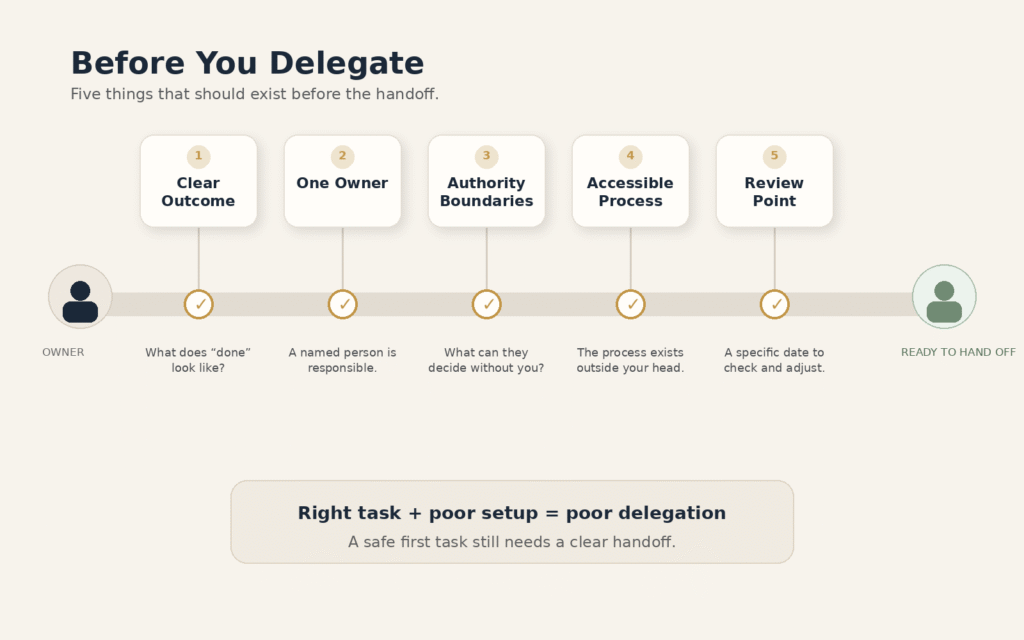
Picking the right task solves half the problem. The other half is failing to prepare it properly, which is how a good task choice still turns into a bad experience. Before you delegate anything, five things need to exist.
A clear outcome. Not a description of the steps, a description of what done looks like. “Follow up with every lead within 24 hours and log the response” is an outcome. “Handle the leads” is not.
A named, responsible person. One person, not a rotating group. Shared ownership of a new task usually means nobody owns it, and you’ll be the one who notices it slipped.
Authority boundaries. What can this person decide on their own, and what needs to come back to you? Write the line down. Most delegation breakdowns happen because the line was assumed instead of stated, and both sides guessed differently.
An accessible process. It doesn’t need to be a polished manual. It needs to exist somewhere other than your memory, in enough detail that someone could follow it without texting you mid-task.
A review point. A specific day, not “check in occasionally.” For a frequently recurring task, a review after the first couple of weeks is often early enough to catch whether the outcome, authority line, or process needs adjusting before small gaps become habits.
Skip any one of these five and you haven’t really delegated. You’ve just quietly kept the task while making someone else do the labor of it, which tends to produce worse results than either doing it yourself or delegating it properly.
A Worked Example: Choosing the First Task
Back to the HVAC owner. He had three candidates: approving quotes, scheduling technician routes, and responding to online reviews. Running them through the filter looked like this.
Quote approval repeated daily and had a real bottleneck cost, but it failed the risk test. An early mistake meant real money, and his pricing judgment wasn’t yet separated from his habits.
Scheduling technician routes repeated daily, was low risk if slightly inefficient at first, and didn’t require judgment beyond a few clear rules about drive time and priority jobs. It scored well everywhere.
Responding to online reviews repeated only a few times a week and, while low risk, had a low bottleneck cost. It wasn’t taking much from him either way.
Scheduling won. He wrote a one-page outcome description, named his office manager as owner, set the boundary that anything involving an unhappy customer still came to him, and put a two-week review on the calendar. Three months later, he’d moved on to quote approval, because by then he’d separated the pricing rules from his gut and could hand those off with confidence too.
What Happens When You Skip the Filter
Most failed delegation attempts don’t fail because the person was wrong for the job. They fail because the task was wrong for a first attempt. Owners often pick whatever feels most annoying, hand it off without any of the five readiness pieces, and interpret the resulting mess as proof that delegation doesn’t work for their business. It’s a reasonable conclusion to draw from the wrong test. The task was set up to fail before anyone touched it.
The cost compounds too. Every failed attempt makes the next one harder, because now you’re also managing your own reluctance, not just the task. That’s how owners end up five years in, still approving every invoice personally, convinced there’s no one they can trust, when really there was never a filter separating the tasks that were safe to test from the ones that weren’t ready yet.
A Few Questions Owners Ask Along the Way
What’s a safe first task to delegate in a small business? Look for something that repeats at least weekly, doesn’t hinge on judgment only you have, and would cause minor, recoverable damage if it went wrong the first couple of times. Scheduling, follow-up communication, and routine data entry usually qualify before pricing or vendor relationships do.
How do I know if I’m actually ready to delegate, or just tired? Delegation readiness isn’t about how exhausted you are. It’s about whether you can write down the outcome, name a responsible person, set an authority boundary, and describe the process in enough detail for someone else to follow it. If you can’t do those four things yet for a given task, the readiness gap is with the task, not the person you’d hand it to.
Should I delegate the tasks I hate first, or the tasks that cost me the most time? Neither one automatically comes first. A task you hate may barely affect the business, while a time-consuming task may still be too risky or judgment-heavy to hand off first. Start with the filter: repetition, teachability, risk, judgment, and bottleneck cost. Preference can break a tie, but it shouldn’t make the decision.
Where This Leaves You
If your business still runs through you for almost everything, the filter above will tell you where to start, but it won’t tell you the full shape of your particular bottleneck. That part is harder to see from inside your own routine, which is exactly why I wrote about it in more depth in When Your Business Lives in Your Head: Building Systems to Free Yourself.
If you’d rather figure out where your specific bottlenecks are and what order makes sense for your business, the free pre-consultation business assessment walks you through the areas that are currently depending too heavily on you and helps clarify what should change first.