Business Model Canvas 101: A Simple Framework for ESL Entrepreneurs
The business model canvas is a one-page visual tool that shows how your business creates, delivers, and captures value. If you’ve ever felt like your business idea lives only in your head, scattered, unclear, and hard to explain, the BMC is the tool that changes that.
Building a business without a canvas is like building a house without a blueprint. You might know you want three rooms and a kitchen, but without a plan on paper, every decision feels uncertain. The business model canvas gives you that blueprint, in one page, in plain language, without the need for a 40-page business plan.
In this guide, I’ll walk you through every single block of the BMC with simple examples built around Middle Eastern markets. Whether you’re in Iran, Turkey, the UAE, or anywhere else in the region, this framework works for you.
What Is the Business Model Canvas?
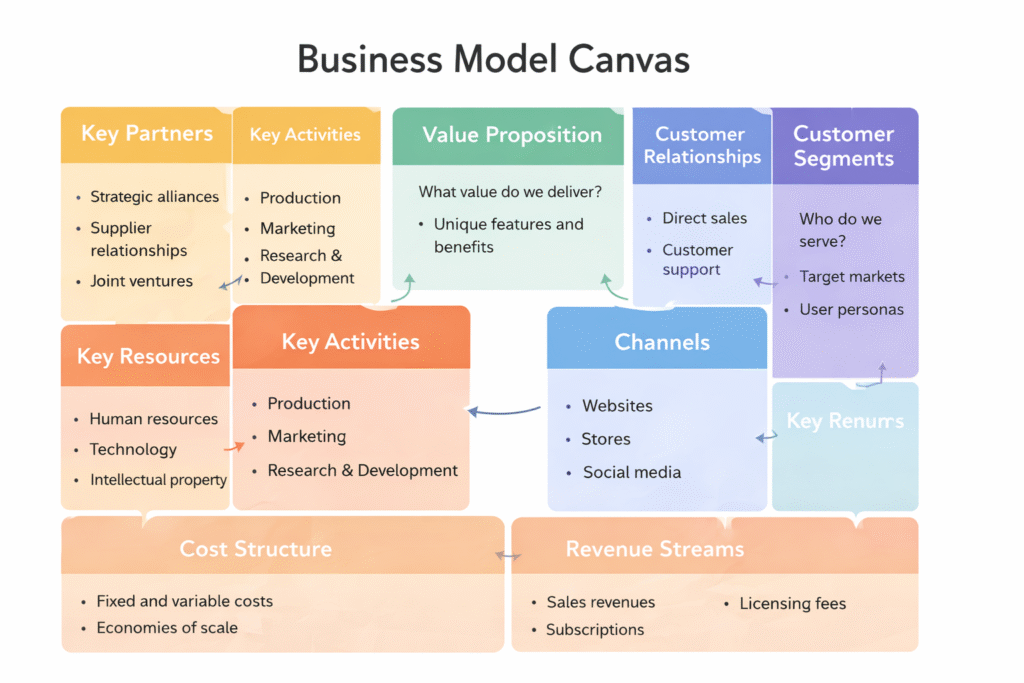
The business model canvas (BMC) is a strategic planning tool created by Alexander Osterwalder. It maps your entire business onto a single visual template using nine building blocks. It’s used by startups, small businesses, and large companies all over the world.
Instead of writing long paragraphs about your business, the BMC asks you to think in short, focused answers. It’s designed to be revised, updated, and reused, not written once and forgotten. And for ESL entrepreneurs, that short-answer format is genuinely helpful.
Why ESL Entrepreneurs Need the BMC More Than Anyone
If English is not your first language, business planning in English can feel like two problems at once: thinking through your business and translating your thoughts. The BMC removes one layer of that complexity.
Each block of the canvas asks you one focused question. You don’t need to write essays, you need to write clear, short answers. That’s a format that works even when you’re working in your second or third language.
I’ve worked with small business owners in the Middle East who had brilliant ideas but couldn’t organize them in a way that made sense to investors, partners, or even their own team. Once they filled out a business model canvas, everything clicked, for them and for the people around them.
The 9 Building Blocks of the Business Model Canvas (Explained Simply)
Here’s the full breakdown of the BMC, block by block. For each one, I’ll give you a real example from Middle Eastern markets so the concept sticks.
1. Customer Segments: Who Are You Serving?
Customer segments are the specific groups of people or businesses you are building your product or service for. Every decision in your business flows from knowing exactly who your customer is.
Example: Imagine you run an online tutoring business in Tehran. Your customer segments could be high school students preparing for the konkur exam, and their parents who are paying for the service. These are two different segments with different needs, and your business has to speak to both.
Ask yourself: Are you serving individuals or businesses? Are they young or older? Local or international? Narrow it down as much as possible.
2. Value Propositions: Why Should They Choose You?
Your value proposition is the specific problem you solve for your customer and the benefit you deliver. It’s the answer to: “Why you, and not someone else?”
Example: A home-based food business in Dubai selling traditional Iranian dishes might offer this value proposition: “Authentic home-cooked Persian food delivered to your door in under 45 minutes , no restaurant, no compromise on taste.” That’s specific, clear, and directly tied to what the customer cares about.
Don’t try to be everything to everyone. The strongest value propositions focus on one real problem and solve it better than anyone else.
Research from CB Insights shows that nearly 42% of startups fail because they build something the market doesn’t actually need. A strong value proposition, built on real customer insight, is what separates the businesses that survive from the ones that don’t.
3. Channels: How Do You Reach Them?
Channels are the ways you communicate with and deliver value to your customers. This includes both how you market your business and how customers actually receive your product or service.
Example: An Etsy-style handmade jewelry seller in Istanbul might use Instagram for awareness, WhatsApp for direct orders, and a local courier service for delivery. Each of those is a channel, and each one matters.
Think about the full journey: How does your customer first hear about you? How do they buy? How do they receive what they bought? Map all three.
4. Customer Relationships: How Do You Keep Them?
Customer relationships describe how you interact with your customers before, during, and after a sale. Do you offer personal service? Self-service? An online community?
Example: A cleaning service in Riyadh might send a WhatsApp message after every visit to confirm satisfaction. That simple touchpoint builds a relationship that makes customers less likely to switch to a competitor. It costs almost nothing, but it keeps them coming back.
Think about whether your relationship is personal, automated, or somewhere in between. And be honest about what’s realistic for your team size right now.
5. Revenue Streams: How Do You Make Money?
Revenue streams are the ways your business generates income from its customer segments. This could be direct sales, subscriptions, commissions, licensing fees, or anything else your customers pay for.
Example: A business consultant in Amman might earn through three revenue streams: one-on-one consulting sessions, a paid online course, and a monthly membership community. Each stream serves the same audience, but at different price points and commitment levels.
More than one revenue stream makes your business more stable. But in the early stages, focus on making one stream work well before adding another.
6. Key Resources: What Do You Need to Deliver?
Key resources are the most important assets you need to make your business model work. These can be physical (like equipment), intellectual (like a brand or patents), human (like a skilled team), or financial.
Example: For an online language school targeting Arabic speakers who want to learn English, the key resources would be qualified teachers, a stable video platform, a structured curriculum, and a website. Take away any one of these and the business breaks.
Be specific here. Don’t write “good team”, write the actual skill or role you need, like “English-speaking curriculum designer.”
7. Key Activities: What Do You Do Every Day?
Key activities are the most important things your business must do to operate and deliver your value proposition. These are the core tasks that drive everything else.
Example: A social media management agency in Cairo has these key activities: producing content, scheduling posts, tracking analytics, and reporting to clients. If any of these stops working, the whole service breaks down.
Your key activities should connect directly to your value proposition. If an activity doesn’t support what you promised your customer, it might not need to be there at all.
8. Key Partners: Who Do You Work With?
Key partners are the external companies, suppliers, or people your business depends on. Partnerships can help you reduce risk, access resources, or reach customers you can’t reach alone.
Example: A small e-commerce store in Jordan selling organic skincare products might partner with a local organic farm for ingredients, a logistics company for shipping, and an Instagram influencer for reach. None of those are employees, but all of them are essential to how the business runs.
Think about who you can’t do business without, and make sure those relationships are solid and documented.
9. Cost Structure: What Does It Cost to Run?
Your cost structure covers all the costs you incur to operate your business model. Some costs are fixed (they stay the same regardless of sales), and some are variable (they change based on volume).
Example: A food delivery startup in Beirut has fixed costs like rent and software subscriptions, and variable costs like packaging materials and delivery fees that grow as orders increase. Understanding which is which helps you plan your pricing and manage cash flow.
Build your cost structure honestly. Underestimating costs is one of the most common, and most damaging, mistakes I see in early-stage businesses.
A Real-World BMC Example: Online Tutoring in the Middle East
Let me put this all together with a simple example. Say you want to start an online tutoring service for students preparing for university entrance exams in Iran.
| Block | Answer |
|---|---|
| Customer Segments | High school students (16–18), parents who pay |
| Value Proposition | Expert exam prep coaching in small groups, online, flexible schedule |
| Channels | Instagram, Telegram groups, word of mouth |
| Customer Relationships | Weekly progress messages to parents, monthly reports |
| Revenue Streams | Monthly subscription per student |
| Key Resources | Expert tutors, Zoom account, structured study materials |
| Key Activities | Teaching sessions, materials development, student tracking |
| Key Partners | Tutors (freelance), payment gateway (like Zarinpal) |
| Cost Structure | Tutor fees, platform subscriptions, marketing |
One page. One view of the whole business. That’s the power of the business model canvas.
How to Fill Out Your Business Model Canvas (Step by Step)
You don’t need a business degree to do this. Here’s exactly how I recommend approaching it:
- Start with Customer Segments. Every other block depends on knowing who you’re serving, so don’t skip this step.
- Move to Value Proposition. Ask yourself: what specific problem do I solve for this person?
- Fill in Channels and Customer Relationships. How do you find them, and how do you keep them?
- Complete Revenue Streams and Cost Structure. Be realistic, this is where most people fudge the numbers.
- Finish with Key Resources, Key Activities, and Key Partners. These are your operations.
Don’t try to make it perfect on the first try. The BMC is meant to be a living document. You’ll revise it as your business grows and your understanding of your market deepens.
If you want to get started today, I created a free Notion template that walks you through every block with prompts and examples. You can grab it here, no email required, just start filling it in:
👉 Download the Free Notion BMC Template
And if you want a deeper, step-by-step playbook that walks you through real case studies and helps you build a full business model from scratch, check out my Business Model Canvas Playbook. It’s also available on Gumroad if you prefer that platform.
Common BMC Mistakes to Avoid
Even smart business owners make these mistakes when they first try the canvas:
Mistake 1: Being too vague. Writing “everyone” as your customer segment is the fastest way to build a business that serves no one well. Get specific.
Mistake 2: Confusing activities with resources. “Marketing” is an activity. “Social media manager” is a resource. Know the difference.
Mistake 3: Forgetting costs. It’s tempting to focus on the exciting blocks (value proposition, revenue). But ignoring cost structure leads to businesses that make sales but lose money.
Mistake 4: Treating it as a one-time exercise. Your business model will change. Revisit your canvas every six months, especially in the first two years.
Frequently Asked Questions
What is the Business Model Canvas used for?
The business model canvas is used to design, describe, and analyze a business model on a single visual page. It helps entrepreneurs and teams align on how a business creates value, reaches customers, and generates revenue, all in one place.
Is the Business Model Canvas good for small businesses?
Yes. The BMC is especially useful for small businesses and solopreneurs because it forces clarity without requiring a lengthy business plan. It’s quick to fill out, easy to update, and gives you a bird’s-eye view of your whole operation.
Can I use the Business Model Canvas if English is my second language?
Absolutely. The BMC’s short-answer format is one of the reasons it works so well for ESL entrepreneurs. Each block asks one focused question. You don’t need to write paragraphs, just clear, honest answers.
How long does it take to complete a Business Model Canvas?
A first draft can take as little as 30–60 minutes. The goal isn’t perfection, it’s clarity. You’ll refine it over time as you learn more about your customers and market.
What is the difference between a business plan and a Business Model Canvas?
A business plan is a detailed written document, often 20–40 pages, designed for banks or investors. A business model canvas is a one-page visual overview designed for thinking, testing, and communicating your business concept quickly.
The Bottom Line
The business model canvas isn’t a complicated tool. It’s a thinking tool, designed to help you see your business clearly, identify gaps, and communicate your model to others in a language everyone understands.
For ESL entrepreneurs especially, the BMC is one of the most powerful business frameworks you can use. It removes the barrier of complex language and forces you to think in short, sharp answers. And when your answers are clear, your business decisions become clearer too.
Start with the free Notion template, fill it out in one sitting, and see what it shows you about your business. You might be surprised how much you already know, and how much clarity a single page can bring.
👉 Grab the Free Notion BMC Template →
I’m Sara Moradi, a business consultant and systemization coach helping small business owners build structured, sustainable operations. If you want to go deeper on business systems and strategy, join my newsletter Business Pulse or check out my book Hustle to Flow.