
Top Benefits of Working with a Business Systems Consultant for Sustainable Growth
Introduction
Hi, I’m Sara Moradi, a Business Systems Consultant at saramoradi.com, and if you’re reading this, you might be juggling a hundred tasks as a founder or business owner — from customer support to managing vendors, finances, operations, and your team. Many leaders reach a point where it feels like every day is reactive rather than strategic.
When your to-do list feels longer than your team, and your business starts to feel chaotic, that’s where bringing in a business systems consultant can offer clarity, structure, and purpose. Instead of digging through problems alone, a systems consultant helps you build strong foundations so you can scale without burning out.
In this article, I’ll walk you through exactly what a business systems consultant does, how this role differs from traditional consultants (including a business consultant or an operations consultant), and the top benefits of working with one. My goal is to help you see the real value that structured systems deliver, beyond buzzwords and strategy decks.
What Is a Business Systems Consultant?
A business systems consultant is a professional who works with companies to evaluate, design, optimize, and implement systems and processes that support growth and efficiency. At its core, this role blends operational insight with strategic thinking to help leaders turn messy workflows into dependable, measurable systems.
Where a business consultant typically focuses on broader performance strategy, such as market positioning, revenue models, goal setting, and business direction, a business systems consultant hones in on the infrastructure that makes execution possible. In contrast, an operations consultant tends to dive deeper into the day-to-day mechanics of workplace processes (like supply chain, workflow gaps, production bottlenecks, and cross-departmental handoffs).
Here’s how they differ:
-
A business consultant provides guidance on what you should do to grow, change, or compete.
-
An operations consultant focuses on how your internal work actually gets done, the nuts and bolts.
-
A business systems consultant bridges the two, designing structured processes that enable your business strategy to run reliably and consistently.
The biggest value of an external consultant, whether systems-led or strategy-led, is that they bring an objective, fresh perspective and specialized know-how that internal teams often can’t see because they’re too close to the work.
Top Benefits of Working with a Business Systems Consultant
Below are the core advantages businesses experience when they choose to work with a knowledgeable systems partner, explained with examples and practical context.
Benefit #1: Objective and Fresh Perspective
One of the most immediate benefits of working with a business systems consultant is perspective.
When you’ve been living in your business for months or years, you can miss inefficiencies, communication gaps, or process breakdowns because they’ve become “normal” to you. External consultants aren’t influenced by internal politics, tribal knowledge, or historical decisions that may no longer make sense.
Example: One founder I worked with had a customer onboarding process that spanned four platforms and took her team 28 manual steps to complete. Because the team had grown accustomed to these steps, no one questioned the logic. After a consultant mapped the workflow objectively, we simplified it into an automated system that cut the onboarding time by 70%.
That kind of clarity simply isn’t possible when you’re operating in the day-to-day noise, which is why an objective viewpoint is such a strategic advantage.
Benefit #2: Access to Specialized Expertise
Business systems consultants bring deep, cross-industry know-how that internal teams often lack, especially in small or midsize businesses where roles overlap and specialization is limited.
Rather than learning by trial and error or piecing together solutions from online guides, consultants have already seen similar challenges in other clients and markets.
Example: A growing e-commerce business faced persistent fulfillment delays. With a seasoned systems consultant’s help, they introduced lean inventory workflows and automation tools that had been proven effective in other retail sectors. This not only increased delivery speed but also reduced errors by over 40%.
With this bench of external experience, you get access to tested solutions, not guesses.
Benefit #3: Operational Efficiency and Systems Optimization
A key value of consultants is turning inefficiencies into streamlined processes. Whether through workflow redesign, automation, or task delegation frameworks, consultants identify bottlenecks that slow growth.
They use data and methodical analysis to see where workflows collapse under pressure and then rebuild them with efficiency in mind.
Example: One software-as-a-service (SaaS) startup had grown its customer base rapidly but struggled to keep up with support tickets. The consultant redesigned their support escalation paths and introduced productivity systems that reduced ticket resolution time by 50%, without hiring more staff.
This type of optimization frees your team to focus on high-value work and reduces churn on repetitive tasks.
Benefit #4: Better Strategic, Data-Driven Decision-Making
Systems consultants don’t just make processes prettier, they help you make decisions with confidence.
Rather than relying on intuition alone, consultants bring metrics, analytics, and structured decision frameworks to guide leadership choices. Consultants help define key performance indicators (KPIs), monitor trends, and recommend actions based on evidence, not assumptions.
Example: A retail business was unsure whether to expand a product line. By developing a data dashboard that tracked product profitability, customer retention correlation, and lifetime value, the consultant provided clarity. The business could pivot resources toward the more profitable category with measurable confidence.
Good decisions are usually informed decisions, and consultants help make that possible.
Benefit #5: Time and Cost Savings
Perhaps the most practical benefit of working with a business systems consultant is saving time and reducing unnecessary costs over time.
Although hiring an external expert is an investment, that cost is often made back many times over through greater efficiency, fewer operational mistakes, and elimination of duplicated work.
Example: One health services business had a chaotic scheduling process that cost the team five hours per week just coordinating appointments. After we introduced a centralized scheduling and automated reminder system, the team regained valuable hours, and the business avoided late-appointment no-shows that previously cost thousands of dollars annually.
When systems are built right the first time, with intelligence, structure, and scalability, you get compound benefits that outperform quick fixes.
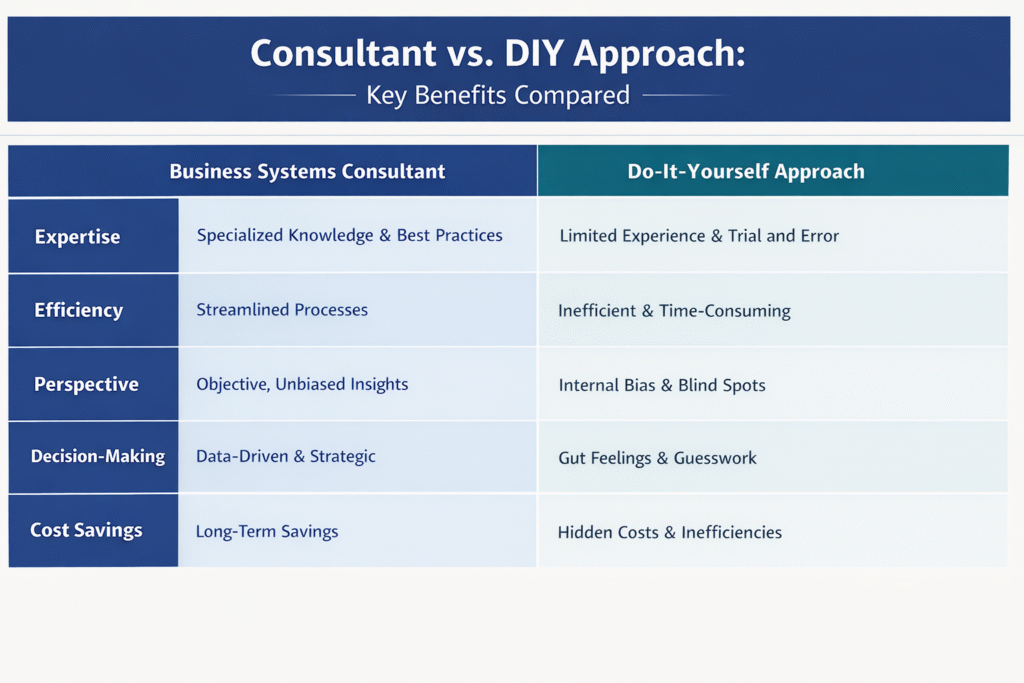
At this point, you might be wondering whether you can build these improvements yourself or if bringing in structured support would make a real difference.
Here’s a simple comparison to clarify the gap between a DIY approach and working with a business systems consultant.
When Should a Business Consider Hiring a Consultant?
Hiring a business systems consultant isn’t just for broken companies, it’s for any organization that wants to move from reactive tasks to proactive growth.
Below are common signals that indicate your business could benefit from expert systems support:
-
Multiple operational bottlenecks: Processes that slow things down repeatedly (e.g., fulfillment delays, miscommunication between teams).
-
Founder burnout: You’re constantly firefighting instead of leading.
-
Repeated mistakes: Similar problems keep happening because there’s no structured process to prevent them.
-
Growth plateau: You’re stuck at a certain revenue or team size and can’t seem to break through.
In each of these situations, a business consultant can help you build systems that unblock your business and create reliable ways of working, instead of repeating the same cycle of chaotic management.
How to Work Effectively with a Consultant
Once you decide to bring in a systems expert, how you engage matters as much as who you choose. Here are best practices to make the collaboration successful:
-
Set Clear Goals: Before engagement, define what success looks like. Examples could include reduced onboarding time, increased workflow throughput, or measurable cost savings.
-
Share Data Early: Provide relevant operational data, team feedback, and existing workflows so the consultant can diagnose accurately.
-
Involve Your Team: Systems change best when your team is part of the transition. Encourage participation and open communication.
-
Treat the Consultant as a Partner: Instead of seeing them as a temporary advisor, bring them into strategic discussions. Their insights are most powerful when aligned with your vision.
If you want help getting started, check out my consulting services at saramoradi.com for a tailored strategy that aligns with your business goals.
A Final Word
I’m Sarah Moradi, Business Systems Consultant, and if your business feels like it’s spinning plates instead of building momentum, it’s not because you’re doing things wrong, it might just mean you need more structure.
Working with a business systems consultant can give you:
-
a clear, objective view of your operations,
-
specialized expertise you can’t easily replicate internally,
-
optimized workflows that save time and money, and
-
better, data-driven decisions that align with your growth goals.
If you’re wondering whether structured consulting support is right for your business, start with the Consulting Readiness Checklist, it’s designed to help you understand where your biggest opportunities lie. When you’re ready, you can book a clarity call with me to interpret your results and explore practical next steps together. Your business doesn’t need more hustle, it needs structured systems and focused execution. Let’s build that together.