Scaling a Small Business: Systems & Processes That Support Growth
The Dirty Secret About Growing a Business Nobody Warns You About
Here’s the truth about scaling a small business: your biggest threat isn’t lack of customers. It’s being wildly unprepared for the customers you already have.
Most small business owners hit a wall somewhere between “this is working” and “I can’t keep up.” Orders pile up. Response times slip. Your quality dips. You’re putting out fires instead of building something real. And the painful irony? This usually happens right when things are going well.
The problem is never the growth itself. It’s the absence of systems.
Without documented processes, every task lives in your head. Every team member does things differently. Every new client is a from-scratch experience. You become the bottleneck in your own business — and no amount of hustle will fix that.
The good news: this is entirely solvable. And in this guide, I’m going to walk you through the exact frameworks I use with my clients to build business growth systems that actually scale.
What Does “Scaling” Actually Mean for a Small Business?
Scaling a small business means growing your revenue and output without growing your stress, your hours, or your costs at the same rate.
Most people confuse scaling with simply getting bigger. But growth without systems isn’t scaling, it’s just expanding chaos.
True scaling happens when:
- A new team member can deliver the same quality you do
- Clients get a consistent experience every time
- You’re not personally involved in every single task
- Your business can run (at least partially) without you
That shift doesn’t happen by accident. It happens through intentional processes for scaling — and building those processes before you desperately need them.
The 4 Core Systems Every Small Business Needs to Scale
If you want to scale without sacrificing quality or sanity, you need four foundational systems in place. Think of these as the operating infrastructure of your business.
1. Client Onboarding System
A client onboarding system is a repeatable, documented process that takes a new client from “yes, I’m in” to fully set up, without your constant involvement.
This is the first place most small businesses bleed time and energy. Every new client is handled slightly differently. You’re answering the same emails. You’re re-explaining the same process. You’re manually sending the same welcome materials.
Here’s how to build one:
- Map out every step from signed contract to first delivery
- Automate what can be automated (welcome emails, intake forms, scheduling links)
- Document what can’t be automated as a standard operating procedure (SOP)
- Assign clear ownership for each step
When you have a real onboarding system, clients feel taken care of, and you get your time back.
2. Delivery & Service System
Your delivery system is the documented, repeatable way you fulfill your product or service, so quality stays consistent regardless of who’s doing the work.
This is the heart of scaling. If your delivery depends entirely on you, you have a job, not a business. The moment you want to bring in help, or serve more clients, everything breaks.
To build a solid delivery system:
- Document every step of how you deliver your work (video walkthroughs work brilliantly here)
- Create templates for repeated outputs (proposals, reports, designs, responses)
- Define your quality standards clearly, what does “done” look like?
- Build in a review checkpoint before anything goes to the client
Your delivery system is what lets you grow your team without growing your anxiety.
3. Communication & Follow-Up System
A communication system defines how, when, and who handles every touchpoint with leads, clients, and collaborators, so nothing falls through the cracks.
Poor follow-up kills businesses silently. A lead reaches out, doesn’t hear back in time, and buys from your competitor. A client feels ignored and doesn’t renew. A team member doesn’t know what they’re supposed to do next.
Build your communication system around:
- Response time standards (e.g., leads get a reply within 2 business hours)
- Templates for the most common messages (inquiries, follow-ups, project updates)
- A shared inbox or CRM so nothing is trapped in one person’s email
- A weekly or bi-weekly client check-in cadence for ongoing projects
This system is what makes you look professional and feel in control, even on your busiest days.
4. Financial Tracking & Review System
Your financial system ensures you always know where your money is coming from, where it’s going, and whether your growth is actually profitable.
You can be fully booked and still be losing money. Without tracking, you won’t know until it’s too late.
A basic financial system includes:
- Monthly revenue and expense tracking (not just in your head)
- A simple profit and loss review, monthly, not annually
- Clear payment terms and a follow-up process for late invoices
- Visibility into your most profitable services or products
You don’t need fancy software. You need consistent habits and a clear picture of your numbers.
How to Prioritize Which System to Build First
Start with whatever is causing you the most pain right now.
That’s not a vague answer, it’s a strategic one. The system that’s most broken is costing you the most time, money, or reputation. Fix that first.
Here’s a simple way to decide:
| If you’re losing time here… | Build this first |
|---|---|
| Explaining your process to every new client | Client Onboarding System |
| Doing the same tasks over and over manually | Delivery & Service System |
| Missing follow-ups or slow to respond | Communication System |
| Unsure if you’re actually profitable | Financial Tracking System |
Once your most urgent system is documented and working, move to the next. Don’t try to build everything at once, that’s how you end up with a half-finished Notion database and no actual processes.
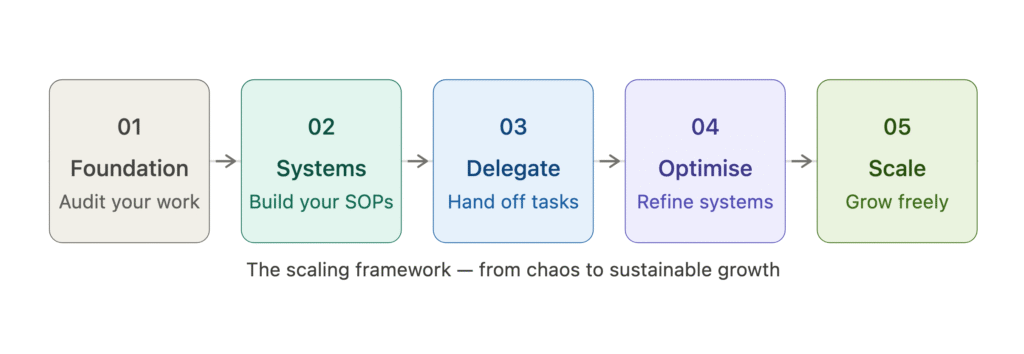
The SOP: Your Most Powerful Scaling Tool
If there’s one tool I recommend to every single business owner I work with, it’s the Standard Operating Procedure or SOP.
An SOP is a step-by-step written (or recorded) guide that explains exactly how to complete a recurring task in your business.
SOPs are what make your knowledge transferable. They’re what allow you to hand off tasks to a team member, a virtual assistant, or a future version of yourself who’s forgotten how you used to do things.
A good SOP includes:
- The purpose: why does this task exist?
- Who does it: which role is responsible?
- When it happens: trigger or schedule
- Step-by-step instructions: clear enough for someone new to follow
- Tools used: software, templates, logins needed
- What “done” looks like: your quality benchmark
Start with your most frequently repeated tasks. Even one or two SOPs can dramatically reduce your cognitive load and free up hours every week.
Common Mistakes When Trying to Scale a Small Business
Most scaling attempts fail not because of bad strategy, but because of poor implementation timing and over-complexity.
Here are the mistakes I see most often:
Waiting too long to systemize. Most owners build systems only after something breaks. By then, the damage is done. Build your systems while things are still manageable.
Building systems that only you can use. If your process requires your specific expertise to execute, it’s not really a system, it’s still just you. The goal is transferability.
Overcomplicating the tools. You don’t need a $500/month tech stack to scale a small business. Start with a simple doc, a spreadsheet, or a free project management tool. Complexity comes later.
Skipping the documentation step. “I’ll remember how to do this” is the enemy of scale. If it’s not written down, it doesn’t exist as a system.
Trying to systemize everything at once. Pick one area. Get it working. Then move on. Progress beats perfection every time.
A Simple Framework to Get Started This Week
You don’t need months to begin scaling. Here’s a practical starting point:
Step 1: Audit your week. For three days, track every task you do and how long it takes. Note which ones repeat.
Step 2: Identify your top 5 repeating tasks. These are your first SOP candidates.
Step 3: Document one task today. Open a Google Doc. Write the steps. That’s your first system.
Step 4: Test it. Have someone else try to follow it. Where do they get stuck? Revise.
Step 5: Stack from there. Add one new SOP per week. In a month, you’ll have a real operations library.
Simple. Not glamorous. But this is exactly how sustainable business growth systems get built, one documented process at a time.
Scaling Is a Decision, Not a Destination
The businesses that scale well aren’t the ones with the most hustle. They’re the ones with the clearest systems.
When you build repeatable processes, you stop being the bottleneck. You start building something that works without you at the center of everything. You create space to actually grow, without burning out.
This is the shift I help small business owners make every day through business systems consulting, moving from reactive chaos to intentional, documented operations that support real growth.
Frequently Asked Questions About Scaling a Small Business
What is the first system a small business should build? Start with your client onboarding system. It’s the first impression your business makes and the area where most time is wasted on repetition. Getting this documented and automated first will free up hours and improve client experience immediately.
How do I scale a small business without hiring a big team? Focus on systems and automation before headcount. Document your processes, automate repetitive tasks, and create templates for common outputs. Many businesses can double their capacity without adding a single full-time employee, simply by removing inefficiencies through better processes.
What tools do I need to build business systems? You don’t need expensive tools to start. A Google Doc for SOPs, a simple project management tool like Trello or Notion, and a CRM for client communication are enough. Focus on building the habit of documentation first, then invest in tools that support the system you’ve already built.
How long does it take to systemize a small business? You can start seeing results within a week by documenting just a few key processes. A full operational foundation, covering onboarding, delivery, communication, and finances, typically takes 60–90 days of consistent effort. The key is to start small and build incrementally.
Ready to Scale Without the Overwhelm?
If you’re tired of being the bottleneck in your own business, I’ve created a free resource to help you get started.
Download the Growth Systems Roadmap
a practical guide that walks you through the exact systems to build first, the tools that support them, and a 30-day action plan to start scaling with confidence.
👉 [Get the Free Growth Systems Roadmap →] (link to lead magnet)